Future demand can change faster than your plans. A promotion, new competitor, price shift, or seasonal change can turn a reliable sales pattern into a weak assumption.
That is where demand forecasting becomes useful. It helps you estimate what customers may buy using sales history, market signals, and other relevant data. I see it as a practical way to reduce guesswork before you make inventory, production, purchasing, or budget decisions.
Here, you can learn how forecasting works, which methods suit different data situations, what affects accuracy, how AI fits into the process, and how businesses turn forecasts into stronger planning decisions.
What Is Demand Forecasting?
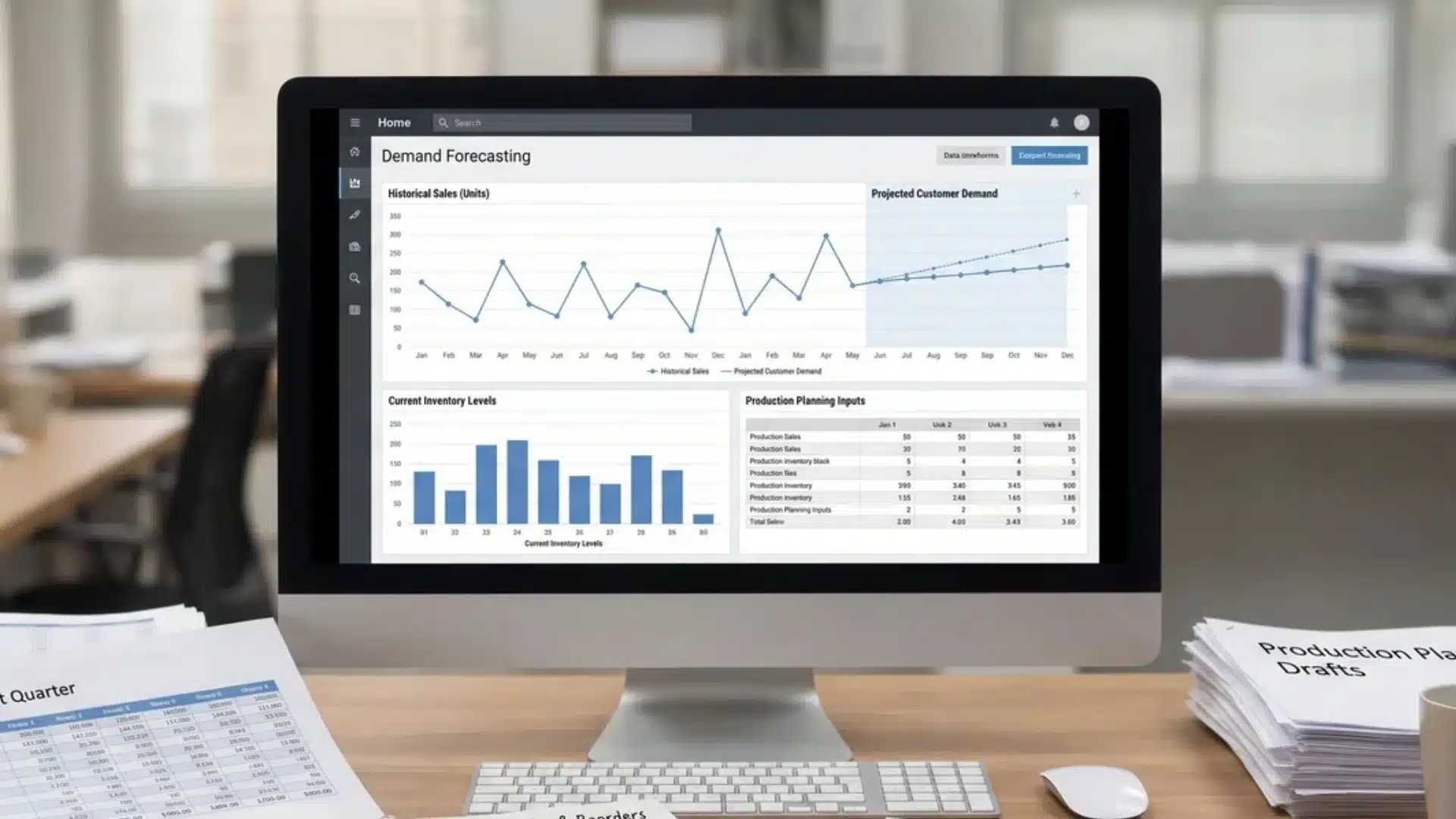
Demand forecasting is the process of estimating how much of a product or service customers are likely to buy during a future period. The estimate may cover the next week, quarter, year, or another period that fits the business need.
A forecast can help answer three basic questions: how much demand may occur, when it may happen, and which products or services may see changes.
Businesses can base these estimates on historical sales, seasonal patterns, customer behavior, pricing, promotions, and broader market conditions. The available information varies by company and product.
An established product may have years of sales history. A new product may depend more heavily on research, comparable products, and expert judgment.
The forecast then supports decisions across areas such as inventory and production management.
Why Is Demand Forecasting Important?
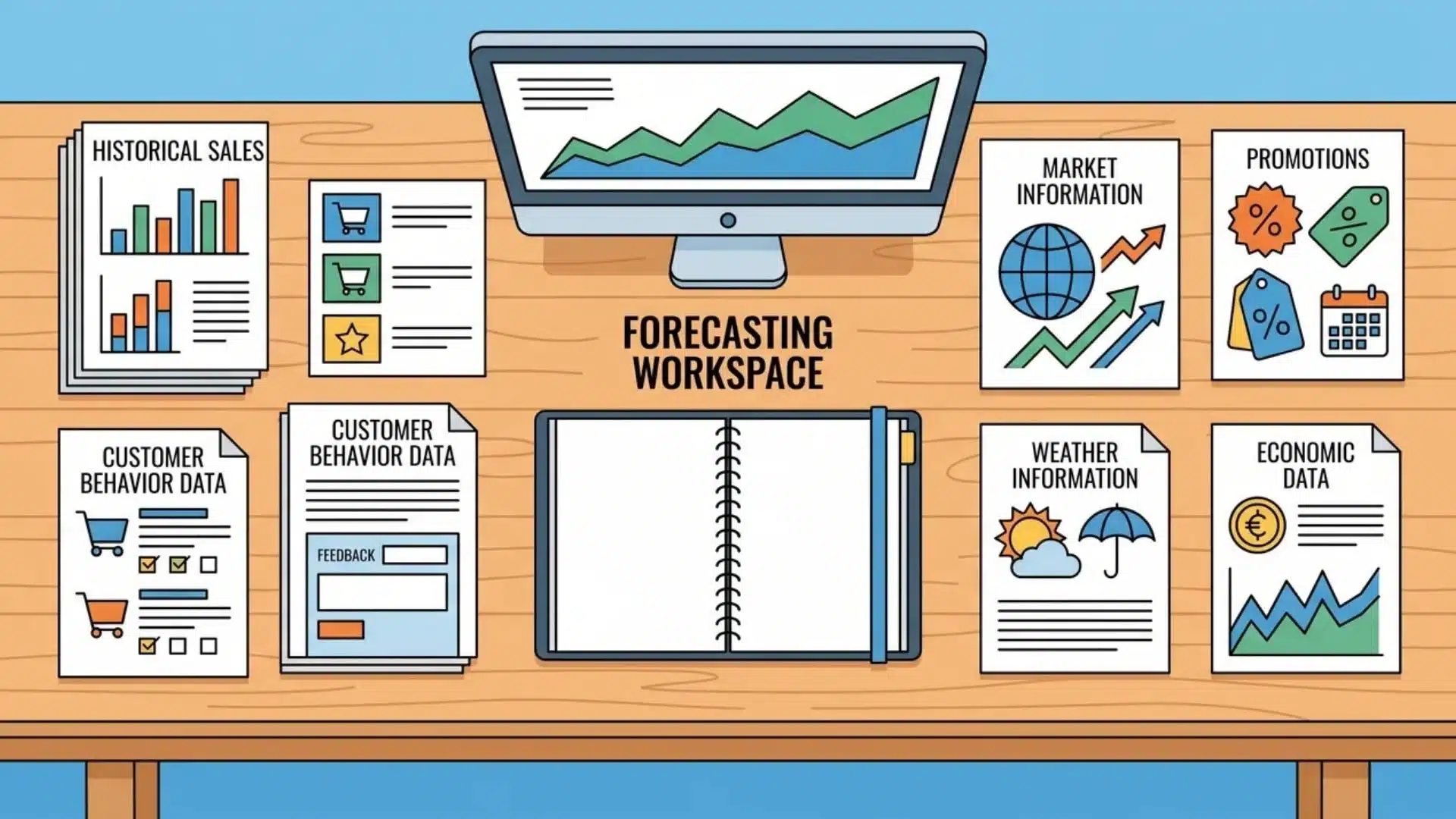
Forecasting connects expected customer demand with decisions made before customers place orders.
Inventory is one of the clearest examples. Ordering too little can create shortages, while ordering too much ties money up in products that may remain unsold.
Production teams face a similar problem. They need enough capacity to support expected demand without producing far beyond what the market is likely to absorb.
Finance teams can use the same forecast when estimating revenue, purchasing costs, working-capital needs, and future cash requirements. Staffing and logistics teams may also use it to prepare for busier or slower periods.
That shared estimate is the real benefit. Different departments can make related decisions from the same expected demand instead of planning independently.
How Does Demand Forecasting Work?
The exact process differs between businesses, but most forecasts follow a similar sequence:
- Set the forecasting goal. Decide what to estimate, such as product units, orders, or revenue.
- Choose the time period. Short-term forecasts often support operations, while longer forecasts support capacity and investment decisions.
- Gather useful data. Combine historical sales with pricing, promotions, seasonality, customer activity, and market information.
- Choose a forecasting method. The method should fit the amount and quality of data available.
- Create the estimate. Teams may use spreadsheets, statistical software, planning platforms, or machine-learning models.
- Compare the forecast with actual demand. The difference shows where the estimate performed well or poorly.
- Revise the forecast. New sales data and changing market conditions should feed into the next estimate.
Forecasting works best as a repeated process rather than a calculation that is completed once and left unchanged.
Types of Demand Forecasting
Demand forecasts can be classified by time period, assumptions, and business factors. Comparing these types helps businesses choose an approach that fits each planning need.
| Type | What It Means | Best Used For |
|---|---|---|
| Passive Forecasting | Uses historical demand patterns to estimate future sales with few changes to past assumptions. | Mature products with stable demand |
| Active Forecasting | Includes expected changes such as promotions, pricing, expansion, marketing activity, or market growth. | Businesses expecting changing conditions |
| Short-Term Forecasting | Estimates demand for days, weeks, or several months ahead. | Inventory, staffing, purchasing, and production |
| Long-Term Forecasting | Estimates demand over longer periods to support major operational or investment decisions. | Capacity, facilities, suppliers, and expansion |
| Internal Forecasting | Uses company factors such as sales targets, resources, staff, production capacity, and operational limits. | Internal resource and capacity planning |
| External Forecasting | Considers economic conditions, competitors, regulations, industry trends, demographics, and customer preferences. | Market and strategic planning |
These types can also overlap. A business may create a short-term active forecast using both internal data and external market information for one decision.
Demand Forecasting Methods
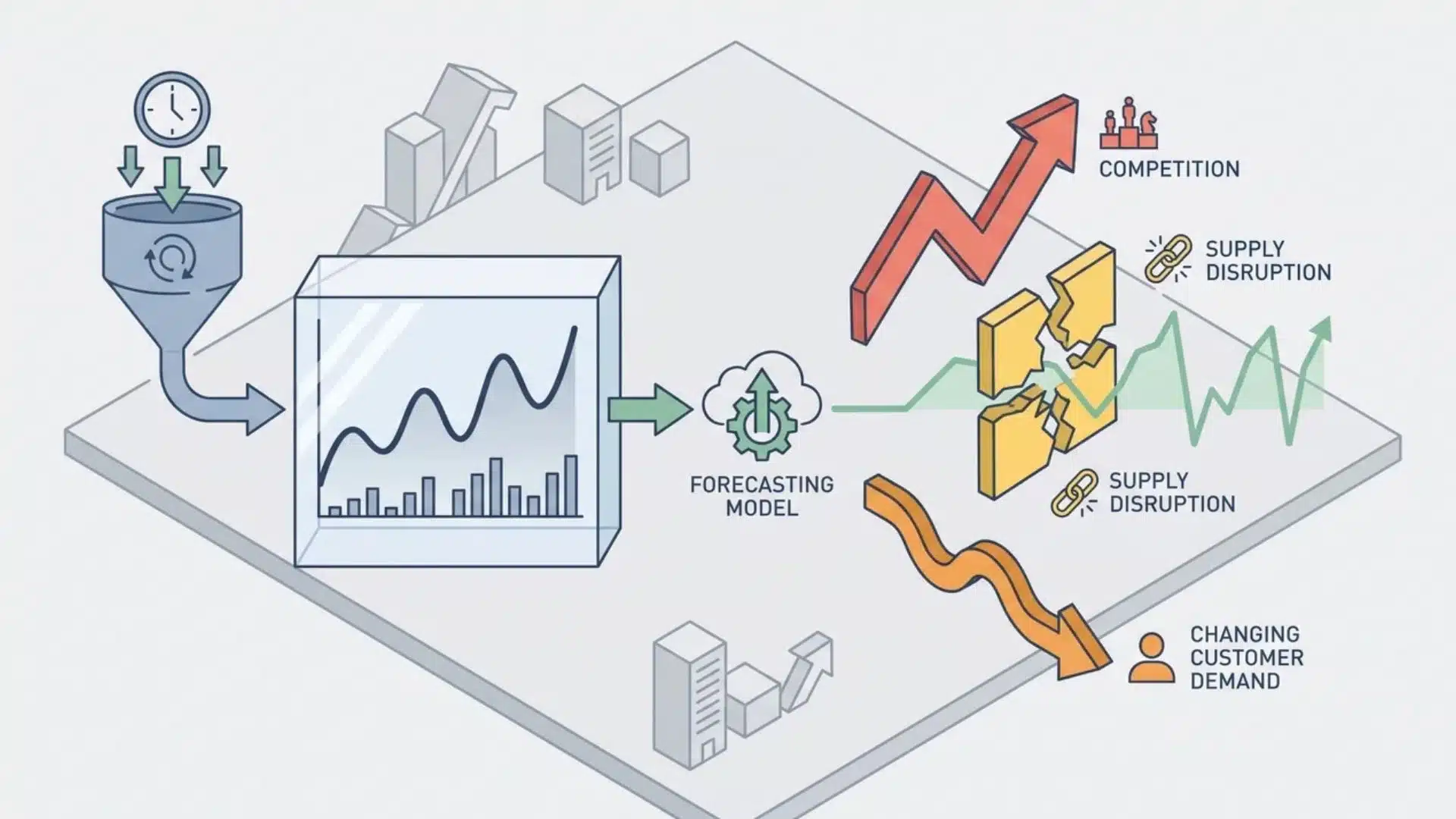
The method used depends heavily on the information available. Some forecasts rely mainly on judgment and research, while others use historical numerical data.
Qualitative Forecasting
Qualitative forecasting is useful when reliable sales history is limited.
A company launching a new product, for example, cannot study several years of direct demand data. It may instead use customer research, expert knowledge, or feedback from sales teams.
Common qualitative methods include expert opinion, market research, sales force estimates, and the Delphi method, where several experts provide independent views before their responses are refined into a broader estimate.
These methods can add useful context, but they can also be influenced by personal assumptions.
Quantitative Forecasting
Quantitative forecasting uses numerical data to estimate future demand.
A moving average uses demand from recent periods to create an average for the next one. It is straightforward but can react slowly when buying patterns change quickly.
- Exponential smoothing also uses previous demand, but gives greater weight to more recent observations.
- Trend projection extends a longer-term rise or decline in historical demand into future periods.
- Regression analysis studies how demand changes in relation to other variables such as price, advertising, income, or temperature.
- Time-series forecasting looks for recurring patterns across historical data, including trends and seasonality.
The strongest method depends on the product and the business question rather than the complexity of the model.
Qualitative vs. Quantitative Forecasting
The simplest difference is the type of information each approach uses.
| Factor | Qualitative | Quantitative |
| Primary Input | Research and human judgment | Historical numerical data |
| Useful For | New products or limited data | Products with reliable sales history |
| Examples | Expert opinion, surveys, Delphi | Moving averages, regression, time series |
| Main Advantage | Adds market context | Produces measurable estimates |
| Main Limitation | Can be subjective | Historical patterns may change |
I would not treat these approaches as competitors. Combining numerical analysis with business knowledge can often provide a more useful estimate than relying entirely on one source.
Demand Forecasting Example
Consider a retailer preparing for summer demand for portable fans.
The retailer could start by reviewing fan sales from previous summers. Historical results may show that demand normally starts rising in May, peaks during June and July, then falls toward the end of August.
Past sales alone may not be enough.
The retailer could also review:
- Expected temperatures
- Current inventory
- Product pricing
- Planned discounts
- Regional differences
- Supplier lead times
- Recent sales growth
Suppose the forecast shows that demand is likely to increase sharply during June.
The business could order additional stock before the expected increase, position more inventory in high-demand locations, prepare warehouse space, and schedule enough staff to handle order volume.
As summer progresses, actual sales can be compared with the estimate. If temperatures stay lower than expected and demand falls below the forecast, the business can reduce future orders.
The forecast supports the decision, but changing conditions determine how the business responds.
Demand Forecasting vs. Demand Planning
Demand forecasting and demand planning are closely related, but they perform different jobs.
Demand forecasting estimates what customers are likely to buy. Demand planning determines what the business should do with that estimate.
The difference becomes clearer when the two processes are compared directly.
| Demand Forecasting | Demand Planning |
|---|---|
| Estimates future customer demand | Turns the forecast into business actions |
| Uses historical and market data | Uses forecasts plus operational limits |
| Produces an expected demand figure | Produces supply, inventory, or production plans |
| Focuses on what may happen | Focuses on how the business should respond |
I think of forecasting as one input in a much larger decision. I would not treat a projected 15% increase in demand as an automatic instruction to increase production by 15%.
Current inventory, supplier capacity, budgets, storage space, and production limits still matter.
That is why forecasting normally feeds into the wider demand-planning process instead of replacing it.
What Can Make a Demand Forecast Less Accurate?
Forecasts become less reliable when the conditions behind them change.
Seasonality can distort comparisons when businesses compare the wrong periods. Promotions may create temporary demand spikes that should not be treated as normal sales. Price changes can also alter customer behavior.
Competitors can affect demand by introducing new products, changing prices, or running aggressive campaigns. Economic changes may influence how much customers are willing or able to spend.
Data problems create another source of error. Missing transactions, duplicated orders, incorrect product codes, or poorly recorded promotions can all weaken the forecast.
New products present a different problem because little direct history exists.
That is why a missed forecast does not always mean the mathematical model was poor. Sometimes the assumptions behind the estimate no longer reflect current conditions.
How to Improve Demand Forecast Accuracy
Improving accuracy is less about finding one perfect model and more about improving the information and review process around the forecast.
- Clean Historical Data: Remove duplicate transactions, incorrect records, and unusual entries that do not reflect normal purchasing behavior.
- Separate Product Patterns: Products with very different sales behavior should not always be forecast together.
- Account for Seasonality: Compare matching periods when demand follows predictable annual patterns.
- Include Market Inputs: Promotions, pricing, economic conditions, competitor activity, and sales-team knowledge can add useful context.
- Measure Forecast Error: Compare forecasts with actual demand to see where errors occur and how large they are.
- Update Forecasts Regularly: Recent information can show that earlier assumptions no longer apply.
- Compare Multiple Models: Testing more than one method can show which model performs better for a certain product or period.
Inventory data can also provide useful context. For example, regularly calculating average inventory can help teams compare stock levels with expected and actual demand.
Forecast accuracy usually improves through repeated testing, measurement, and correction rather than one major change.
How AI Is Used in Demand Forecasting
AI and machine learning can help businesses process larger and more varied datasets.
Traditional forecasting may focus heavily on historical sales. AI-based systems can potentially analyze sales alongside pricing, promotions, weather, customer behavior, economic indicators, and other demand signals.
Possible uses include:
- Processing large product catalogs
- Identifying complex sales patterns
- Updating forecasts more frequently
- Comparing many demand variables
- Detecting changes earlier
- Producing forecasts by product, store, or region
AI still has important limits.
Poor data can produce poor estimates, no matter how advanced the model is. Sudden events can also create conditions that have little resemblance to the historical information used during training.
Human judgment remains useful when products are new, promotions are unusual, market conditions change suddenly, or operational teams know something the model cannot see.
AI is therefore best treated as another forecasting tool rather than a guarantee of accurate demand predictions.
Measuring Forecast Performance
A forecast becomes more useful when teams measure how closely it matched actual demand.
Mean Absolute Error (MAE) measures the average size of forecast errors in the same units as demand.
Mean Absolute Percentage Error (MAPE) expresses error as a percentage, which can make comparisons easier across products with different sales volumes. It becomes less reliable when actual demand is very low or zero.
Root Mean Squared Error (RMSE) gives greater weight to large errors, making it useful when a major miss creates more serious business consequences.
Forecast bias looks for a consistent direction in the errors. A forecast that repeatedly runs too high may create unnecessary inventory, while repeated underforecasting can increase shortage risk.
The best metric depends on which forecasting mistakes matter most to the business.
Conclusion
Demand estimates are most useful when they support real decisions rather than sit in a report. Demand forecasting gives you a structured way to use sales data, market signals, and business knowledge before future demand becomes clear.
I see the strongest approach as one that matches the method to the available data, checks forecasts against actual results, and updates assumptions when conditions change. You can use that process to make inventory, production, purchasing, budgeting, and capacity decisions with better context.
Forecasts can still miss the mark, but regular review makes them more useful over time. Try applying these practices to your current process, or check out related supply chain blogs for more practical planning ideas.
Frequently Asked Questions
What are the five types of demand forecasting?
There is no single universal list of five types. Common classifications include passive, active, short-term, long-term, internal, and external forecasting. Businesses may use several at the same time.
What are the four main forecasting methods?
Four common groups are qualitative forecasting, time-series analysis, causal or regression models, and machine-learning methods. The best choice depends on available data, forecast period, and business needs.
What is demand forecasting in supply chain management?
Demand forecasting in supply chain management estimates future product demand so teams can prepare purchasing, inventory, production, warehousing, transportation, and supplier requirements before customer orders arrive.
What is demand forecasting in economics?
In economics, demand forecasting estimates future demand for goods or services using factors such as price, consumer income, market conditions, preferences, population changes, and other economic variables.
Can AI be used for demand forecasting?
Yes. AI can analyze large datasets and identify relationships between sales and variables such as pricing, promotions, weather, and customer behavior. Accuracy still depends heavily on data quality and suitable model design.
What is the difference between a sales forecast and a demand forecast?
A demand forecast estimates what customers may want to buy. A sales forecast estimates what the business expects to sell after accounting for pricing, capacity, distribution, inventory, and commercial plans.