Your vehicles are generating data every second, but is any of it actually reaching the right place at the right time? That’s the question fleet managers rarely ask until a deployment underdelivers.
IoT fleet management solutions are only as good as the architecture behind them, and most of that architecture is invisible until something goes wrong.
Understanding what’s actually happening between a sensor firing and an alert landing on your dashboard changes how you buy, deploy, and run these systems entirely.
What IoT Fleet Management Solutions Actually Connect
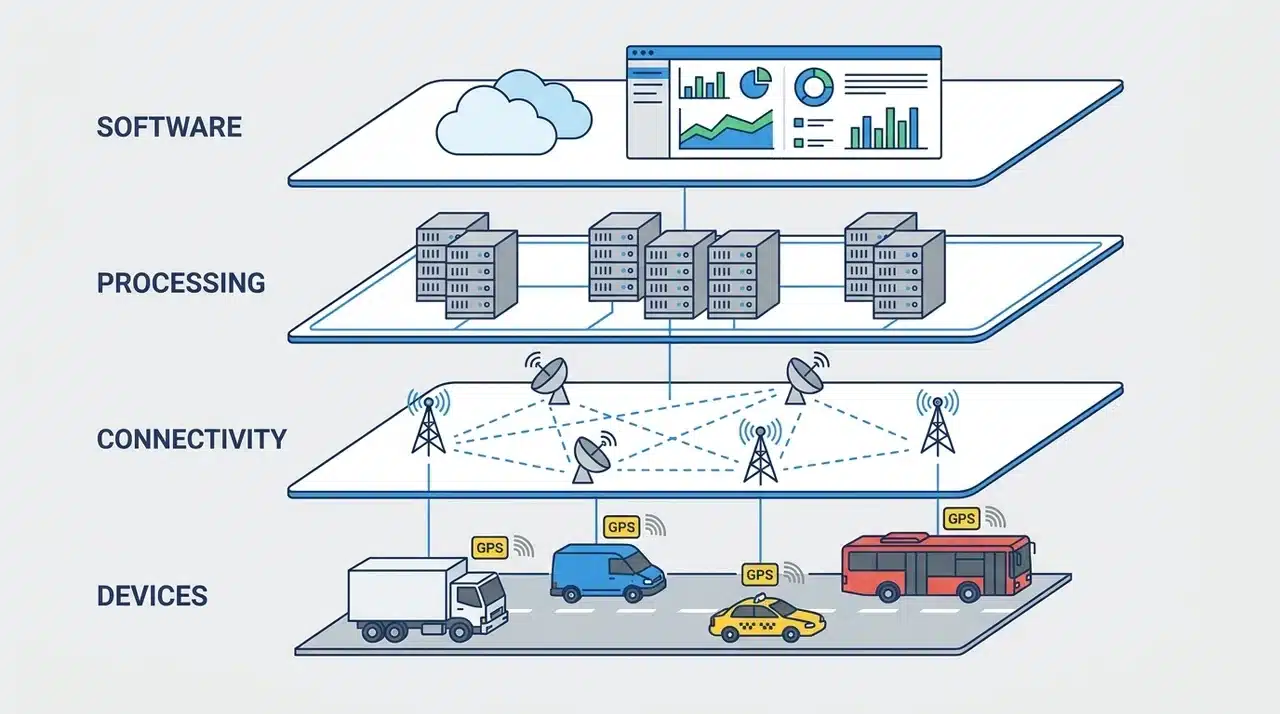
IoT fleet management is a three-layer architecture: physical sensors, a connectivity layer, and cloud software that continuously streams data from your vehicles and assets into a platform where it becomes actionable.
“IoT fleet management” and “telematics” are used interchangeably. That’s worth clearing up now.
Telematics captures vehicle data, engine diagnostics, speed, and location through an OBD port or hardwired device. IoT fleet management includes that, but it doesn’t stop there.
Add trailers, cargo containers, or yard equipment, and the system changes. Those assets have no OBD port. They need battery-powered cellular tags or environmental sensors running their own connections.
That connectivity layer is also where things break. Cellular dead zones, weak GPS signal, remote corridors, any gap there means your platform receives incomplete data. And incomplete data doesn’t just leave blanks. It quietly distorts the patterns your analytics depend on.
How the Data Chain Works: From Sensor Event to Fleet Decision
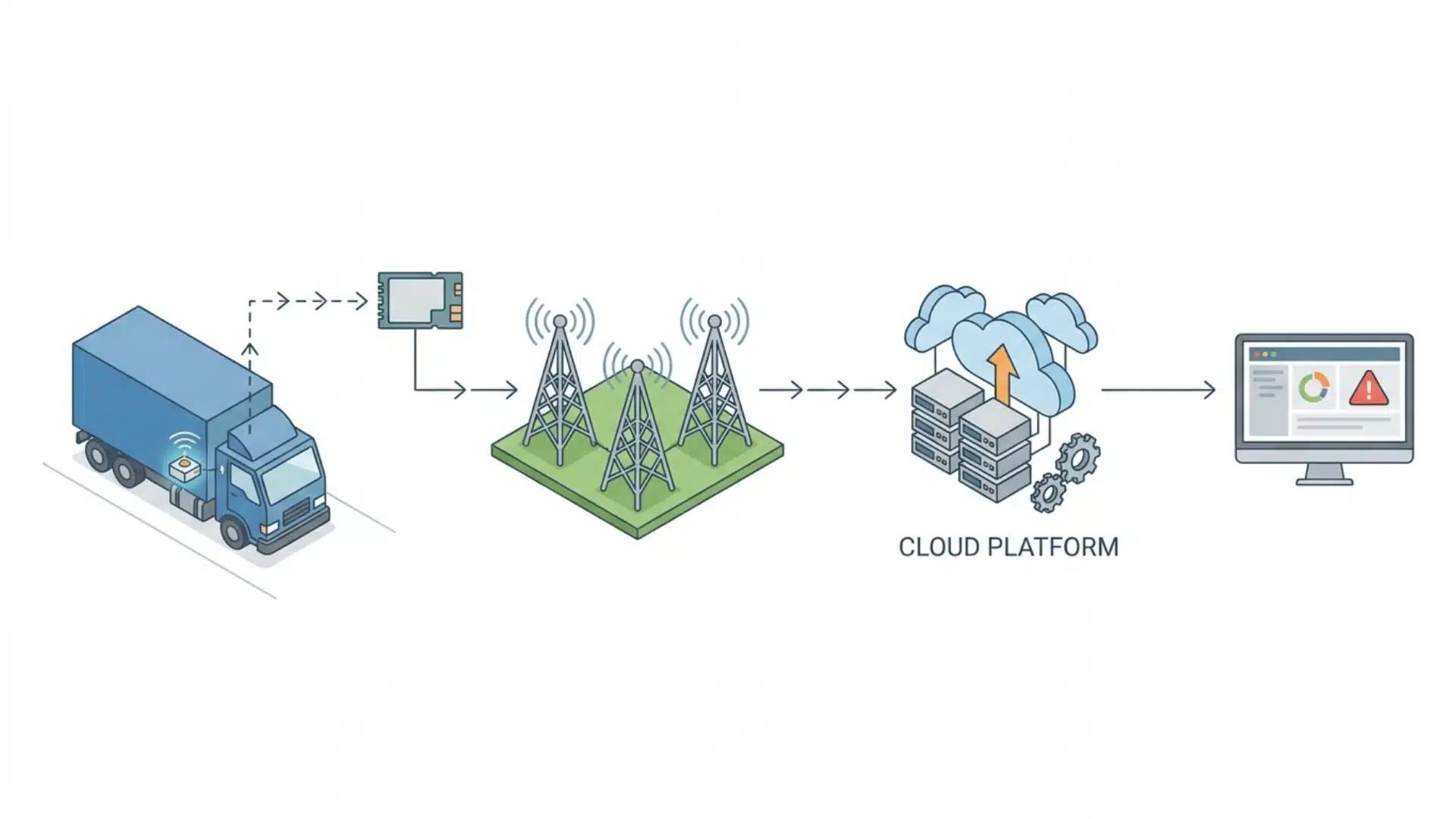
IoT fleet management runs on a three-stage pipeline: a physical event is captured by hardware, transmitted through a connectivity layer, and processed by cloud software into an alert or metric you can act on.
Every benefit, predictive maintenance, route optimization, and cargo monitoring comes from that same chain. The difference between platforms isn’t which outcomes they promise. It’s how cleanly each stage runs.
The Hardware Layer: What Gets Installed on the Vehicle
Hardware determines what data enters the pipeline. An OBD dongle plugs into your vehicle’s diagnostic port and reads engine data, temperature, RPM, and fault codes.
A hardwired device like Geotab’s GO unit goes deeper, capturing higher-frequency data the OBD port can’t surface on its own.
Trailers and containers have no engine bus. They use battery-powered cellular tags or environmental sensors that independently track temperature, humidity, door openings, and location.
What you install determines what you can see. A platform can’t analyze data it never receives.
The Connectivity Layer: How Data Moves from Asset to Cloud
Devices typically transmit over 4G LTE. Fleets running remote routes, mining, forestry, and long-haul often need satellite as a fallback.
When coverage drops, devices buffer data locally and upload when the connection is restored. But bulk uploads arrive out of sequence.
A predictive model that reads timestamped events in the wrong order can misread a pattern, flagging a problem that has already resolved or missing one still developing. Connectivity directly affects what your software can reliably conclude.
The Software Layer: Where Raw Data Becomes a Decision
Rules engines work on thresholds. Engine temp exceeds 105°C, trigger an alert. Fast, transparent, easy to configure. They catch discrete events well.
ML models work differently. They watch for patterns across weeks of data, a gradual shift in engine behavior no single reading would flag. That’s how you get ahead of a failure before a warning light fires.
Rule engines react in milliseconds, while ML models require historical data and can take weeks to calibrate to a new asset. They’re not competing approaches; most platforms use both.
What IoT Fleet Management Can Actually Monitor (and What It Cannot)
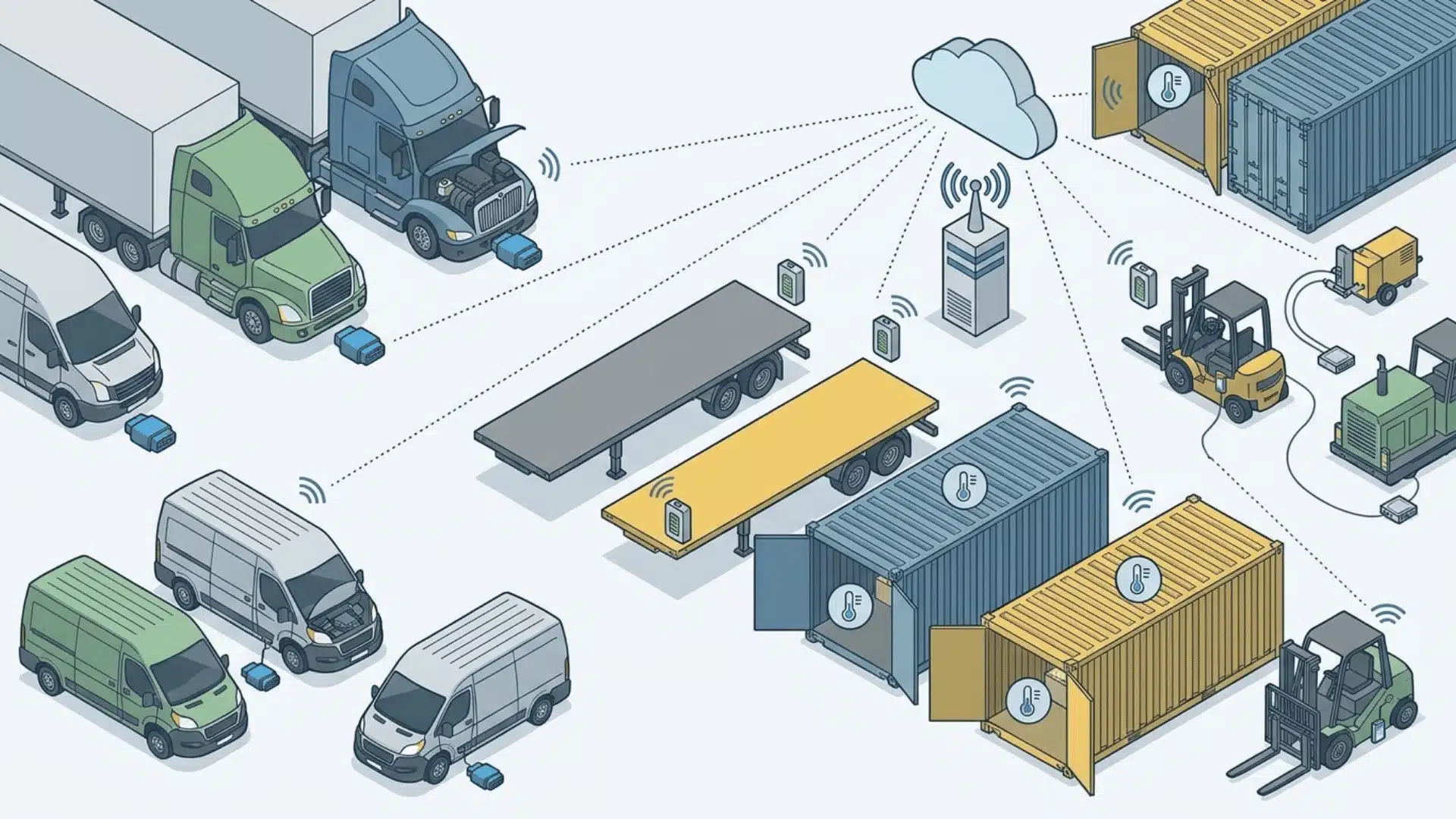
IoT fleet management covers four functional categories: predictive maintenance, driver safety analytics, real-time geolocation, and cargo and asset monitoring. Which of those you can actually access depends on your hardware configuration, not your platform subscription.
That distinction matters more than most buyers realize before they’ve signed a contract.
1. Predictive Maintenance
Requires a hardwired device or an OBD dongle to read your engine bus. Without one, your platform has no diagnostic data to work from:
- No fault codes
- No temperature readings
- No RPM patterns
No hardware means no visibility, and no amount of software capability changes that.
2. Driver Safety Analytics
The software can support distraction detection, fatigue alerts, and inward-facing video analysis. But the hardware has to match:
- No inward-facing camera means no distraction or fatigue data
- No outward-facing camera means no forward collision or lane departure detection
- No dashcam integration means no video evidence of incidents
If the camera isn’t there, the data isn’t there. The platform can only work with what’s physically installed.
3. Real-Time Geolocation
GPS tracking comes built into most OBD dongles, making it the most accessible category. The constraints are coverage-based:
- Cellular-dependent devices lose signal in remote corridors
- Data buffers locally during outages and uploads out of sequence
- Location accuracy and alert timing both suffer during connectivity gaps
GPS tracking sounds simple until your fleet runs routes where coverage isn’t guaranteed. That’s when the gaps show up.
4. Cargo and Asset Monitoring
The category where hardware gaps show up most often:
- OBD dongles capture nothing about cargo temperature, humidity, or door events
- Trailers and containers have no engine bus; they need battery-powered cellular or BLE tags
- Yard equipment falls into the same gap, invisible to your platform without passive asset tags
Without purpose-built sensors for non-motorized assets, they simply don’t exist in your platform’s view. This is the category most fleets underestimate until something goes wrong.
Where IoT Fleet Systems Break Down in Practice
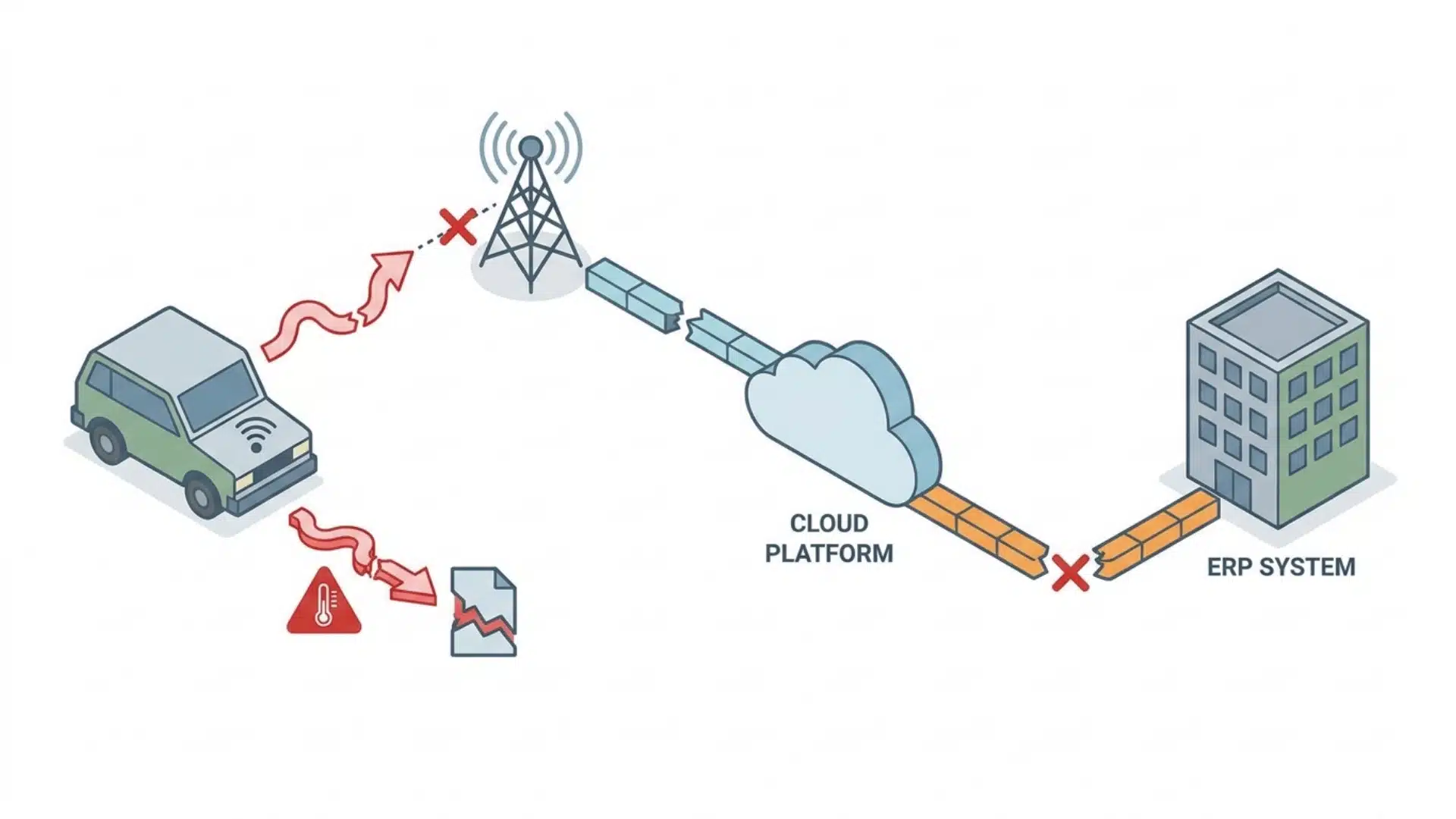
Three failure categories account for IoT fleet deployments that underdeliver: connectivity loss, integration failure, and sensor drift. None of them appear in vendor documentation. All of them show up in the field.
1. Connectivity Loss
Connectivity loss hits harder than it looks, and its impact isn’t immediate; it’s gradual.
Real-time alerting fails the moment the signal drops. But predictive models degrade quietly over days as buffered data fills gaps with interpolated readings rather than actual ones.
By the time the inaccuracy shows up in your alerts, it’s already been building for a while.
2. Integration Failure
IoT data is only useful if it talks to your existing systems. When it can’t connect to your fleet management software or ERP, you end up with data sitting in a silo no one acts on.
Fleetio takes an API-first approach, built to connect without engineering overhead. AWS IoT FleetWise takes the opposite route, a custom cloud pipeline that’s powerful but requires engineering resources to build and maintain.
The right choice depends entirely on what your team can support.
3. Sensor Drift
Hardware degrades. Sensors that were accurate at installation become less reliable over time, and when they drift, predictive maintenance models start generating false positives.
Vendors rarely mention this. Fleets without a calibration schedule typically see alert accuracy decline within 18 to 24 months.
A false-positive culture, where alerts are ignored because they’re often wrong, is harder to fix than the drift itself.
How to Evaluate an IoT Fleet Management Platform?
Three criteria should drive your platform decision: hardware compatibility, connectivity options, and integration depth. Evaluate them in that order; each one constrains what’s possible in the next.
- Hardware compatibility: If the platform doesn’t support your asset types, mixed fleets, non-motorized assets, or specialty equipment, you’ll be building workarounds from day one.
- Connectivity options: A platform without satellite fallback will leave gaps in your data whenever routes pass through low-coverage areas.
- Integration depth: A platform that can’t connect to your existing fleet management software or ERP creates a data silo, a dashboard no one acts on.
The buyer profile matters too. Geotab is built for operations teams, deep engine analytics, and a proprietary, ready-to-deploy device. AWS IoT FleetWise is built for engineering teams constructing custom data pipelines at scale. They’re not competing for the same buyer.
Start with the pipeline, not the interface. A platform with more dashboards but a weak connectivity layer will underdeliver in the field.
Wrapping Up
IoT fleet management solutions promise a lot. The ones that deliver share something in common: they were evaluated on architecture, not features.
Hardware compatibility, connectivity reliability, and integration depth determine what you can actually see and act on.
The data pipeline either runs cleanly or it doesn’t, and no dashboard fixes a broken layer beneath it. Sensor drift, connectivity gaps, and integration failures don’t announce themselves.
They erode accuracy quietly. Know the system before you buy into it, and you’ll be in a far stronger position to run it well. Ready to assess your current setup? Start with your hardware.
Frequently Asked Questions
What is the difference between IoT fleet management and telematics?
Telematics focuses on collecting and sending vehicle data such as location, speed, fuel use, and engine status. IoT fleet management is broader because it combines telematics with data from cargo sensors, environmental monitors, and other connected assets through a single cloud-based system.
Does IoT fleet management work for small fleets, or only for enterprises?
IoT fleet management works for both small fleets and large enterprises. Small businesses often use it for GPS tracking, maintenance reminders, and basic monitoring, while larger fleets use advanced analytics, automation, and connected systems to improve efficiency and decision-making.
What connectivity does IoT fleet management require?
Most platforms use 4G LTE as the primary transmission layer, with satellite connectivity available for fleets operating in remote or low-coverage areas. Devices store data locally during connectivity gaps and upload when the connection is restored, though this introduces data latency risks for real-time alerting.
Can IoT fleet management monitor cargo, not just vehicles?
Yes, but it requires additional hardware. Cargo monitoring, temperature, humidity, and shock sensors for sensitive freight use separate IoT sensors installed in trailers or containers. These run their own cellular or BLE connections and feed into the same cloud platform as vehicle data.