Predicting customer demand sounds simple until sales suddenly rise, fall, or shift with the season. If you order too much, cash gets tied up in stock. If you order too little, you risk missed sales and unhappy customers.
I know it can be hard to choose between all the demand forecasting methods available today. Some rely on historical data, while others use market research, expert judgment, or AI.
The right choice depends on your product, data quality, and planning needs. Here, you’ll learn how the main methods work, when each one fits best, and how you can choose a forecasting approach that supports better business decisions.
What Are Demand Forecasting Methods?
Demand forecasting methods are techniques businesses use to estimate how much of a product or service customers are likely to purchase during a future period. Forecasts may cover the next week, quarter, year, or several years depending on the decision being made.
Most methods fall into two main categories. Quantitative forecasting uses historical numerical data and mathematical models to identify demand patterns. Qualitative forecasting relies more on customer research, market knowledge, and expert opinion when reliable historical data is unavailable.
Businesses do not always need to choose one category exclusively. An established company may generate a statistical forecast and then adjust it using sales-team knowledge or current market information. These estimates can also support better stock planning decisions by helping businesses balance expected demand with available inventory.
Modern forecasting platforms can combine traditional models with artificial intelligence and machine learning to process larger datasets.
Quantitative Demand Forecasting Methods
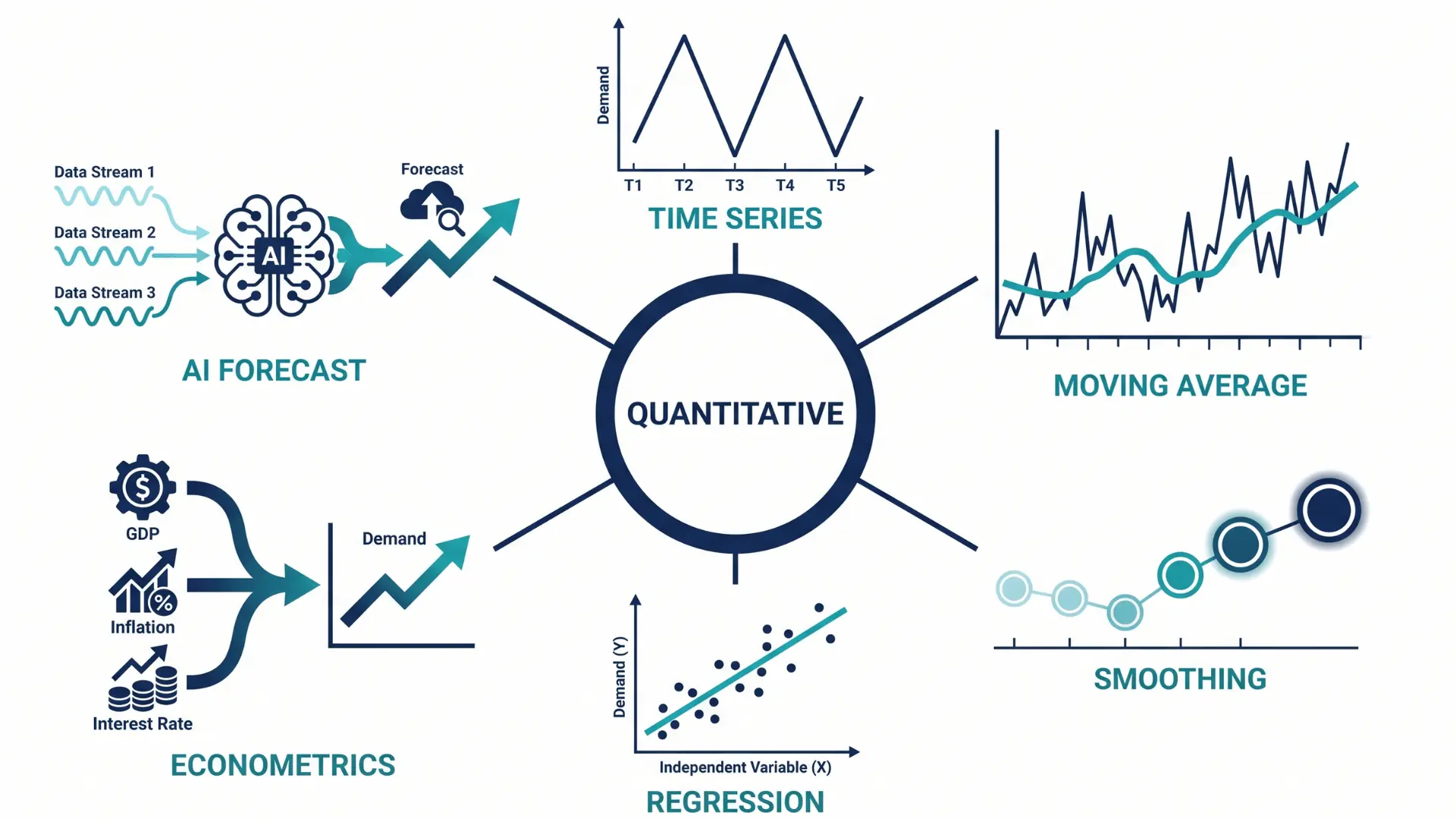
Quantitative forecasting is most useful when a business has enough reliable historical data. These methods analyze sales patterns mathematically, making them suitable for established products with measurable demand histories.
1. Time-Series Analysis
Time-series analysis examines demand recorded over regular periods, such as days, weeks, months, or quarters. It looks for patterns that may continue into the future.
These patterns can include long-term growth, seasonal peaks, recurring cycles, and short-term fluctuations. A retailer, for example, may identify higher demand every December and use that pattern to estimate future holiday sales.
Time-series forecasting works best when historical patterns remain reasonably consistent.
2. Moving Average
A moving average forecasts future demand by calculating the average demand from a selected number of recent periods.
A business might average sales from the previous three or six months to estimate demand for the next month. As new data becomes available, the oldest period is removed and the latest period is added.
This method is simple and useful for products with relatively stable demand, but sudden changes can take time to appear in the forecast.
3. Exponential Smoothing
Exponential smoothing also uses historical demand but gives greater importance to recent observations.
Older data gradually receives less weight, allowing the forecast to respond faster when customer demand begins changing.
This makes exponential smoothing more flexible than a basic moving average for short-term planning. However, businesses must still choose appropriate smoothing settings because giving too much weight to recent activity can make forecasts overly sensitive to temporary spikes.
4. Trend Projection
Trend projection identifies a general upward or downward movement in historical demand and extends that direction into future periods.
For example, if sales have increased steadily over several years, a business may use that growth pattern to estimate future demand.
Before projecting the trend, review unusual events carefully. A one-time promotion, shortage, or sudden market disruption can distort historical data and create an unrealistic future estimate.
5. Regression Analysis
Regression analysis estimates how demand changes when one or more related variables change. A business might study the relationship between sales and:
- Product price
- Advertising spending
- Promotions
- Weather
- Customer income
- Economic conditions
Regression is particularly useful when historical sales alone cannot explain demand. It can help businesses understand which variables influence demand and estimate what may happen when those variables change.
6. Econometric Models
Econometric forecasting combines statistical techniques with economic variables to estimate future demand.
Models may include inflation, employment levels, interest rates, consumer spending, housing activity, or gross domestic product.
These methods are often more useful for industries strongly affected by wider economic conditions, such as automobiles, construction, housing, and financial services. Econometric models can be powerful, but they typically require more data and expertise than simple forecasting techniques.
Qualitative Demand Forecasting Methods

Qualitative forecasting becomes valuable when historical sales numbers are limited or when past demand may not accurately represent future conditions. It is commonly used for new products, emerging markets, and major strategic decisions.
1. Market Research
Market research collects information directly from potential customers through surveys, interviews, focus groups, and purchase-intent studies.
Businesses can use this information to estimate customer interest before launching a product or entering a new market.
Market research provides insight that historical sales cannot offer, but stated customer intentions do not always translate into actual purchases. Results therefore need careful interpretation.
2. Delphi Method
The Delphi method gathers forecasts from a panel of experts over several rounds.
Experts usually provide their opinions independently. A summary of the responses is then shared, allowing participants to reconsider their estimates before another round begins.
The process continues until the forecasts become more consistent.
This approach can reduce the influence of dominant personalities and is often used for long-term forecasting, emerging technologies, or uncertain markets.
3. Sales Force Composite
The sales force composite method asks sales representatives to estimate future demand within their territories or customer groups.
Because sales teams regularly communicate with customers, they may notice changing preferences, delayed orders, upcoming projects, or competitor activity before those changes appear in sales reports.
Management combines individual estimates into a broader forecast. The method offers valuable frontline insight, although optimism or sales targets can sometimes influence estimates.
4. Expert Judgment
Expert judgment relies on experienced managers, consultants, analysts, or industry specialists to estimate future demand.
It can be useful when a company lacks enough numerical information for a statistical model or faces conditions that historical data cannot explain.
The main limitation is subjectivity. Two experts may interpret the same market conditions differently, so businesses often combine expert judgment with additional research or quantitative evidence.
5. Historical Analogy
Historical analogy estimates demand for a new product by comparing it with the performance of a similar existing product.
A company launching a new appliance, software plan, or consumer device might examine the early sales pattern of a previous comparable launch.
The approach is useful when the new product has no sales history. Its accuracy depends on how closely the comparison product matches the new product’s price, customers, competition, and market conditions.
Quantitative vs Qualitative Forecasting
Quantitative and qualitative forecasting serve different situations. The best approach depends largely on available data, product maturity, and the level of uncertainty surrounding future demand.
| Factor | Quantitative Forecasting | Qualitative Forecasting |
|---|---|---|
| Main input | Historical numerical data | Human judgment and research |
| Best for | Established products | New products or markets |
| Data requirement | Usually high | Usually lower |
| Common methods | Time series, regression, smoothing | Delphi, surveys, expert judgment |
| Main strength | Objective and measurable | Useful when history is limited |
| Main limitation | Past patterns may change | Results can be affected by bias |
Many companies combine both approaches. Statistical models can provide a consistent baseline, while market research and employee knowledge help account for events that historical numbers may not capture.
This combination can also strengthen broader supply planning when inventory, scheduling, and supplier decisions depend on expected demand.
AI and Machine Learning in Demand Forecasting
AI and machine learning expand forecasting beyond traditional statistical techniques by processing larger datasets and identifying complicated relationships between variables.
A machine-learning model may analyze sales history alongside promotions, website traffic, weather, pricing, holidays, inventory levels, and economic indicators. As fresh information enters the system, forecasts can be updated more frequently.
These tools can be especially useful for businesses with thousands of products, locations, or customer segments. In complex retail planning environments, forecasts can help align purchasing and inventory decisions with seasonal patterns, promotions, and changing customer demand.
However, AI does not automatically guarantee a better forecast. Poor-quality data can still produce unreliable predictions. Models also need regular monitoring because customer behavior and market conditions change.
The strongest systems combine suitable technology with clean data, business knowledge, and ongoing forecast evaluation.
How to Select a Forecasting Method
The best forecasting technique depends on the specific decision being made, not on which model appears most advanced.
Consider these factors before choosing a method:
- Historical data: Established products usually support statistical forecasting, while new products may require market research or analogies.
- Forecast horizon: Short-term forecasts may use moving averages or exponential smoothing, while strategic forecasts may need broader economic analysis.
- Demand stability: Stable demand is easier to forecast with simple statistical methods.
- Seasonality: Products with repeating seasonal patterns benefit from time-series models that account for those cycles.
- External influences: Regression can help when pricing, weather, promotions, or economic conditions strongly affect demand.
- Business complexity: Large organizations with extensive datasets may benefit from machine-learning models.
The simplest method that produces reliable results is often more useful than an unnecessarily complex model.
Demand Forecasting Process
Selecting a model is only one part of forecasting. Businesses also need a consistent process for preparing data, generating predictions, and measuring whether those predictions remain useful.
- Define the objective: Decide what needs to be forecast and why the forecast is required.
- Choose the forecast period: Determine whether planning covers days, months, quarters, or years.
- Collect relevant data: Gather historical demand and useful market information.
- Clean the dataset: Correct errors and separate unusual events that could distort the results.
- Select the method: Match the model with the available data and forecasting purpose.
- Generate the forecast: Produce an estimate for the selected period.
- Compare forecast and actual demand: Measure the size and direction of forecast errors.
- Refine the approach: Update assumptions or change models when accuracy deteriorates.
Treat forecasting as an ongoing process because demand conditions rarely remain unchanged.
Factors That Can Reduce Forecast Accuracy
Forecast accuracy can fall even when the model is strong. Data issues, market changes, promotions, and limited history can all make future demand harder to predict.
| Factor | How It Affects Forecast Accuracy |
|---|---|
| Poor data quality | Missing sales records, inaccurate inventory data, and inconsistent product information can produce unreliable forecasts. |
| Economic changes | Recessions, inflation, or sudden shifts in consumer spending can make past demand patterns less useful. |
| Supply disruptions | Delays, shortages, or production issues can distort sales and make actual demand difficult to measure. |
| Competitor activity | New products, price cuts, or promotions from competitors can quickly change customer demand. |
| Unusual weather | Extreme or unexpected weather can create sudden increases or drops in demand for certain products. |
| Promotions | Temporary sales spikes caused by discounts may be mistaken for long-term demand growth. |
| Changing customer preferences | Trends and buying habits can shift faster than historical data can reflect. |
| New products | Limited or no sales history makes it harder to build accurate data-based forecasts. |
Regularly comparing forecasts with actual demand helps businesses spot errors early and update data, assumptions, and models before small forecasting problems become larger planning issues.
How Businesses Use Demand Forecasts
Demand forecasts support decisions across many parts of a business, not just inventory planning.
Retailers use forecasts to determine how much merchandise to order before seasonal peaks. Manufacturers use expected demand to schedule production runs and purchase raw materials.
Forecast information can also guide:
- Staffing levels
- Warehouse capacity
- Supplier orders
- Transportation planning
- Marketing campaigns
- Financial budgets
- Cash-flow planning
A company expecting higher demand may increase inventory and labor before sales rise. If demand is predicted to fall, it can reduce orders and avoid unnecessary stock.
Better coordination between sales, operations, finance, and supply chain teams makes forecasts more useful because each department can plan from a shared view of expected demand.
Improving Demand Forecast Accuracy
Forecast accuracy usually improves through regular testing rather than by selecting one model and leaving it unchanged.
Businesses can improve forecasts by:
- Using recent and reliable data
- Removing or labeling unusual one-time events
- Updating forecasts frequently
- Comparing predicted demand with actual sales
- Tracking forecast error over time
- Including relevant external variables
- Testing several models
- Adjusting for promotions and seasonal events
- Adding business judgment when the data does not capture current conditions
It is also useful to evaluate forecasting performance by product or category. One method may work well for stable products but poorly for highly seasonal items.
The goal is not to eliminate every forecasting error. Instead, businesses should identify where errors occur and continuously improve the decisions made from the forecast.
Building More Reliable Demand Forecasts
Good forecasting comes down to using the right method for the right situation. Historical data can support statistical models, while new products may need market research, expert insight, or comparable-product analysis. AI can add value when you have larger datasets and complex demand patterns.
I find that demand forecasting methods work best when you compare predictions with actual results and adjust the process over time. This helps you plan inventory, production, staffing, and budgets.
You do not need the most complicated model to get useful results. Start with the method that matches your data and goals, test its accuracy, and refine it. Try these approaches and see what works best for your business.
Frequently Asked Questions
What are the main demand forecasting methods?
The main methods are quantitative and qualitative forecasting. Quantitative techniques include time-series analysis, moving averages, exponential smoothing, regression, and econometric models. Qualitative techniques include market research, the Delphi method, expert judgment, sales force estimates, and historical analogy.
Which forecasting method is best for seasonal demand?
Time-series forecasting is commonly used for seasonal demand because it can identify patterns that repeat at regular intervals. Businesses should use several years of reliable historical data when possible to distinguish genuine seasonal patterns from temporary sales fluctuations.
What forecasting method works for a new product?
New products often require qualitative methods because they lack historical sales data. Market research, expert judgment, customer surveys, and historical analogy can provide initial estimates. Forecasts can gradually shift toward quantitative models once the product develops a usable sales history.
Is regression used for demand forecasting?
Yes. Regression analysis can estimate how demand changes in response to factors such as price, promotions, advertising, weather, or economic conditions. It is particularly useful when businesses need to understand the drivers behind demand rather than simply extend historical sales patterns.
Can demand forecasting ever be completely accurate?
No forecasting method can predict future demand with complete certainty. Customer behavior, economic conditions, competitors, weather, and unexpected events can change quickly. Businesses therefore measure forecast errors and update their models regularly, rather than expecting a single forecast to remain accurate indefinitely.