A supplier may deliver perfectly for months while financial pressure, cyber weaknesses, or capacity problems quietly build behind the scenes. By the time performance drops, the business may already be exposed.
That is where supplier risk management becomes valuable. It helps you identify problems that may affect a supplier relationship before they become missed deliveries, compliance issues, security incidents, or operational disruptions.
The challenge is not simply collecting more supplier data. You need to know which suppliers matter most, what risks deserve attention, how often they should be reviewed, and what action makes sense when conditions change.
A structured approach makes those decisions easier and keeps supplier oversight focused on actual business exposure.
Supplier Risk Management Explained
Supplier risk management is the process of identifying, assessing, monitoring, and reducing risks connected with suppliers and vendors. It helps businesses understand what could go wrong, how severely a supplier failure could affect operations, and what safeguards to prepare in advance.
Supplier risk should not be confused with supplier performance. Performance metrics show what has already happened through delivery times, quality levels, service results, and contract targets.
Risk management looks further ahead.
A supplier can maintain strong performance while facing financial trouble, cyber threats, production constraints, regulatory issues, or external disruption. This matters even more when broader supplier sourcing decisions have concentrated the business around one vendor or left few practical alternatives.
The objective is therefore not only to measure supplier results but also to understand future exposure.
Main Types of Supplier Risk
Supplier exposure usually comes from several areas rather than one isolated problem. Separating risks into categories makes assessment and monitoring easier.
| Risk Type | What It Can Include | Possible Business Impact |
|---|---|---|
| Financial | Cash-flow problems, debt, rising costs, financial instability | Delays, price increases, reduced capacity, supplier failure |
| Operational | Production issues, poor quality, limited capacity, logistics disruption | Missed orders, shortages, interrupted operations |
| Cybersecurity | Weak controls, breaches, unauthorized system access | Data exposure, system disruption, security incidents |
| Compliance and Legal | Regulatory failures, labor issues, trade rules, industry standards | Penalties, contract issues, reputational damage |
| Geopolitical | Trade restrictions, conflicts, policy changes, regional instability | Shipping delays, sourcing disruption, reduced availability |
These categories reflect the main supplier risks identified throughout the source material.
The importance of each category depends on the supplier relationship. A software vendor may create more cybersecurity exposure, while a manufacturer supplying a unique component may present greater operational and continuity risk.
The Supplier Risk Management Process
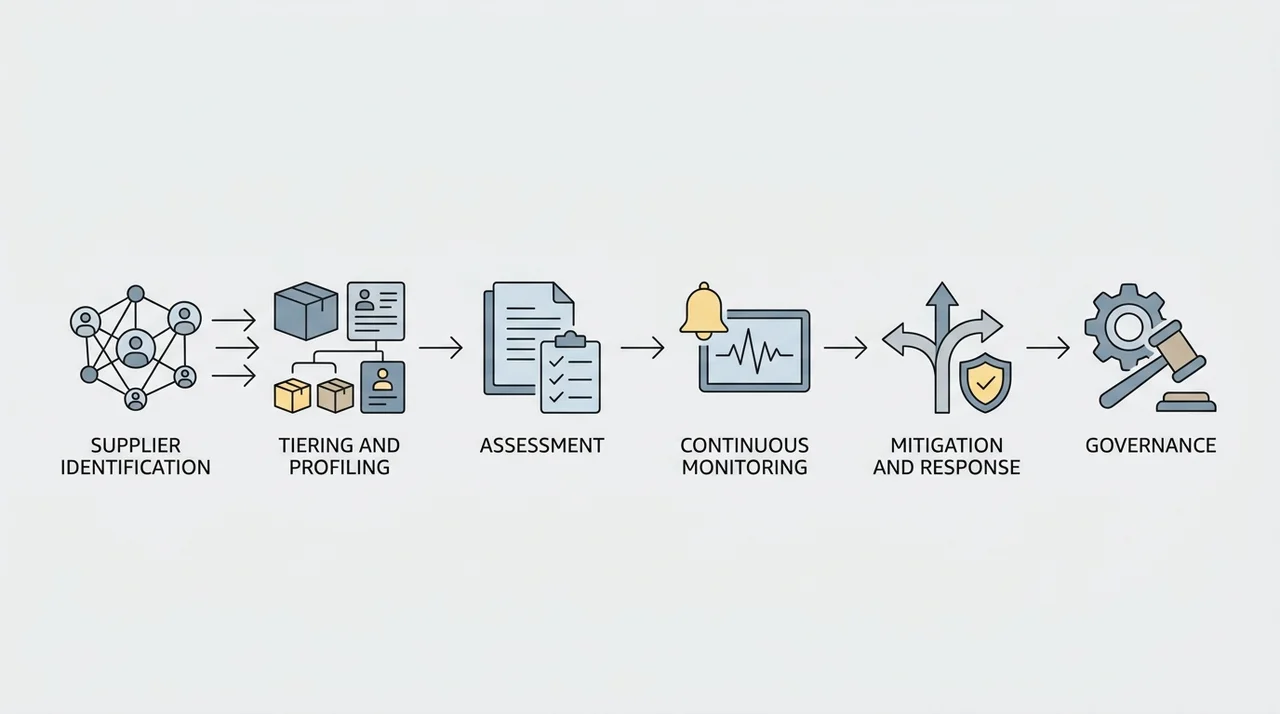
A useful supplier risk process should follow one connected workflow rather than treating onboarding, assessment, monitoring, and mitigation as separate activities.
1. Identify Where Supplier Risk Exists
Start by mapping the supplier base and understanding which relationships could create meaningful disruption.
Risk identification may consider:
- Financial stability
- Operational dependency
- Cybersecurity exposure
- Compliance obligations
- Geographic concentration
- Supply-chain dependency
- Limited replacement options
The goal is not to label every supplier as dangerous. It is to understand where failure would matter most.
A low-spend supplier, for example, may still deserve close attention if it provides a unique component that cannot be replaced quickly. Identification creates the foundation for everything that follows because it determines where deeper assessment is justified.
2. Tier Suppliers by Criticality
Not every supplier needs the same level of review. Supplier tiering helps businesses concentrate resources on relationships with the greatest potential impact.
Teams may consider:
- Dependency on the supplier
- Importance to daily operations
- Access to sensitive information
- Availability of alternatives
- Contract value or spending
- Regulatory exposure
- Difficulty of replacing the supplier
Spending should not be the only factor. A small supplier can still be critical when there is no practical substitute.
Supplier tiers should also change when the relationship changes. A vendor that was once easy to replace may become more important as business processes become increasingly dependent on its services.
3. Assess the Relevant Risks
Once you understand supplier criticality, assess the risks that apply to that relationship. Depending on the supplier, this may involve:
- Financial reviews
- Security questionnaires
- Certifications
- Compliance checks
- Supplier audits
- Business continuity reviews
- Operational capability checks
For logistics suppliers, external standards verification can provide additional evidence that a provider follows defined safety, quality, and compliance requirements.
The assessment should be proportional to risk. Requiring every low-impact vendor to complete the same extensive review as a critical supplier slows the process without necessarily improving risk decisions.
4. Monitor Changes Continuously
Supplier conditions can change between scheduled assessments. Continuous monitoring helps businesses spot signs of deterioration before the next formal review.
Useful indicators may include:
- Credit or financial changes
- Cyber incidents
- Ownership changes
- Compliance problems
- Relevant supplier news
- Delivery reliability
- Quality issues
- Service-level changes
Performance data remains useful because sudden deterioration can indicate a wider problem. However, good current performance should not be treated as proof that supplier risk is low.
Monitoring tools can automate some checks, but alerts still need ownership. A system that generates hundreds of warnings without clearly identifying who should review them can create noise rather than better risk management.
5. Reduce the Exposure
When a significant supplier risk is identified, decide how the business can reduce its potential impact.
Common mitigation measures include:
- Adding backup suppliers
- Using dual or multiple sourcing
- Strengthening contract requirements
- Updating service-level agreements
- Building contingency plans
- Increasing oversight temporarily
- Using insurance or other contractual protections where appropriate
A broader network resilience strategy may also include supplier diversification, calibrated safety stock, and qualified alternatives for important materials or services. Replacing a supplier is not always immediate or realistic.
A company may depend on specialized tooling, certifications, technology, or intellectual property that makes switching difficult. In those situations, mitigation may focus on stronger contingency planning, closer monitoring, and finding alternatives over time rather than terminating the relationship immediately.
6. Assign Clear Ownership
Supplier risk management cannot operate effectively when responsibility sits with one department alone. Different teams often see different parts of the supplier relationship.
Procurement may understand day-to-day performance, while finance sees financial exposure, cybersecurity teams understand digital risk, and legal or compliance teams evaluate regulatory obligations.
Clear governance should define:
- Who approves suppliers
- Who reviews assessments
- Who owns monitoring alerts
- When risks should be escalated
- Who approves mitigation measures
- Who makes decisions about high-risk suppliers
Without clear accountability, assessments and alerts may exist without leading to action.
How Risk Levels Should Change Supplier Oversight
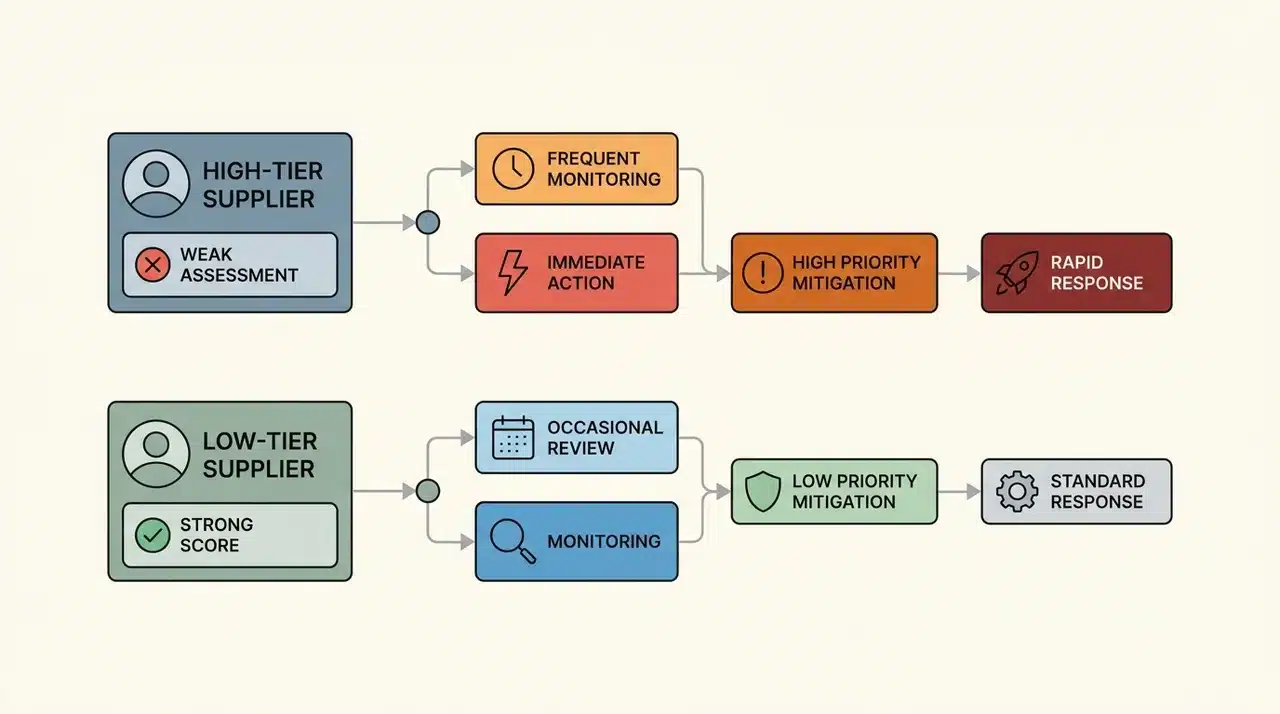
Supplier tiers only provide value when they affect what the business actually does.
A critical supplier should normally receive more frequent monitoring, stronger evidence requirements, and faster escalation than an easily replaceable vendor.
For example, a critical single-source supplier showing signs of financial stress may require immediate review and contingency planning. A minor performance issue from a low-risk vendor with several alternatives may only need routine follow-up.
Risk level should influence:
- Assessment depth
- Approval requirements
- Monitoring frequency
- Escalation speed
- Mitigation priority
- Reassessment timing
This prevents teams from spending equal effort on unequal risks.
The original draft correctly emphasizes that supplier tier and risk score should guide response intensity rather than treating every issue the same.
Building a Strong Supplier Risk Program
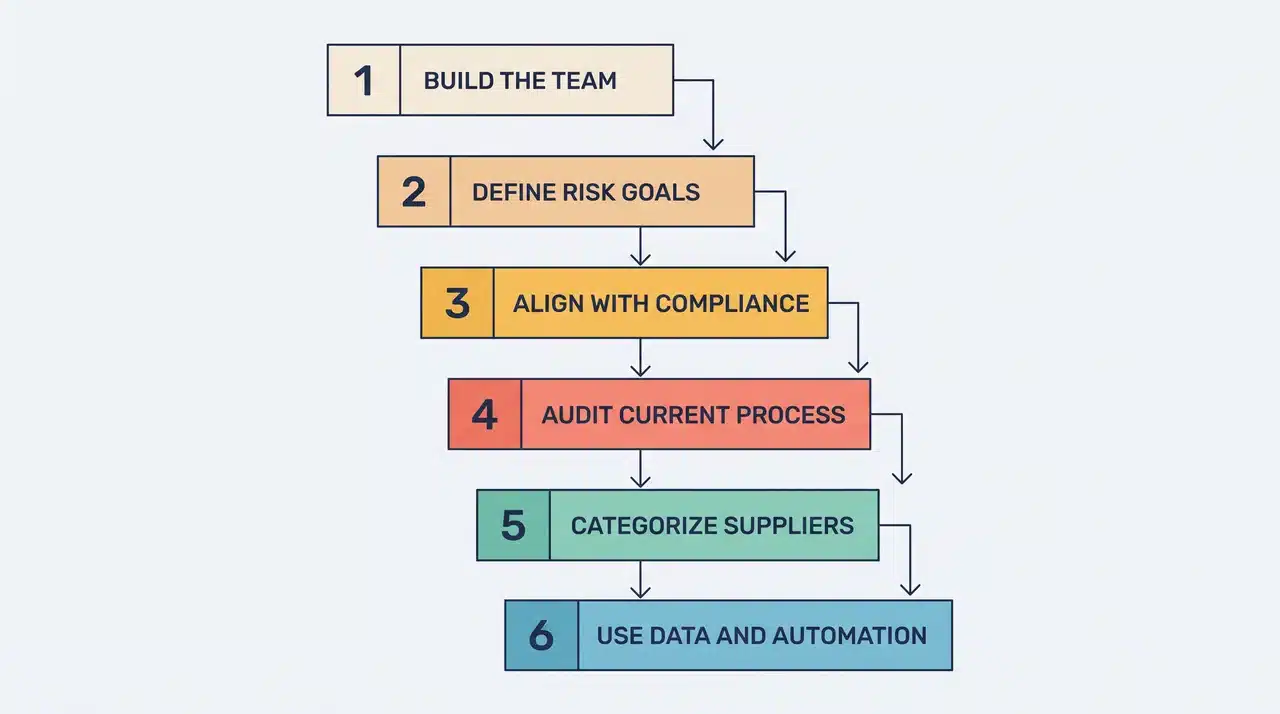
The process becomes more effective when several supporting elements are established before problems occur.
1. Build a Cross-Functional Team
Supplier risk rarely belongs entirely to procurement.
Finance, legal, compliance, cybersecurity, vendor management, audit, and operational teams may all have relevant responsibilities depending on the supplier.
Before launching or revising the program, define each team’s role and agree on how serious supplier issues will be escalated.
Executive support is also useful when supplier decisions involve high cost, operational disruption, or strategic relationships.
2. Set Clear Risk Thresholds
Risk ratings should have practical meaning. If a supplier is categorized as low, medium, high, or critical risk, teams should understand what each level changes.
Clear thresholds may determine:
- Who approves the supplier
- What evidence is required
- How frequently monitoring occurs
- When escalation is necessary
- What mitigation measures are expected
Risk scoring becomes much less useful when employees can see a number or color but do not know what action should follow.
3. Match Controls to Industry Requirements
Supplier reviews should reflect the regulatory and operational environment of the business. A financial institution, healthcare company, food manufacturer, and software business will not necessarily evaluate vendors using the same criteria.
Relevant checks may involve financial regulation, privacy obligations, sanctions, labor requirements, product safety rules, or sector-specific standards.
The objective is not to request every possible document from every supplier. Businesses should identify which obligations apply to each relationship and build those requirements into supplier assessment and approval.
4. Review the Existing Workflow
Before adding new questionnaires, technology, or controls, map how suppliers currently move through onboarding and ongoing review. Look for:
- Approval bottlenecks
- Repeated checks
- Unclear ownership
- Unnecessary paperwork
- Identical reviews for very different suppliers
- Assessments that collect information nobody uses
The purpose is to make the process more risk-based rather than simply making it larger.
A simpler process that directs greater effort toward critical suppliers is usually more useful than a complicated process applied equally across the entire supplier base.
5. Use Automation Selectively
Technology can reduce manual work in areas such as financial monitoring, sanctions checks, ownership changes, cybersecurity events, and supplier record updates.
Automation is most useful when it handles repetitive checks and brings meaningful changes to the attention of the right person. It should not replace judgment.
A credit downgrade, for example, does not automatically mean a supplier relationship should end.
Teams still need to understand how serious the change is, how dependent the business is on that supplier, and what alternatives are available. Automation should therefore support decisions rather than make every supplier decision independently.
Where Supplier Risk Programs Commonly Fail
Supplier risk programs often weaken gradually rather than failing all at once.
One common problem is allowing supplier information to become outdated. Reviews may be postponed, even though ownership, production capacity, financial health, or business dependency has changed.
Another weakness appears when every alert receives the same response.
If a minor issue from a replaceable vendor creates the same escalation as a serious warning from a single-source supplier, supplier tiering has little practical value.
Programs also become less effective when:
- Assessments happen only during onboarding.
- Supplier performance is mistaken for supplier risk.
- Risk data is collected but not acted upon.
- Teams depend entirely on supplier questionnaires.
- Risk scores are too complicated to interpret.
- Monitoring alerts have no clear owner.
- Supplier classifications are never reassessed.
The strongest processes keep risk information connected to actual decisions about monitoring, escalation, sourcing, and mitigation.
Supplier Risk Management Best Practices
A few operating principles can keep the program practical as the supplier base changes.
First, focus the most attention on suppliers whose failure could cause the greatest disruption.
Second, separate current performance from future risk. Strong delivery history matters, but it does not reveal every financial, cybersecurity, compliance, or continuity issue.
Third, update supplier classifications when circumstances change. Risk levels should not remain fixed simply because a supplier received a particular rating during onboarding.
Finally, make sure every important risk signal has a defined response.
Supplier information only creates value when it leads to a decision, such as increasing oversight, requesting corrective action, preparing an alternative source, or escalating the issue to leadership.
Final Thoughts
Supplier problems become harder to manage when businesses notice them only after deliveries, systems, or operations are already affected.
A strong supplier risk management process helps you identify critical suppliers, assess relevant risks, monitor changing conditions, and choose responses based on the level of exposure involved.
I would start with the suppliers your business would struggle most to replace. Review what could interrupt those relationships, how quickly you would notice a change, and what options would exist if the supplier suddenly could not perform.
When assessment, monitoring, governance, and mitigation work as one connected system, supplier risk becomes easier to prioritize and far more practical to manage.
Frequently Asked Questions
Is supplier risk management the same as third-party risk management?
No. Supplier risk management focuses on suppliers and vendors, while third-party risk management covers a wider group, including contractors, consultants, partners, and service providers.
What is fourth-party risk?
Fourth-party risk comes from companies your suppliers depend on, such as subcontractors or technology providers. Problems there can still affect your operations, data, or services.
When should a company conduct an on-site supplier review?
On-site reviews make sense for critical suppliers when you need deeper checks of operations, security practices, facilities, or controls beyond documents and remote assessments.
Does supplier risk management continue after a contract ends?
Yes. Offboarding may still require access removal, data return or deletion, final compliance checks, and confirmation that remaining supplier dependencies have been closed properly.