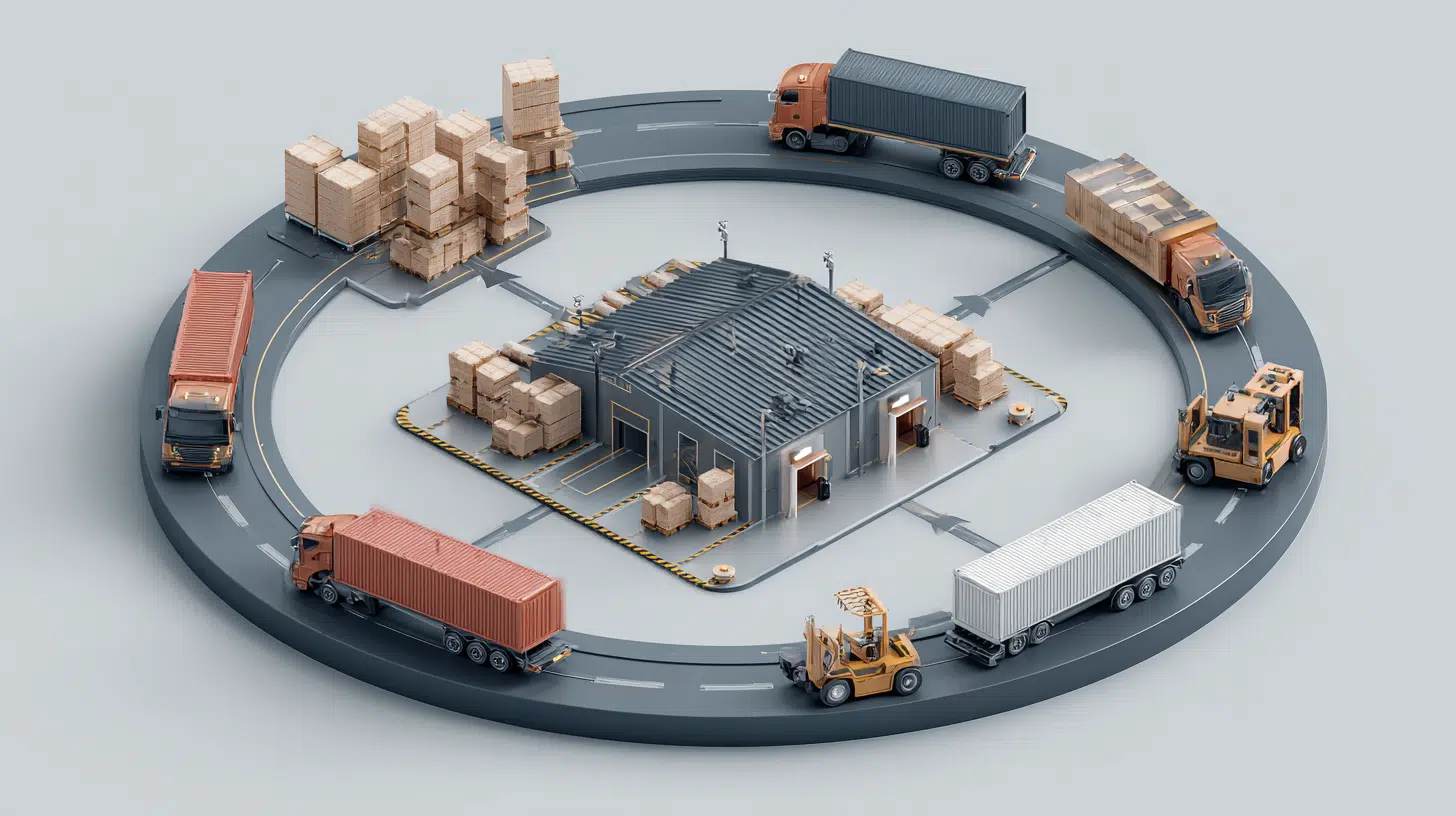
Many shipments fail not because the packaging was wrong, but because it was never matched to the product and the route it had to survive.
Temperature-controlled packaging is a system of materials, formats, and decisions; each variable affects whether the product arrives within its required range.
The line between a protected shipment and a failed one often comes down to understanding how thermal systems actually work and where they break down.
Everything needed to make that determination, from system selection to regulatory stakes, is covered in full detail ahead.
What is Temperature-Controlled Packaging?
Temperature-controlled packaging keeps products at the right temperature during shipping. Think of it like a lunchbox with an ice pack.
People often confuse this with the cold chain. The cold chain is the entire system. Temperature-controlled packaging is just the physical box or liner traveling with the product.
Insulated packaging slows heat transfer, helping products remain closer to their starting temperature during transit. It reduces temperature change but does not maintain a validated range.
Temperature-controlled packaging is engineered for a specific target range, with insulation and refrigerants sized for the transit duration. It maintains defined limits, making it a cold chain decision.
The biggest misconception is that temperature-controlled always means cold. However, chocolate, medicines, lotions, and electronics all need temperature protection within their own safe ranges.
When Temperature Goes Wrong and How Packaging Fights Back?
Temperature failures in products vary depending on their chemistry and packaging. Understanding how these factors interact helps prevent failures during storage and transport.
- Products fail differently: Food enzymes activate, vaccines denature, cosmetics separate, and chemicals destabilize. Temperature failure is determined by the product’s unique chemistry and reaction to heat.
- Packaging’s role: Packaging slows temperature change but doesn’t block it. Insulation resists heat, and refrigerants absorb it before it reaches the product. Proper sizing of both is crucial.
- Refrigerant depletion: Once the refrigerant is consumed, insulation alone can’t maintain the temperature. Without refrigerants, heat rises rapidly, causing unexpected temperature failures in the product.
Undersized thermal budgets at packout lead to temperature failure. Proper sizing of insulation and refrigerants is essential to ensure product stability and prevent heat-related issues.
The Three Temperature Ranges and What Each Demands
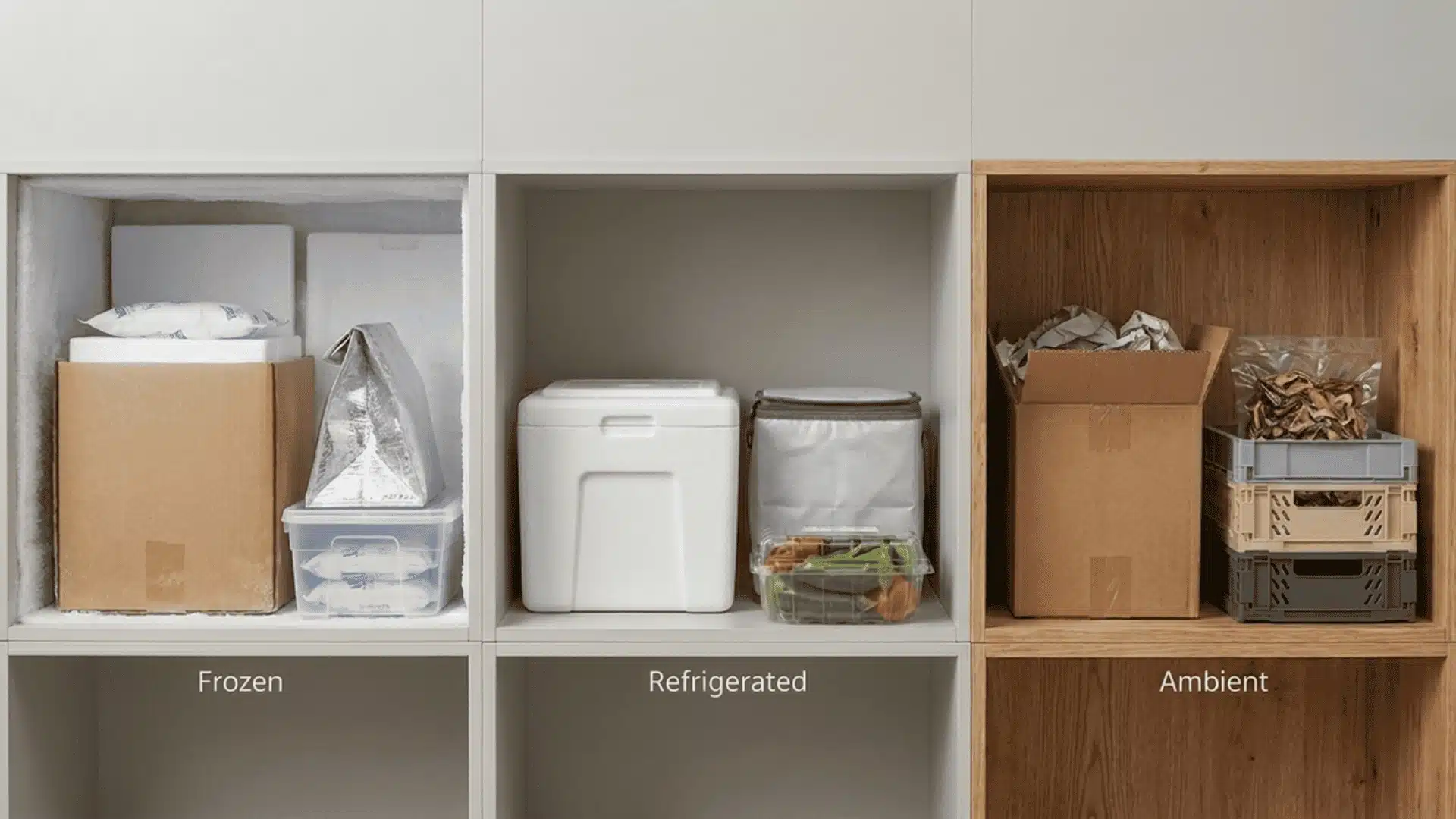
Not all temperature-sensitive products ship the same way. Each range has its own rules, and mixing them up damages products.
Frozen: Below −18°C / 0°F
Common products: Frozen seafood, ice cream, frozen biologics, clinical samples
| What It Needs | Why It Matters |
|---|---|
| Dry ice only | Gel packs phase-change at 0°C and cannot sustain sub-zero temperatures |
| 1.5-inch+ insulation wall | A large temperature differential means heat enters faster than in other ranges |
| Hazmat compliance | Dry ice off-gasses CO₂, enclosed packaging must account for this |
The critical mistake: Substituting gel packs for dry ice in frozen applications adds thermal mass but never maintains frozen temperature. The product thaws regardless.
Refrigerated: 2°C to 8°C
Common products: Vaccines, fresh meat, dairy, GLP-1 pharmaceuticals, diagnostics
| What It Needs | Why It Matters |
|---|---|
| Gel packs conditioned to 4°C | A 0°C gel pack touching the product can freeze it below the 2°C floor |
| Validated quantity | Too few exhaust the thermal budget. Too many over-cools. Both are failures |
| Lane-specific validation | A 25°C-validated packout fails at 38°C summer ambient and over-cools in winter |
The critical mistake: Estimating gel pack quantity instead of validating it. A pack count that holds 2°C to 8°C in summer heat sheds too much heat inside a cold winter trailer, pulling the product below the 2°C floor. Freezing a refrigerated product ruins it as completely as overheating does, which makes winter over-cooling a common and easily overlooked cause of refrigerated-lane failures, not just a summer-heat problem.
Ambient: 15°C to 25°C
Common products: OTC medications, cosmetics, confections, electronics
| What It Needs | Why It Matters |
|---|---|
| Reflective or foil-bubble liners | The primary threat is radiant heat, not sustained thermal assault |
| Two-direction buffering | Protection from heat spikes and freeze events is equal |
| Lightweight insulation only | EPS or vacuum panels add cost with no performance benefit at this range |
The critical mistake: Focusing only on summer heat protection. Confections, cosmetics, and liquid medications freeze just as easily in winter transit and the damage is equally real.
Why are These Ranges Not Interchangeable?
Each range faces a different thermal threat, demands a different refrigerant, and fails in a different way.
A frozen-grade packout on an ambient product wastes money.
An ambient-grade mailer on a refrigerated pharmaceutical fails the product entirely. The range determines everything that follows.
Passive, Active, Hybrid: How They Work and When They Fail?
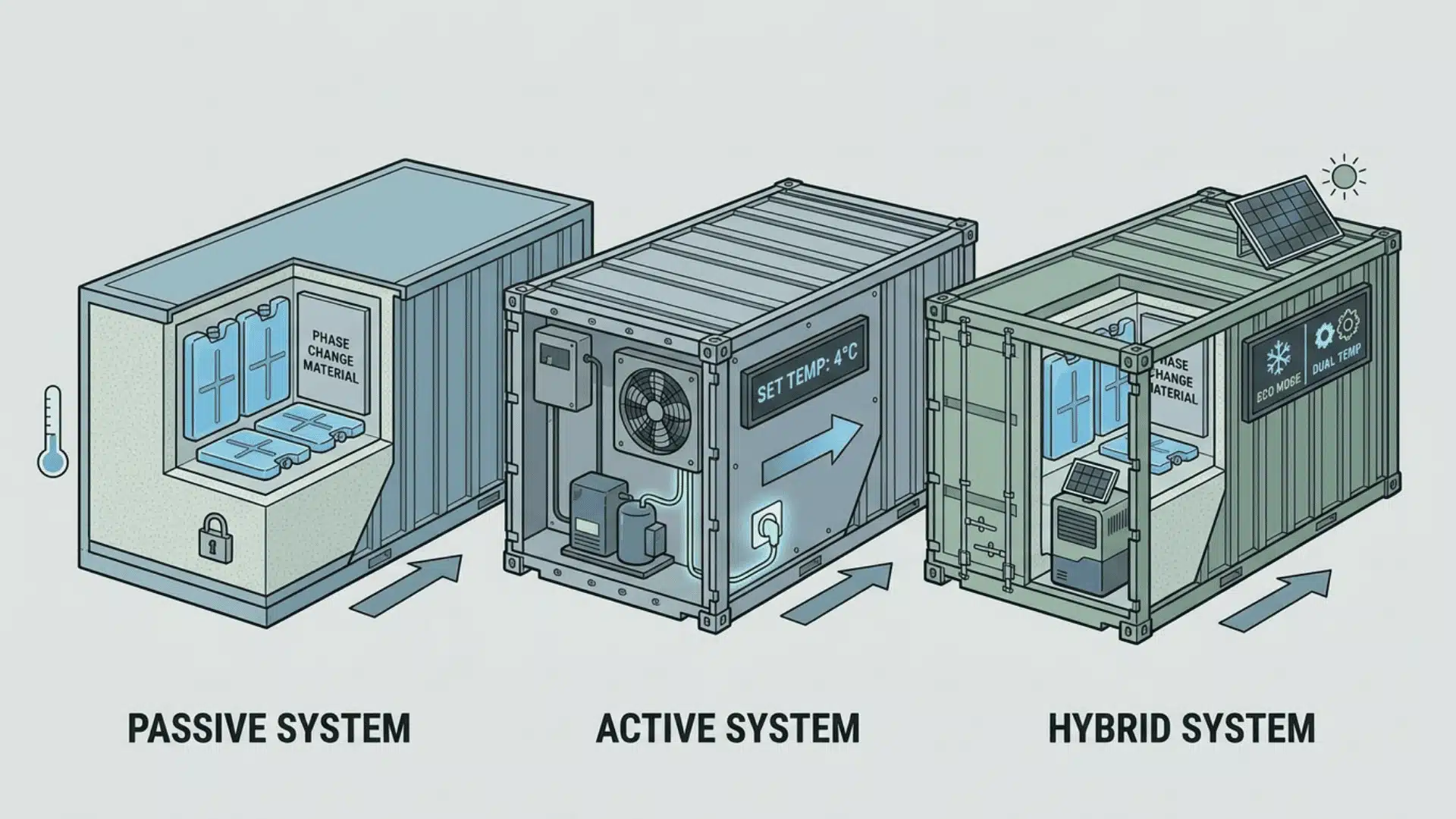
Same goal, three different strategies. Choosing wrong does not just reduce performance; it eliminates it.
Passive: Fixed from the Start
Passive systems rely on pre-conditioned insulation and refrigerants, with no external power or adjustment capability. Performance is determined before shipment begins and declines over time.
Phase-change materials (PCMs) offer precise temperature control by maintaining specific target temperatures rather than broad ranges, making them suitable for tightly validated pharmaceutical shipments.
Passive packaging performs reliably within validated transit windows, often up to 96 hours. Delays or extreme conditions can exhaust thermal capacity, causing temperature control to fail.
Active: Maintained Throughout
Powered refrigeration actively regulates temperature throughout transit, eliminating dependence on preconditioned thermal mass or fixed refrigerants loaded before shipment departure.
This is well suited to long routes, unpredictable transit times, and shipments where maintaining temperature continuously is more important than cost.
Active systems become less practical when shipment volumes are smaller or transit durations are shorter, as equipment, infrastructure, and operating costs increase.
Hybrid: Both Layers Together
Hybrid systems combine passive packaging with active refrigeration. The refrigerated environment handles most temperature control, while the packaging adds protection when refrigeration is unavailable.
This setup works well when cargo holds stay temperature-controlled, but products still face loading, unloading, customs, or last-mile delivery delays.
If active refrigeration fails for longer than expected and the passive packaging lacks sufficient thermal capacity, protection can run out before delivery is complete.
Primary Packaging Format Types and How Each Works
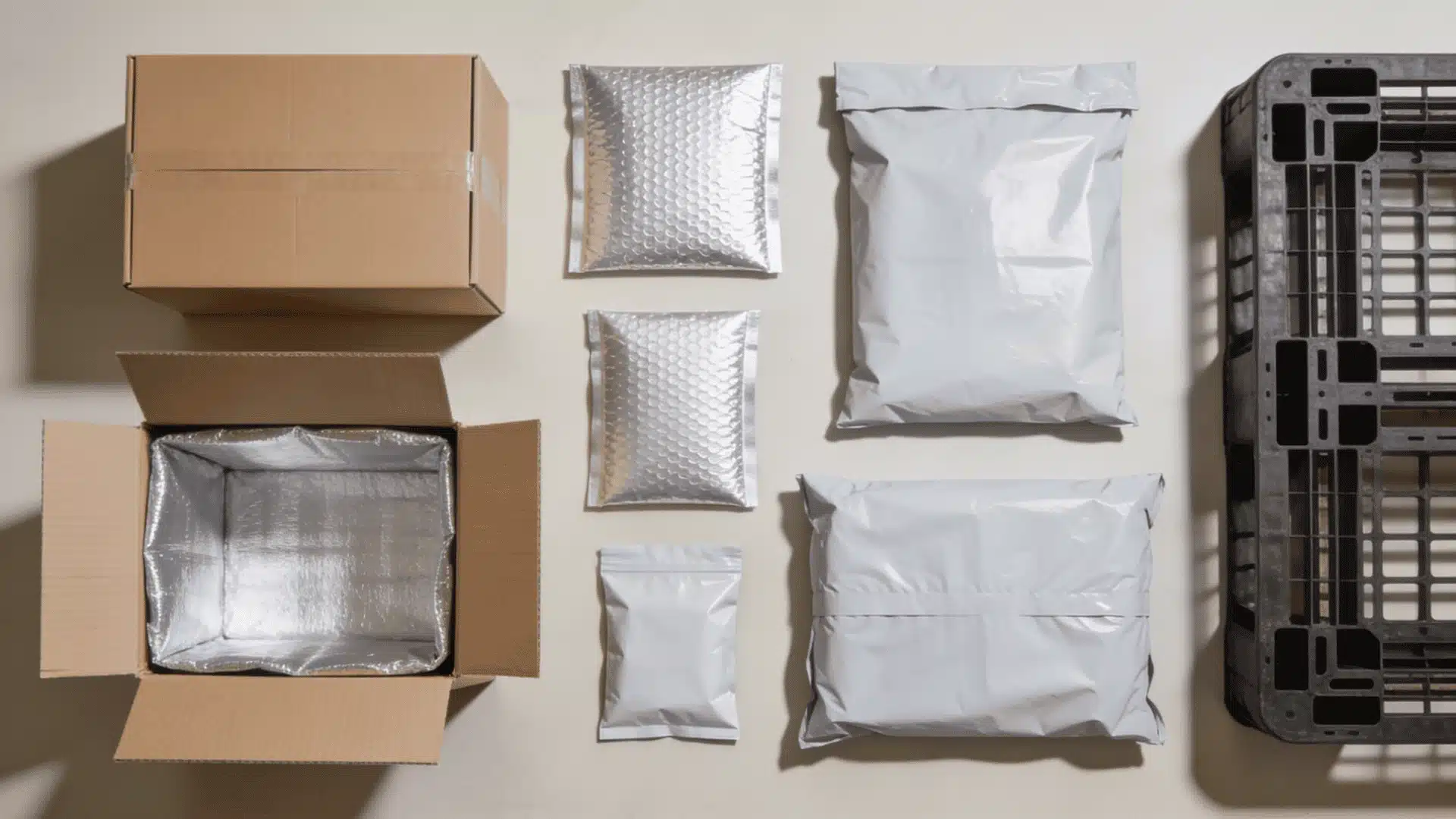
The right format depends on shipment size, transit duration, and temperature range, not preference.
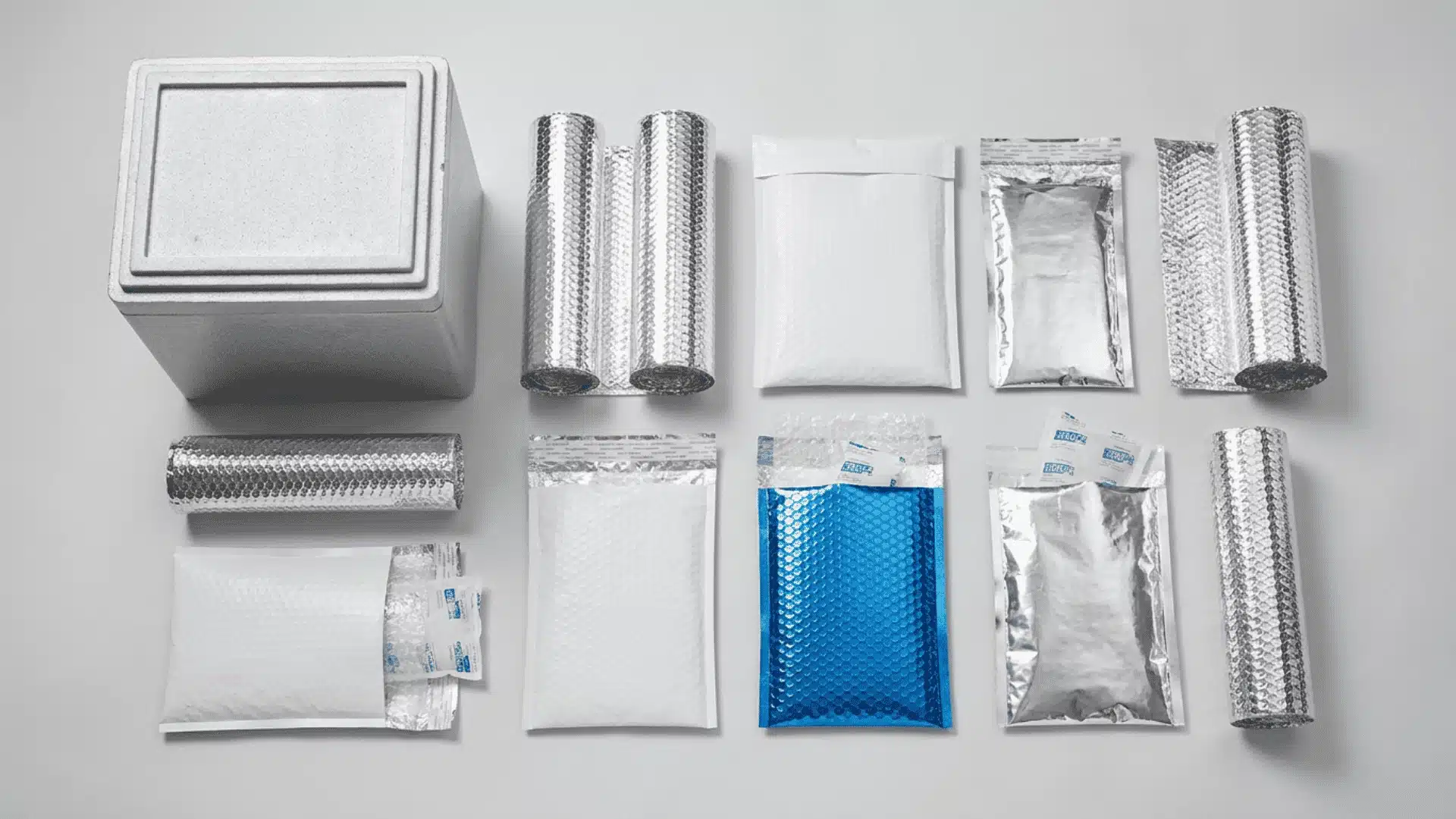
- Insulated Shippers: A corrugated box with a molded inner liner forming a sealed chamber. Best for pharmaceutical unit doses and direct-to-consumer shipments.
- Box Liners: An insulated insert inside a standard corrugated box. Swap the liner to change thermal performance without replacing the entire shipper seasonally.
- Pouches and Mailers: Flexible insulated envelopes for smaller shipments. Hold time is 24 hours maximum. Best for small pharmaceutical units and cosmetics on short lanes.
- Pallet Covers: Large-format reflective wrap for entire pallets. Extends the thermal window only at docks and transfer points. Does not replace refrigerated transport.
Every format solves the same problem differently. Matching the right one to your shipment is where temperature-controlled packaging actually begins.
Key Components and How They Work Together?
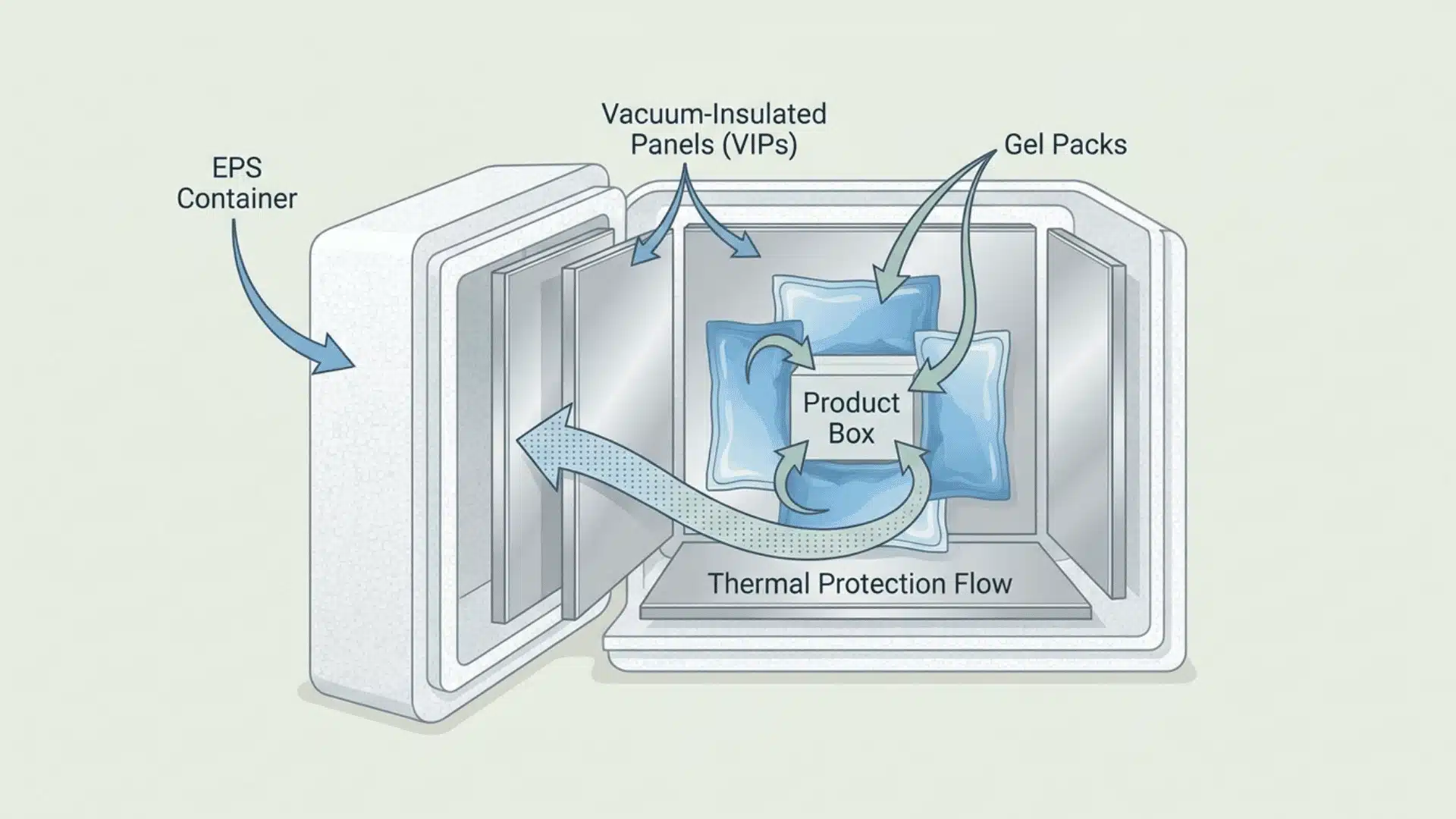
Components do not work in isolation.Every material and monitoring tool feeds into the format and system decisions.
Insulation determines how long the thermal boundary remains effective, while refrigerants define how much heat the system can absorb.
Monitoring confirms whether temperature excursions are detected early enough for corrective action. Without visibility, even a well-designed system can fail unnoticed.
The ideal combination depends on the selected system and shipping format. A 48-hour refrigerated lane requires a different thermal capacity than a 72-hour international route.
Insulation Materials
Insulation is the foundation of temperature-controlled packaging. It slows heat movement between the product and its surroundings, helping preserve thermal stability during transit.
- EPS (Expanded Polystyrene): Rigid, cost-effective, widely validated, but has a moderate R-value and is not curbside recyclable.
- Polyurethane (PUR/PU) Foam: Higher R-value and far more durable than EPS, molded into rigid shippers for extended refrigerated and frozen lanes, but heavier and more expensive per unit.
- Vacuum-Insulated Panels and Compressed Mylar Liners: Offer the highest R-value per inch but are expensive and puncture-sensitive; a single breach can kill performance.
- Foil-Bubble Composites: Lightweight and effective for ambient heat but insufficient on their own in frozen or extended refrigerated lanes.
- Paper-Based Insulation: Sustainable and emerging, suited for short ambient or refrigerated lanes only.
No insulation material is universally best. Performance depends on the temperature range, transit duration, sustainability goals, and the required level of thermal protection.
Refrigerant Types
Refrigerants do the active work of absorbing heat before it reaches the product.
- Gel Packs: Standard for refrigerated use must be fully frozen before packout, or the hold time is immediately lost.
- Dry Ice: The only viable frozen refrigerant requires hazmat compliance and off-gassing management throughout transit.
- Phase-Change Materials (PCMs): Precise target temperatures for tight pharmaceutical validation, more accurate than gel packs but at higher cost.
Each refrigerant serves a different purpose. Matching it to the temperature range and transit conditions determines whether temperature control succeeds or fails.
Temperature Monitoring
Monitoring provides proof that temperature requirements were maintained during transit. Without data, it is often impossible to verify product quality after delivery.
- Passive Indicators: Confirm a breach happened, but they provide no timestamp or duration data, making them insufficient for regulatory investigations.
- Data Loggers: Continuous timestamped temperature record throughout transit, required for pharmaceutical lot release and regulatory audits.
- Real-Time GPS Monitors: Live temperature transmission during transit, enabling proactive intervention before a threshold is breached.
The right monitoring level depends on product risk and compliance needs. Better visibility improves decision-making and helps prevent costly temperature-related losses.
Packaging Validation: Why Choosing the Right Materials isn’t Enough?
Picking the right materials is the starting point. Validation turns material choices into a proven cold chain solution.
Validation exposes packouts to ISTA summer and winter profiles for the required hold time. Pass or fail is set by product range.
Every lane is a different test. A domestic validation does not cover international routes with longer transit and additional loading exposure.
Winter recalibration is equally critical. The same refrigerant, passing summer validation, can over-cool the product below the lower threshold during winter transit.
A validated packout is not permanent. Every route change, season shift, or product update requires testing again from scratch.
When is Temperature Control Required and When is it a Choice?
Not every product ships under the same rules. Some face legal mandates. Others face market consequences.
| Elements | Pharmaceutical & Life Sciences | Food & Perishables | Cosmetics, Confections & Consumer Goods |
|---|---|---|---|
| Governing Framework | Good Distribution Practice (GDP) | Hazard Analysis and Critical Control Points (HACCP) | No legal framework |
| Temperature Requirement | 2°C to 8°C | Product-dependent critical control points | 15°C to 25°C recommended |
| Who Enforces It | Regulatory agencies via lot release documentation | USDA and FDA across meat, poultry, dairy, and produce | No enforcement body |
| Packaging Failure Is Classified As | A compliance failure requiring a documented lot release decision | A HACCP violation, not a quality complaint | A commercial or liability event |
| Consequence of Non-Compliance | The entire lot is rendered non-administrable regardless of appearance | Recall liability | Retailer chargebacks, product liability claims, reputational damage |
| Documentation Required | Continuous temperature records for every shipment | Temperature logs at critical control points | No mandate, but records support dispute resolution |
| Is It a Choice? | No | No | Commercially, yes, financially, no |
The absence of regulation does not reduce the financial stakes. Failure costs the same either way.
Conclusion
Temperature-controlled packaging is not a box category. It is a series of engineering decisions made before a shipment moves.
Every product has a thermal threshold. Every lane has conditions that test it. Correctly matching the two is what separates a protected shipment from an assumption.
The full picture, system type, refrigerant, validation, and compliance make one thing clear: each layer exists because the one before it is not enough on its own.
Start with the temperature range your product requires, then work outward. The right packaging decision follows from that single starting point.
Frequently Asked Questions
Can gel packs replace dry ice for frozen shipments?
No. Gel packs phase-change at 0°C and cannot sustain the sub-zero temperatures required for frozen applications. Once a gel pack reaches 0°C, it loses its ability to absorb additional heat, and the product begins warming immediately. Dry ice is the only viable refrigerant for shipments requiring temperatures below −18°C. Substituting gel packs adds thermal mass but never maintains a frozen state; the product thaws regardless of how much insulation surrounds it.
What is the difference between temperature-controlled packaging and cold chain?
The cold chain is the entire system, every step from manufacturing through storage, transit, and final delivery, that keeps a product within its required temperature range. Temperature-controlled packaging is one physical component within that system: the insulated box, liner, or shipper traveling with the product. A cold chain can fail at a warehouse, a transfer point, or a loading dock. Temperature-controlled packaging only governs what happens inside the package itself during transit.
What does CRT mean in shipping?
CRT stands for Controlled Room Temperature, defined as 15°C to 25°C. Despite the name, CRT shipments still require temperature-controlled packaging whenever ambient conditions fall outside that range, including hot summer freight lanes, unheated winter warehouses, and air cargo holds with variable climate control. CRT does not mean unpackaged or ambient shipping. Products in this range face freeze risk in winter transit just as readily as heat damage in summer.
How long can passive temperature-controlled packaging maintain its target range?
Passive systems typically hold their target range for 24 to 96 hours, depending on insulation type, refrigerant mass, and the ambient temperature profile the packout was validated against. Vacuum-insulated panels paired with phase-change materials can extend performance beyond 96 hours under standard conditions. Expanded polystyrene with gel packs generally performs reliably for 24 to 48 hours. Routing delays, seasonal temperature extremes, or packout errors reduce effective hold time across all passive formats.
When should a shipper use active rather than passive temperature-controlled packaging?
Active systems are appropriate when the transit duration exceeds the reliable hold time of available passive materials, when routes pass through extreme ambient temperature zones without climate-controlled infrastructure, or when the product has zero tolerance for any temperature excursion. For most standard 24 to 48-hour pharmaceutical or food shipments on domestic lanes, validated passive systems are sufficient. The decision is not primarily a cost trade-off; it is a function of transit duration, route predictability, and the consequence of a single failure.