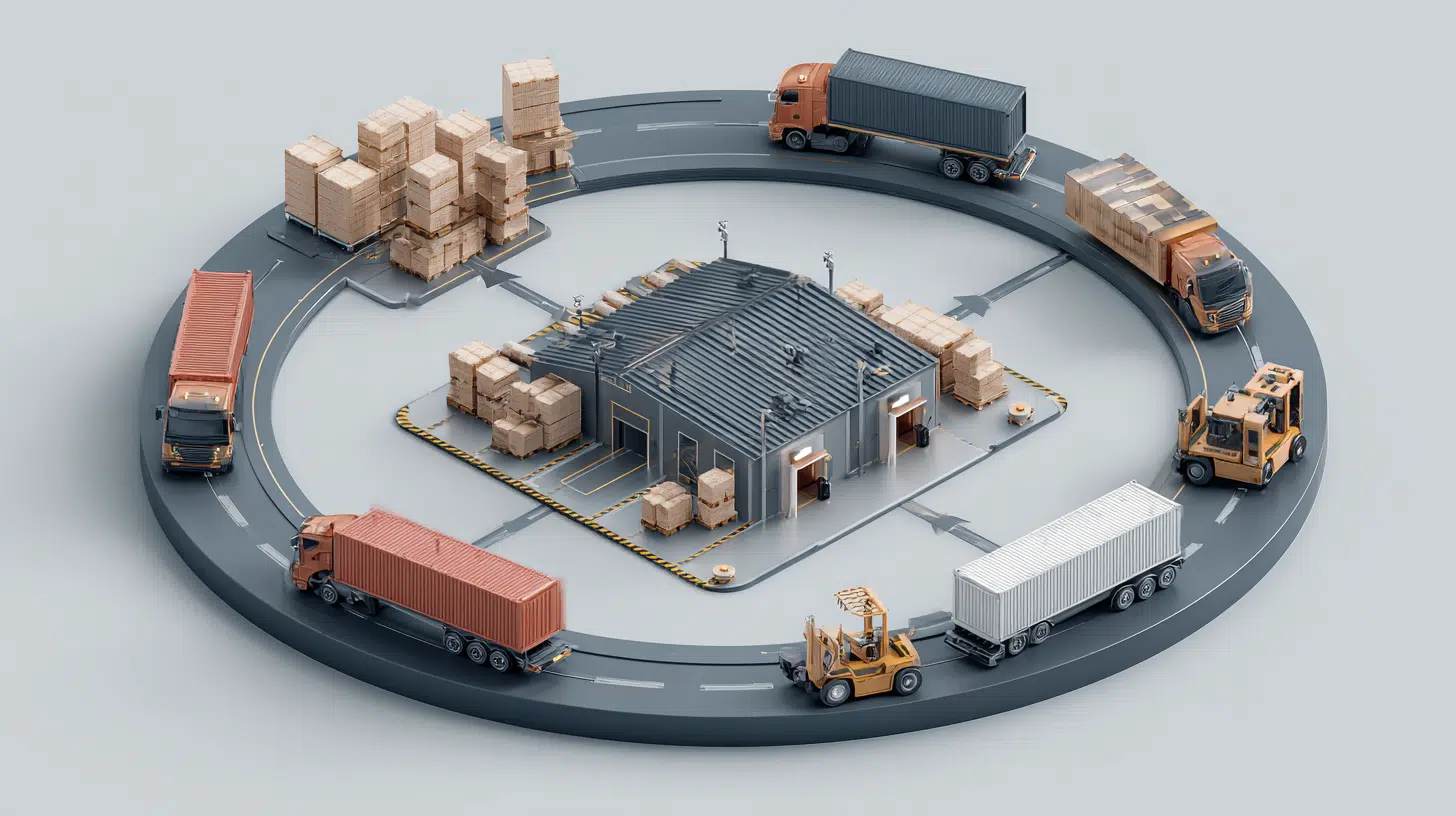
Logistics companies rarely suffer from a shortage of data. They suffer from data arriving too late, living in the wrong system or failing to reach the person who needs it.
A dispatcher knows a driver is behind schedule, but the customer service team does not. The warehouse changes the loading sequence, but the route plan still reflects the original order. A customer signs for a delivery, yet finance cannot find the proof needed to raise the invoice. Vehicles are busy all week, while nobody can explain why the routes remain unprofitable.
Good logistics software connects those moving parts. It helps a company plan work, execute it, capture evidence and understand the financial result. The strongest systems do not simply replace paper with screens. They remove a specific source of delay, uncertainty or cost.
For delivery operators, couriers, distributors, wholesalers, third-party logistics providers and field-service fleets, the following software categories solve some of the most persistent operational problems.
Courier Delivery Software: Five Strong Options
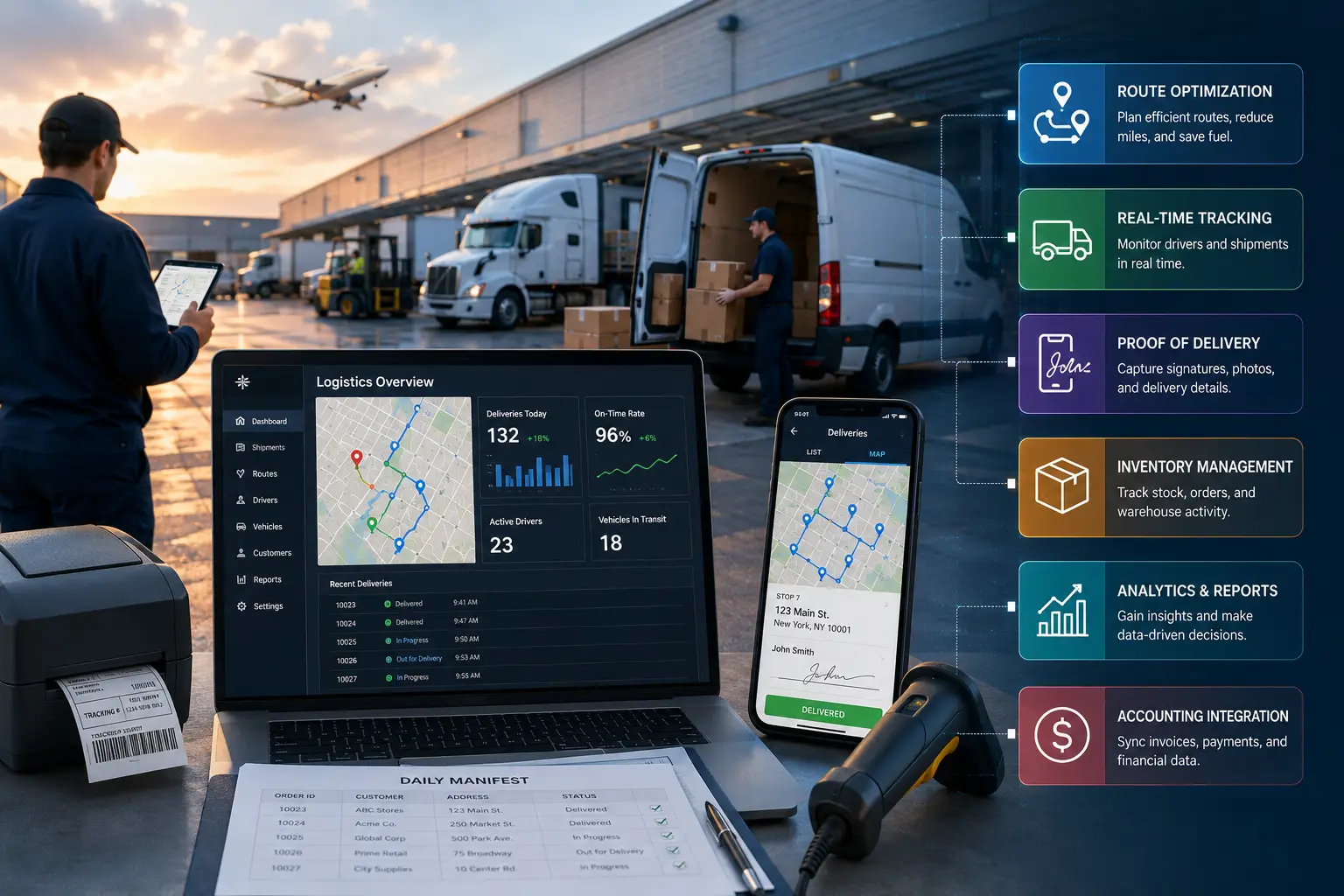
Courier delivery software brings route planning, dispatch, driver communication, delivery tracking and proof of delivery into one operational workflow. It helps dispatchers assign work, gives drivers clear stop information and allows customers to receive updates without repeatedly calling the office.
No single platform is best for every operator. A five-driver local courier needs something different from a national distributor managing hundreds of vehicles. These five options cover a useful range of business sizes and delivery models.
1. Spoke
Spoke takes the top position for growing courier teams that want route optimization and delivery management without an unnecessarily heavy enterprise system. Spoke Dispatch, formerly Circuit for Teams, is built around multi-driver routing, dispatch, real-time driver visibility, proof of delivery and live customer updates.
Its strength is practical usability. Routes can be created and assigned centrally, while drivers work through an app designed for daily delivery execution. It is a strong fit for local couriers, regional delivery teams, retailers and operators moving away from spreadsheets, messaging apps and manual route building.
Businesses with highly complex freight networks or deep multimodal requirements may still need a larger TMS, but Spoke is a well-focused option for professional last-mile teams.
2. Onfleet
Onfleet is well suited to delivery businesses that place a high value on customer communication and real-time visibility. Its platform combines route optimization, dispatch, GPS tracking, proof of delivery, automated notifications and branded tracking experiences.
It can work particularly well for retail delivery, food and beverage, healthcare, ecommerce and scheduled local distribution. Its integration options also make it useful for businesses that want delivery tasks to flow from an ordering, point-of-sale or ecommerce system.
For a very small fleet, the platform may offer more functionality than the company immediately needs. For an established operator seeking polished customer-facing tracking, however, Onfleet deserves serious consideration.
3. Route4Me
Route4Me has a strong route-optimization focus and can support more complicated operating rules. The platform covers route planning, dispatch, GPS tracking, customer notifications, proof of delivery and business constraints such as time windows, mixed vehicle types and driver requirements.
It is a good candidate for operators whose routes cannot be solved by simple stop sequencing. That might include distributors managing territories, fleets with different vehicle capacities or businesses balancing pickups and deliveries.
The tradeoff is that a broad, configurable platform may require more setup than a smaller courier team expects. Companies should test it with real routes rather than judging it from a feature checklist.
4. OptimoRoute
OptimoRoute is designed for both delivery and field-service scheduling. It can account for time windows, priorities, driver skills, vehicle characteristics, variable job durations, reverse-logistics orders and capacity limits.
That flexibility makes it useful for businesses where drivers do more than leave a parcel at the door. Appliance delivery, installation, repair, collection and service work can all require meaningful time at each location.
Operators running straightforward parcel routes may not need every scheduling feature. Companies combining deliveries with site work, collections or specialist vehicle requirements are more likely to benefit.
5. Track-POD
Track-POD combines delivery scheduling, route optimization, live vehicle tracking, electronic proof of delivery, notifications and analytics. It also supports delivery documentation such as delivery notes and bills of lading.
This makes it especially relevant for distributors, wholesalers and logistics teams that need stronger documentation alongside route execution. Its proof-of-delivery and transport-management features can help connect dispatch activity with invoicing and customer records.
As with any broad platform, implementation quality matters. Workflows, document templates and driver processes should be configured carefully rather than copied from an old paper system without review.
Transportation Management Software: The Control Layer

A transportation management system, or TMS, coordinates the broader movement of goods. It can support planning, carrier selection, rates, shipment execution, documentation, freight tracking and reporting across inbound and outbound transportation.
This is broader than route planning. A route planner focuses on how a driver serves a set of stops. A TMS may coordinate multiple carriers, warehouses, modes, regions and customer contracts.
Oracle defines a TMS as a logistics platform used to plan, execute and optimize the physical movement of goods while supporting documentation and compliance. That makes it especially relevant for businesses managing a mixture of owned vehicles, subcontracted carriers, line-haul movements and final-mile delivery.
A TMS can help solve problems such as:
- Different departments booking freight independently
- Carrier rates stored in spreadsheets
- Weak visibility across subcontracted shipments
- Repeated manual data entry
- Missed documentation
- Poor comparison between planned and actual transport costs
- Difficulty measuring performance by lane, carrier or customer
Smaller delivery companies may not need a full enterprise TMS. For them, a focused dispatch platform may be easier to implement. A multi-site logistics company, however, can quickly outgrow separate routing, carrier and reporting tools.
Warehouse Management Software: Fixing Errors Before the Van Leaves
A failed delivery often begins in the warehouse.
The wrong product is picked. A parcel is loaded onto the wrong vehicle. The final stop is placed at the front of the cargo area while the first delivery is buried behind it. A return enters the building but never makes it back into available inventory.
Warehouse management software creates control over receiving, storage, picking, packing, staging, loading and returns. A WMS gives the business visibility into inventory and manages fulfillment activity as products move through the warehouse and toward the customer. (Oracle)
For delivery businesses, the most valuable connection is between the warehouse plan and the route plan. If the routing system changes the stop sequence, the loading process should reflect that change. Otherwise, a perfectly optimized route can still be undermined by a badly loaded vehicle.
Useful WMS functions include:
- Barcode-based receiving and picking
- Inventory location control
- Batch, lot and expiration tracking
- Route staging
- Load verification
- Returns processing
- Damaged-stock reporting
- Stock-count reconciliation
- Labor and task allocation
A WMS becomes particularly important when the company carries inventory on behalf of customers, operates multiple depots or handles high volumes of similar-looking products.
Electronic Proof of Delivery: Turning Completion Into Evidence
A driver marking a stop “complete” is not always enough.
Customers may dispute quantity, condition, time, location or the identity of the recipient. Finance may need delivery evidence before invoicing. Regulated goods may require a signature, identification check or chain-of-custody record.
Electronic proof-of-delivery software can capture:
- Recipient names
- Signatures
- Time stamps
- GPS coordinates
- Photographs
- Barcode scans
- Package condition
- Delivery notes
- Reasons for failure
- Return quantities
The evidence should be attached to the correct order automatically. A photograph sitting in a driver’s personal camera roll has limited operational value. It needs to be searchable by job, customer, date and route.
Zebra’s transportation systems combine mobile hardware, scanning and software to capture delivery data from the facility through the final stop. That reflects an important principle: proof of delivery works best when it is part of the full order flow rather than an isolated signature app. (Zebra Technologies)
Fleet Telematics: Seeing How Vehicles Are Actually Used
Route software knows what should happen. Telematics shows what happened on the road.
Fleet telematics can collect GPS position, mileage, fuel or energy use, engine diagnostics, idling, harsh braking, speeding and other vehicle data. Logistics platforms may then connect that information with route progress, maintenance and driver-safety workflows. (samsara.com)
Useful telematics questions include:
- Which routes regularly run late?
- Where are vehicles idling?
- Are drivers following the planned sequence?
- Which vehicle is approaching a service interval?
- Is one depot creating unusual empty mileage?
- Are certain routes associated with harsher driving?
- How much energy do electric vehicles consume by route type?
The value lies in focused exception reporting. A fleet manager does not need to watch dots moving across a map all day. The software should surface the activity that requires action.
Vehicle Maintenance Software: Preventing the Expensive Breakdown
A delivery vehicle does not have to suffer a complete engine failure to damage the operation. A warning light, tire problem or overdue service can remove capacity on the busiest day of the week.
Maintenance software tracks inspections, mileage, defects, repairs, warranties, parts and service schedules. When connected with telematics, odometer readings and diagnostic alerts can enter the maintenance process automatically.
A useful system should allow drivers to report defects quickly, preferably through the same device they use for delivery work. It should also distinguish between a cosmetic issue, a fault to monitor and a safety-critical defect that removes the vehicle from service.
Useful measures include:
- Unplanned downtime
- Cost per vehicle
- Repeat repair frequency
- Days out of service
- Maintenance cost per mile
- Preventive versus reactive work
- Warranty recovery
- Parts availability
A fleet that measures delivery performance but ignores vehicle health is measuring only half the operation.
Customer Communication Software: Reducing “Where Is My Order?” Calls
Customer communication should be triggered by delivery events, not by optimistic guesses.
A useful notification flow might include:
- Order confirmed
- Delivery date scheduled
- Estimated time window issued
- Driver approaching
- Delay identified
- Delivery completed
- Attempt unsuccessful
- Redelivery or collection instructions
The quality of the estimated arrival time matters more than the number of messages. Customers will tolerate a sensible two-hour window more readily than an exact time that repeatedly changes.
Business-to-business recipients may need different information from consumers. A warehouse may care about dock time, pallet count and delivery references. A homeowner may simply want a tracking link and arrival alert.
The software should support those differences rather than forcing every customer into the same communication sequence.
Accounting Software: Understanding the Profit Behind the Route
Delivery software can show that a route was completed. Accounting software determines whether that route made money.
A logistics company needs to combine operational data with:
- Driver payroll
- Contractor payments
- Fuel or charging costs
- Vehicle depreciation
- Repairs and maintenance
- Insurance
- Tolls
- Warehouse costs
- Software subscriptions
- Failed-delivery expense
- Customer credits
- Interest expense
This allows management to calculate contribution margin by route, customer, depot or vehicle type.
A high-revenue account can still be unprofitable if it produces long waiting times, awkward time windows and repeated redelivery. Without integrated financial reporting, that problem can remain hidden behind a healthy-looking sales figure.
Accounting for Debt Under ASC 470
Debt is common in logistics. Companies borrow to purchase trucks, vans, warehouse equipment, scanning hardware and automation systems. They may use revolving credit to fund fuel, payroll and seasonal working capital. Larger operators may issue notes or bonds to finance acquisitions and distribution facilities. Accounting for debt under ASC 470 isn’t too complex, but it pays to read up on it and make sure your processes are on point.
Under U.S. GAAP, ASC 470 provides the primary accounting and reporting guidance for debt obligations, including loans, notes, bonds, convertible debt and certain other contractual obligations to pay money. ASC 210 also informs current and noncurrent balance-sheet classification, while related guidance addresses interest and issuance costs.
Consider a delivery company that obtains a $2 million five-year term loan to finance vehicles and warehouse automation. The company records the debt liability and separately records the assets purchased. The loan proceeds are financing, not revenue.
Each payment must then be separated between:
- Interest expense
- Reduction of principal
- Any lender fees or issuance-cost amortization
The principal portion reduces the debt liability. It does not pass through operating expense. Interest and qualifying cost amortization affect earnings over the debt term.
Qualifying debt issuance costs associated with term debt are generally presented as a direct deduction from the carrying amount of the related debt liability. They are then amortized through interest expense using the interest method. A $2 million loan with $40,000 of qualifying issuance costs may therefore appear initially at a net carrying amount of $1.96 million, even though the contractual principal remains $2 million. (viewpoint.pwc.com)
Classification also matters. Long-term obligations are ordinarily presented as noncurrent, while amounts due within the relevant near-term period are generally current. A covenant violation can force debt into current classification if the lender has not provided an effective waiver or the relevant conditions for noncurrent presentation are not met. For a logistics business with tight working capital, that reclassification can significantly change liquidity ratios and lender conversations. (viewpoint.pwc.com)
Debt accounting becomes more complicated when terms are renegotiated. Logistics companies frequently refinance vehicles, extend revolving facilities or modify loans during acquisitions and fleet expansion.
ASC 470-50 requires an analysis of whether changed terms represent a modification or an extinguishment. For many term-debt exchanges with the same creditor, the company applies a 10% cash-flow test, alongside qualitative considerations, to determine whether the new terms are substantially different. (dart.deloitte.com)
If the transaction is an extinguishment, the old debt is derecognized, the new arrangement is recorded, and a gain or loss may be recognized. If it is a modification, the existing debt generally remains, a new effective interest rate is calculated and remaining discounts, premiums or issuance costs are normally carried forward, subject to the detailed rules. The treatment of lender fees and third-party costs also differs between the two outcomes. (dart.deloitte.com)
Revolving credit facilities have their own considerations. Changes to a line of credit may require a borrowing-capacity analysis rather than the same analysis used for ordinary term debt. Treating every refinancing as a simple replacement can therefore produce the wrong accounting result. (dart.deloitte.com)
A logistics finance team should maintain a debt schedule showing:
- Original principal
- Net carrying amount
- Interest rate
- Effective interest rate
- Payment dates
- Current and long-term portions
- Unamortized issuance costs
- Covenant requirements
- Maturity dates
- Collateral
- Modification history
The debt schedule should reconcile to lender statements and the general ledger every reporting period. It should also feed cash forecasting, because a profitable delivery operation can still face liquidity pressure if debt maturities cluster in the same period.
Yard, Dock and Appointment Scheduling Software
Some delivery failures happen because a vehicle reaches the right location at the wrong time.
Dock and yard scheduling software coordinates appointments, gates, loading bays, trailers and warehouse teams. It can reduce queues and improve communication between carriers, drivers and receiving locations.
This is especially valuable for:
- Grocery distribution
- Building materials
- Furniture and appliances
- Multi-tenant warehouses
- High-volume wholesale operations
- Manufacturers with timed collection slots
For the carrier, appointment data should flow into route planning. A 10:00 a.m. dock booking is not a suggestion; it is a routing constraint.
Returns and Reverse-Logistics Software
Returns are frequently treated as an exception even when they happen every day.
Reverse-logistics software manages collections, condition assessments, return reasons, replacement orders, repairs, recycling and restocking. It helps the company understand whether a returned item should go back to inventory, to a repair center, to disposal or directly to another customer.
A strong returns workflow records:
- Return authorization
- Collection status
- Item condition
- Photographic evidence
- Reason codes
- Refund or replacement status
- Restocking decision
- Final disposition
Without a defined system, returns sit in warehouse corners, customer credits remain open and the same operational problem repeats without being measured.
Analytics and Artificial Intelligence: Useful Only When the Data Is Clean
Analytics can reveal patterns that individual route reports cannot.
A logistics dashboard might compare:
- Planned versus actual mileage
- On-time performance by depot
- Failed deliveries by customer
- Stops per driver hour
- Cost per delivery
- Waiting time by location
- Vehicle utilization
- Route profitability
- Customer complaint trends
Artificial intelligence can assist with forecasting, ETA prediction, anomaly detection, dispatch recommendations and document processing. It cannot rescue incomplete addresses, inconsistent status codes or unreliable cost data.
Before investing in advanced analytics, standardize the basics. Every depot should use the same definition of “on time.” Every failed delivery should have a reason code. Every route should use accurate driver and vehicle data.
Clean operational language creates usable intelligence.
Integration Matters More Than Feature Count
A company can own excellent software and still run a fragmented operation.
An order might enter through the customer portal, be copied into the WMS, exported into routing software, texted to a driver and manually entered into accounting after delivery. Every handoff creates delay and error risk.
A better workflow might look like this:
- Customer order enters the central system.
- Inventory is allocated in the WMS.
- The order flows into route planning.
- The driver completes the delivery and captures proof.
- Delivery status updates the customer automatically.
- Completed work triggers invoicing.
- Revenue and route cost appear in management reporting.
Integration does not require every system to come from the same vendor. It requires clear ownership of data and reliable connections between platforms.
How to Choose the Right Logistics Software
Begin with the problem, not the vendor demonstration.
Write down where the company loses money or credibility. It may be route planning, warehouse errors, unanswered customer calls, delayed invoicing, vehicle downtime or weak debt reporting.
Then test software against real work.
Use actual addresses. Include the awkward customer who accepts deliveries only between 9:15 and 9:45. Add the rural route with poor mobile service. Test a damaged parcel, a failed delivery and a last-minute driver absence.
Ask:
- Can staff understand the workflow?
- Does it work on the hardware drivers already use?
- Can it operate offline?
- Does it integrate with accounting and order systems?
- Can the company export its data?
- Are permissions and audit trails adequate?
- What happens during peak volume?
- How are implementation and support handled?
- What does the full cost become as the fleet grows?
A successful pilot should measure outcomes: planning time, mileage, stops per hour, failed deliveries, invoice speed and customer contact volume.
Final Thoughts
The best software for logistics and delivery companies is software that makes expensive problems visible and manageable.
A TMS coordinates transportation. A WMS prevents warehouse errors. Courier delivery software improves routes, dispatch and customer updates. Telematics shows how vehicles are being used. Electronic proof of delivery protects revenue. Accounting systems reveal whether the operation is profitable, while proper ASC 470 debt accounting keeps financing costs and obligations visible.
Spoke is a strong first choice for many growing courier operations, but the correct platform depends on route complexity, fleet size, documentation needs and customer expectations.
A logistics technology stack should make the operation easier to explain. Dispatchers should know what is late. Drivers should know what comes next. Customers should know when to expect the delivery. Finance should know whether the work made money.
When those answers live in connected systems rather than individual inboxes and spreadsheets, the business can grow without multiplying confusion.