For decades, copper has been treated as one of the dependable constants of electrical design. Engineers specify conductor sizes, busbar dimensions, cable requirements or fabricated components, then procurement finds the material. The assumption is that copper will be available in the required form when needed.
That assumption is becoming less comfortable.
The International Energy Agency’s 2026 Global Critical Minerals Outlook expects copper to record the largest absolute volume increase among key energy minerals, adding about 7 million tonnes of demand by 2040 under its stated-policies scenario. Australia’s Department of Industry, Science and Resources also expects global demand to strengthen from 2027, driven by clean energy technologies, data centres and wider electricity infrastructure, while supply growth remains gradual.
For electrical contractors, switchboard manufacturers, engineering consultants and project managers, the important question is not whether the world will “run out” of copper. It is whether the exact material a project needs will be available at the right specification, quantity and date.
That turns availability from a purchasing concern into a design constraint.
Availability Is More Specific Than Tonnage
Commodity headlines flatten copper into a single number: tonnes produced, tonnes consumed, price per tonne. Projects do not buy theoretical tonnes. They buy particular products.
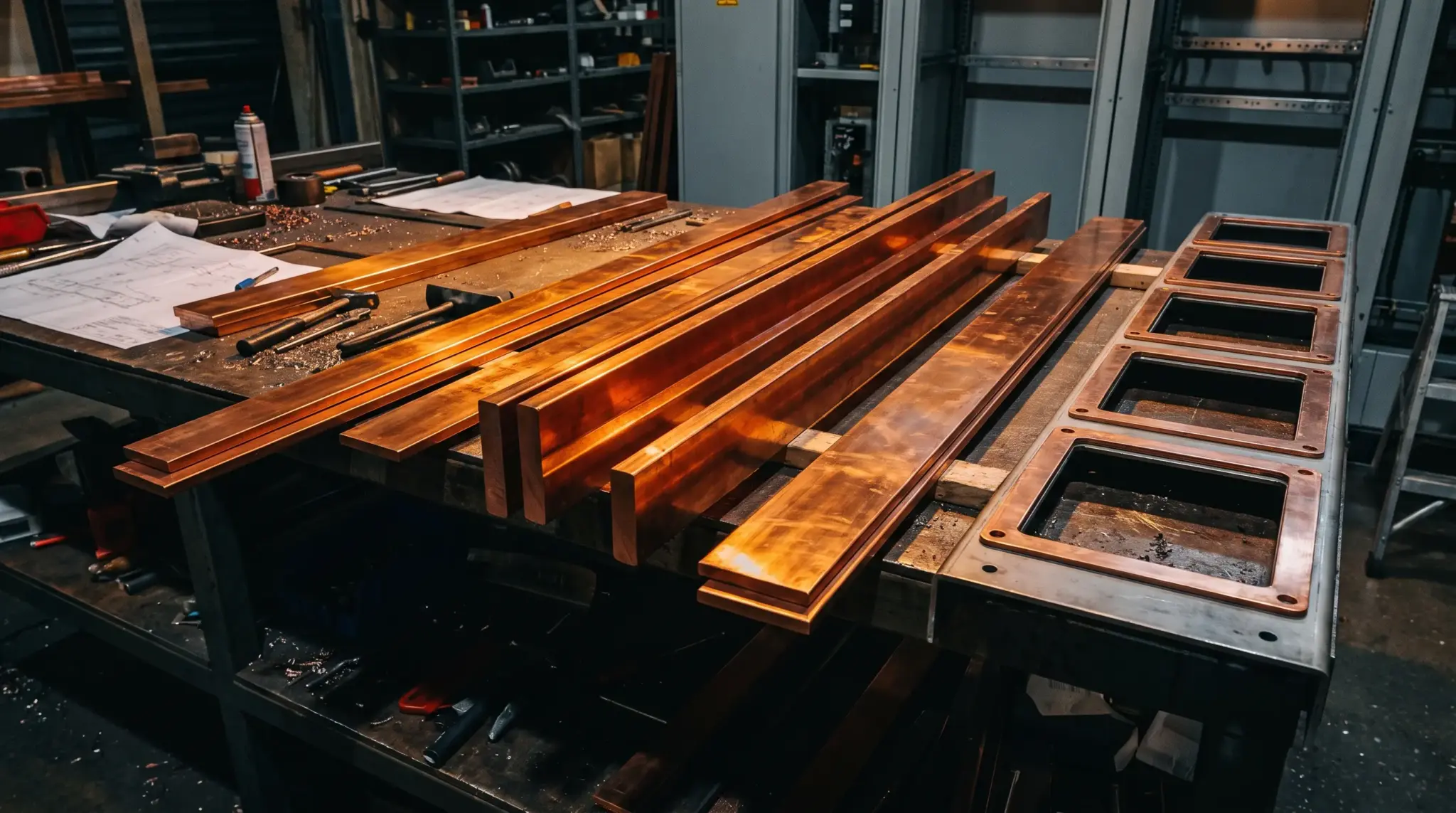
A switchboard manufacturer may need flat copper bar in a defined width and thickness. A fabricator may need sheet within a narrow gauge range. Another project may require tube, rod, coil, a particular alloy or a non-standard cut size. Standards, tolerances and certification can all matter.
This creates an important distinction between copper supply and usable copper availability. A market can have metal in circulation while an individual project still struggles to obtain the form it needs within its programme.
That is why experienced buyers increasingly speak with copper suppliers before treating a material specification as settled. The question is no longer simply, “Can this be manufactured?” It is also, “Can this be manufactured from material we can reliably source?”
A technically valid specification can still be commercially fragile.
The Design Freezes Before the Supply Chain Does
Electrical projects operate through progressive commitment. Early drawings leave room for options. Detailed design removes some of them. Procurement removes more. Fabrication removes almost all of them.
An engineer might design around a preferred bar dimension because it produces an efficient arrangement inside an enclosure. Months later, procurement discovers that the dimension is not readily stocked, the minimum order is excessive, or the lead time no longer fits the build programme. The team must then wait, pay for custom processing, change the design or qualify an alternative.
Each decision can touch thermal calculations, clearances, support spacing, enclosure geometry, fabrication drawings and testing documentation.
This suggests a useful rule: design optionality has a shelf life. The later an availability problem is discovered, the more expensive the answer becomes.
The Contradiction Between Optimisation and Resilience

Engineering teams are rewarded for precision. Procurement teams are rewarded for cost, availability and continuity. Those priorities are compatible in theory but can conflict in practice.
A highly optimised design may depend on one specific material form. A slightly less elegant design may accommodate two or three readily available sizes with only minor performance differences. The first may look better on paper. The second may be more resilient in the real world.
Standardisation can look like compromise until the supply chain tightens. Then flexibility becomes an engineering advantage.
The IEA expects copper demand to keep rising because of electricity networks and next-generation technologies, while projecting that announced supply will still fall short of future primary requirements. That does not mean every project will face shortages. It does mean there is less reason to assume historical sourcing patterns will remain frictionless.
Why Teams Leave the Conversation Too Late
There is also a behavioural reason availability is often tested late.
Design work feels controllable. Engineers can calculate, model, revise and approve. Supply conditions are external and uncertain, so teams often postpone the conversation until there is a bill of materials substantial enough to quote.
Psychologically, that is understandable. Operationally, it creates a trap: the desire to avoid premature procurement discussions can produce premature design certainty.
Early supplier conversations can establish whether common thicknesses, bar dimensions, alloys and product forms are normally stocked, which items require mill orders, where minimum quantities apply, and what alternatives can be designed in without compromising performance.
The aim is not to outsource engineering decisions. It is to stop engineers making decisions with incomplete supply-chain information.
Material Intelligence Belongs Earlier in the Project
Nobody waits until fabrication to check enclosure dimensions, thermal limits or fault levels. Availability deserves similar attention when a component depends on a specific copper form.
For standard work, this may be a quick verification exercise. For unusual profiles, special alloys, custom coatings, slit coil, non-standard sheet sizes or fabricated parts, it may require much earlier engagement. These are all examples of product and processing requirements that can sit outside straightforward off-the-shelf purchasing.
The commercial value is not necessarily a lower copper price. It is fewer late substitutions, drawing revisions, urgent freight decisions and instances in which workshop labour is ready but material is not.
A purchasing department can negotiate price. It cannot negotiate back a week already lost from the programme.
Designing for a Less Predictable Supply Environment
Copper will remain central to electrical systems because of the properties that made it useful in the first place. What is changing is the confidence with which project teams can treat availability as somebody else’s problem.
The best response is not to redesign around hypothetical shortages. It is to identify where a project has single points of material dependency and validate them early.
That means asking which dimensions are readily available, where acceptable alternatives exist, which products require custom processing and how much programme risk sits behind an ordinary line item.
As electrical demand expands across grids, buildings, renewables, industrial equipment and data centres, capable copper suppliers will increasingly be part of that early information loop, not merely the final purchasing transaction.
The broader lesson is simple: supply resilience begins at the drawing board. When availability can force a redesign, it is already a design constraint.