Shipping freight seems simple at first, but when the invoice arrives, it often contains unexpected charges that can make the process feel much more complicated.
Less than truckload (LTL) shipping offers a balanced solution. It’s cost-efficient for regular shipments and doesn’t require a dedicated trailer, making it ideal for businesses that don’t need to fill a full truck.
The difference between a smooth, affordable LTL shipment and an expensive one lies in the decisions made before the freight leaves the dock. Small adjustments to packaging, scheduling, or delivery can lead to significant cost savings.
Understanding the details before booking your next shipment can help you avoid unpleasant surprises and get the best deal.
What is Less Than Truckload (LTL) Shipping?
Less-than-truckload (LTL) shipping is a freight method for shipments that are too large for parcel shipping but not big enough to fill an entire truck trailer.
LTL shipments typically weigh between 150 and 15,000 pounds. Freight under 150 pounds is usually better suited for parcel carriers, while shipments above 15,000 pounds may qualify for volume LTL or full truckload pricing.
In LTL shipping, multiple businesses share space in the same trailer. The carrier consolidates freight from different shippers and transports it through a network of terminals, with each shipper paying only for the space their freight occupies.
How Does LTL Shipping Work?
LTL shipping is ideal for palletized freight, such as boxes or palletized equipment. It makes loading and unloading easier and more efficient.
- Shared Trailer System: Shipments from different businesses are consolidated at terminals.
- Optimized Space: Multiple shipments share a single trailer, reducing each shipper’s costs.
- Efficient Transport: Freight is moved through a network of terminals, ensuring timely delivery.
- Cost-Effective: Businesses only pay for the space their freight occupies, reducing transportation expenses.
LTL shipping offers cost savings, efficiency, and convenience by consolidating shipments, making it a smart choice for businesses.
What Does LTL Shipping Include?
LTL shipping moves freight through a shared carrier network, where shipments from multiple businesses travel together until they reach the final destination.
This is done through a hub-and-spoke network, where regional terminals (the spokes) collect local pickups and send them to larger distribution hubs. From there, the freight is sorted and dispatched toward the destination region.
The shared-trailer system allows most national LTL carriers to cover long distances efficiently by utilizing dozens of terminals across their service areas.
Freight goes through several stages, each helping reduce shipping costs while maximizing trailer space.
Stages of LTL Shipping
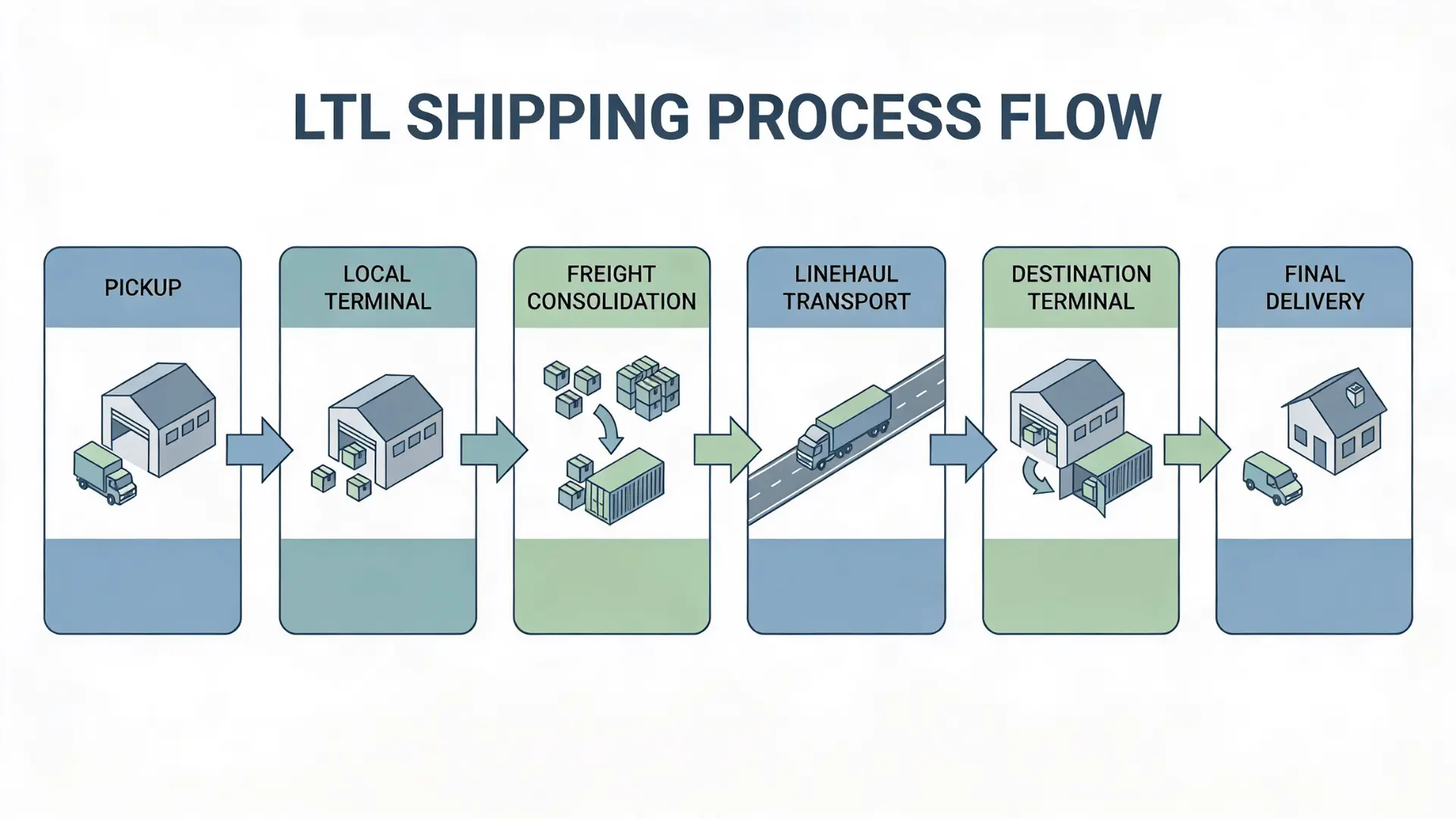
The LTL shipping process involves several stages that ensure freight is handled, transported, and delivered to the final destination efficiently.
- Pickup: The carrier collects palletized freight from the shipper and checks shipment details using the Bill of Lading (BOL).
- Terminal Entry: Freight is delivered to a local terminal, where shipments are sorted by destination and delivery region.
- Consolidation: Shipments moving in the same direction are combined into shared trailers to improve efficiency.
- Linehaul: The freight travels long distances between regional terminals on linehaul trucks, passing through multiple transfer points.
- Final Delivery: Upon arrival at the destination terminal, freight is loaded onto a local truck for delivery to the receiver.
Each stage of LTL shipping plays a crucial role in efficiently moving freight, ensuring accurate, timely delivery at minimal cost.
LTL Shipping vs. Other Freight Methods
LTL shipping is often confused with FTL, parcel, and LCL shipping, but each method serves different shipment sizes, distances, and transport needs.
Here is how they compare:
| Feature | LTL Shipping | FTL Shipping | Parcel Shipping | LCL Shipping |
|---|---|---|---|---|
| Full Form | Less-than-truckload | Full truckload | — | Less-than-container-load |
| Transport Type | Truck freight | Truck freight | Ground/air | Ocean freight |
| Trailer/Space Use | Shared truck trailer | Dedicated trailer | Individual packages | Shared shipping container |
| Freight Movement | Moves through terminals | Usually moves directly | Conveyor and package systems | Port-to-port via container |
| Handling | Multiple handling points | Minimal handling | Conveyor and package systems | Multiple handling points |
| Weight Range | 150–15,000 lbs | 15,000+ lbs | Under 150 lbs | Varies by container |
| Best For | Medium-sized freight | Large or urgent freight | Small package delivery | International cargo shipping |
| Transit Speed | Usually slower | Usually faster | Fast for small packages | Slowest; ocean transit |
The right method depends on shipment size, urgency, and whether the freight is moving domestically or internationally.
When Should You Use LTL Shipping?
LTL shipping works best for freight shipments that do not need a full trailer and can move through a shared terminal network. It is commonly used for palletized freight with flexible delivery timelines.
It works well when:
- The freight is palletized properly
- The shipment does not require urgent delivery
- Standard terminal handling is acceptable
- Freight class details are accurate
Residential and limited-access deliveries can also move through LTL networks with the right accessorial services.
| Good Fit for LTL Shipping | Poor Fit for LTL Shipping |
|---|---|
| Retail inventory shipments | Fragile products |
| Industrial supplies | High-value freight |
| Replacement parts | Oversized shipments |
| Packaged business freight | Time-sensitive deliveries |
| Palletized commercial goods | Freight needing direct transport |
Accurate shipment details, proper packaging, and correct freight classification reduce delays, damage risks, and extra charges in LTL shipping.
Why Does LTL Shipping Cost Less but Take Longer?
LTL shipping costs less because the trailer cost is split across multiple shippers; each pays only for the space their freight occupies, rather than the full trailer rate.
Transit takes longer because freight does not travel directly from pickup to delivery. After pickup, it enters a terminal where it is sorted, reloaded, and combined with freight heading in the same direction.
Depending on the route, a shipment may pass through two or three terminals before reaching the destination terminal and going out for final delivery.
A regional shipment might take 2 to 3 business days. A cross-country move can take five to seven days.
Main Cost Factors
LTL shipping costs are based on more than just shipment size, travel distance, and time. Carriers also consider how the freight is packaged, handled, and delivered when calculating the final rate.
LTL shipping rates depend on several factors:
- Shipment weight
- Freight density
- Freight class
- Shipping distance
- Packaging and handling needs
Freight class is a standardized rating system managed by the NMFC (National Motor Freight Classification). Every commodity shipped via LTL is assigned one of 18 classes, ranging from Class 50 to Class 500. The higher the class number, the higher the rate per hundred pounds.
Class is determined by four factors:
- Density: Heavier freight in less space earns a lower class and a lower shipping rate.
- Stowability: Freight that stacks neatly and fits standard trailer dimensions costs less to ship.
- Handling Difficulty: Freight requiring special equipment or extra care adds handling cost and raises the class.
- Liability: Fragile or high-value freight carries a greater damage risk, pushing the class higher.
To calculate it, divide the shipment’s weight in pounds by its volume in cubic feet.
A shipment that weighs 50 lbs per cubic foot qualifies for Class 50, the lowest rate tier. Lighter, bulkier freight falls into higher classes and costs more to ship.
If the freight class on the BOL is incorrect, the carrier will reclassify the shipment and charge accordingly. Verifying the class before booking is one of the most effective ways to avoid unexpected fees.
Accessorial Services and Fees
Some shipments require services beyond standard pickup and delivery. Each accessorial adds to the total cost and can affect transit time.
| Accessorial Service | Estimated Cost (USD) | What It Covers |
|---|---|---|
| Liftgate Service | $65–$150 | Mechanically lowers freight from the trailer at locations without a loading dock. |
| Residential Delivery | $75–$175 | Delivers freight to a home or non-commercial address not equipped for freight trucks. |
| Delivery Appointment | $45–$85 | Carrier confirms a delivery window with the receiver before the truck arrives. |
| Limited-Access Delivery | $75–$175 | Covers difficult-to-reach locations such as schools, churches, or remote addresses. |
| Inside Delivery | $85–$200 | The driver moves freight past the standard curbside or dock drop-off point. |
Declaring all accessorial requirements at booking prevents unexpected charges and avoids delays at pickup or delivery.
How to Get an Accurate LTL Quote?
An accurate LTL quote requires accurate shipment data. Carriers calculate rates based on what is declared at the time of booking. If the actual freight differs from the declared details, the carrier will adjust the charge after pickup or delivery.
Before requesting a quote, have the following ready:
- Shipment weight: Use an accurate scale, not an estimate
- Dimensions: Measure the longest, widest, and tallest points of the palletized freight
- Freight class: Look up the correct NMFC class for your commodity before booking
- Pickup and delivery addresses: Note whether either location is residential, requires an appointment, or lacks a loading dock
- Accessorial requirements: Identify any special handling needs upfront
Declaring the wrong weight or dimensions triggers a carrier reweigh or reclassification after pickup. These adjustments add charges and can delay delivery. Leaving accessorial needs off the BOL creates the same problem at the delivery end.
Common Charges from Inaccurate Quotes
Incorrect shipment details at booking trigger additional carrier charges after pickup or delivery. These are the most common ones to avoid.
| Additional Charge | Estimated Cost (USD) | What Triggers It |
|---|---|---|
| Reweigh Fee | $25–$75 | Declared weight does not match the actual weight measured at the terminal. |
| Reclassification Fee | $50–$150 | Declared freight class does not match the carrier’s assessment of the shipment. |
| Redelivery Fee | $75–$150 | Delivery fails due to an incorrect address, a missed appointment, or an inaccessible location. |
Accurate shipment information at booking is the most reliable way to keep the final invoice close to the quoted rate.
Why Does LTL Shipping Matter for Businesses?
LTL shipping gives businesses a cost-effective way to move partial freight loads regularly without paying for unused trailer space or delaying shipments.
| Benefits | Risks |
|---|---|
| Lower shipping costs by sharing trailer space | Longer transit times due to terminal transfers |
| Smaller freight shipments can move more frequently | Higher damage risk from repeated freight handling |
| Restock inventory without waiting for full loads | Extra charges for missing accessorial details |
| Handle seasonal demand changes more easily | Billing issues caused by incorrect freight class data |
| Ship replacement parts and business orders efficiently | Delivery delays from inaccurate BOL information |
| Reduced warehouse storage pressure | Reweigh or reclassification fees from inaccurate shipment data |
Proper packaging, accurate freight classification, and complete BOL details reduce most LTL risks before the shipment leaves the dock.
Wrapping Up
LTL shipping works well when the details are right from the start.
Freight class, shipment weight, accessorial requirements, and accurate BOL information all feed into the final cost, and getting any one of them wrong can lead to avoidable charges.
The terminal network keeps costs lower than dedicated transport, but freight changes hands multiple times, making packaging and documentation more important than most shippers expect.
Businesses that treat LTL as a managed process consistently see fewer billing surprises and fewer delivery delays.
Frequently Asked Questions
What is the weight limit for LTL shipping?
LTL shipping handles freight between 150 and 15,000 pounds. Below 150 pounds uses parcel carriers; above 15,000 pounds moves under volume LTL or full truckload pricing.
What is freight class, and why does it matter?
Freight class is a standardized 18-tier rating system that determines the shipping rate. An incorrect class triggers reclassification charges after pickup.
What are accessorial charges in LTL shipping?
Accessorial charges apply when shipments require services beyond standard pickup and delivery, such as liftgate, residential delivery, or limited-access delivery.
What is a bill of lading in LTL shipping?
A bill of lading is the shipment document carriers use to verify freight details at pickup. Inaccurate BOL information causes billing issues and delivery issues.