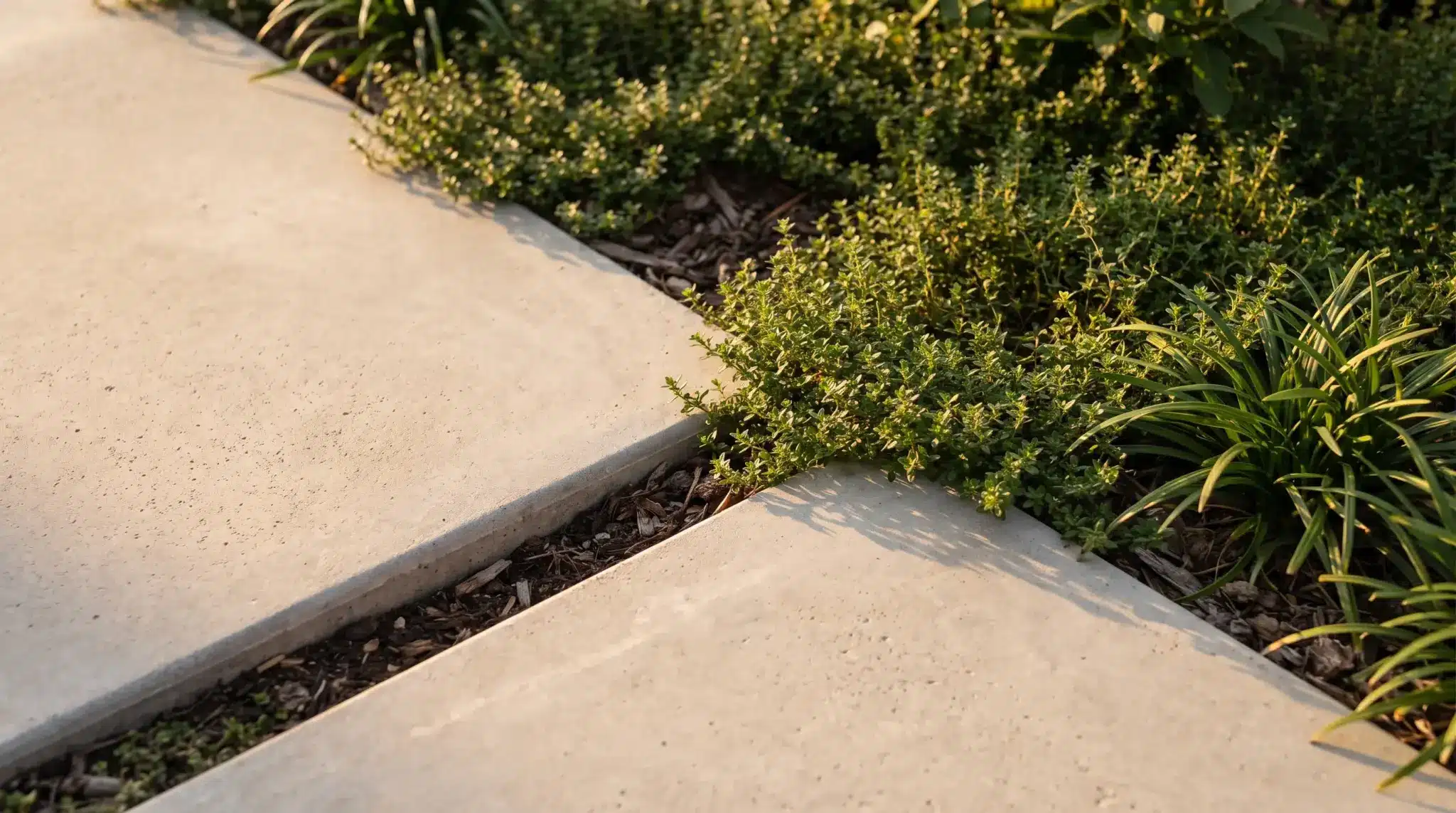
Outdoor spaces are often designed as separate pieces. The patio gets one plan, the planting beds another, and walkways, lawn, retaining edges, and garden features are added around them.
Yet some of the most noticeable problems develop in the few inches where those elements meet.
Grass becomes difficult to trim along an awkward slab edge. Mulch repeatedly washes onto a walkway. Plants spread farther than expected and crowd a patio. Concrete sits slightly too high beside a bed, making the transition feel abrupt. A narrow strip between two hard surfaces becomes impossible to plant well or maintain cleanly.
These are not necessarily concrete problems or landscaping problems by themselves. They are boundary problems.
Treating the seam between hardscape and softscape as a design feature can make an outdoor area easier to maintain and more coherent as it ages.
Start With the Shape of the Hard Edge
A patio or walkway establishes more than usable surface area.
Its outline determines the shape of every planting bed, lawn edge, and transition beside it.
Simple geometry is often easier to maintain than a collection of tight curves and narrow pockets. A small decorative indentation in a patio may look interesting on a plan but create a planting area too narrow for healthy mature growth.
Corners deserve the same attention.
Sharp inside corners can trap leaves and mulch. Very tight spaces between a walkway and wall may be difficult to mow, plant, or clean.
Before finalizing concrete dimensions, look at the leftover spaces created around them.
The negative space matters just as much as the slab itself.
Finished Elevation Controls How the Seam Feels
Height can make the difference between a clean transition and an awkward one.
Concrete that sits noticeably above an adjacent planting bed creates a strong visual edge. Soil or mulch placed too high beside the slab can spill onto the surface after rain or routine maintenance.
The intended relationship should be decided before installation.
That may involve accounting for topsoil, mulch depth, sod thickness, or other finished materials that will be added later.
Homeowners planning patios, sidewalks, or similar work through commercial concrete services can discuss finished elevation and edge geometry while the hardscape is still being laid out, rather than leaving the landscape to compensate for whatever height remains afterward.
A small adjustment during planning can make the boundary much easier to finish cleanly.
Curves Should Have a Reason
Curved patios and walkways can soften an outdoor design, but curves work best when they respond to something.
They may follow a garden bed, preserve a tree, direct movement toward a destination, or create space for planting.
Random curves often create maintenance problems without adding much visual value.
A narrow crescent-shaped bed may be too small for the plants originally imagined. A sweeping edge can also make mowing more difficult if the lawn has to follow several tight turns.
Use curves deliberately.
If the shape does not improve movement, planting space, or the overall composition, a simpler edge may age better.
Plant According to Mature Width, Not Installation-Day Size
New landscapes can be deceptive.
Young shrubs and perennials leave generous gaps around concrete when first planted. Within a few seasons, those spaces may disappear.
Plants can lean over walkways, reduce usable patio space, interfere with chairs, or trap moisture and debris along edges.
The solution is not to avoid planting close to hardscape.
It is to plan from a mature size.
Read expected spread as carefully as expected height. Consider whether plants naturally arch outward, form dense clumps, or send growth across nearby surfaces.
A bed may look sparse during the first year and still be correctly spaced for the future.
Think About How the Edge Will Be Maintained
Every boundary eventually needs maintenance.
Grass beside concrete must be cut. Beds need mulch or other surface material. Leaves accumulate in corners. Weeds may appear where materials meet.
Ask who will maintain the edge and how.
A lawn that runs directly against a patio may be simple if mower access is clear. A narrow planted strip between two hard surfaces may require hand work every time it needs attention.
Decorative edging can create a crisp visual line, but it also becomes another material that has to remain aligned.
Good design does not eliminate maintenance. It makes maintenance predictable.
Mulch, Gravel, and Groundcover Create Different Seams
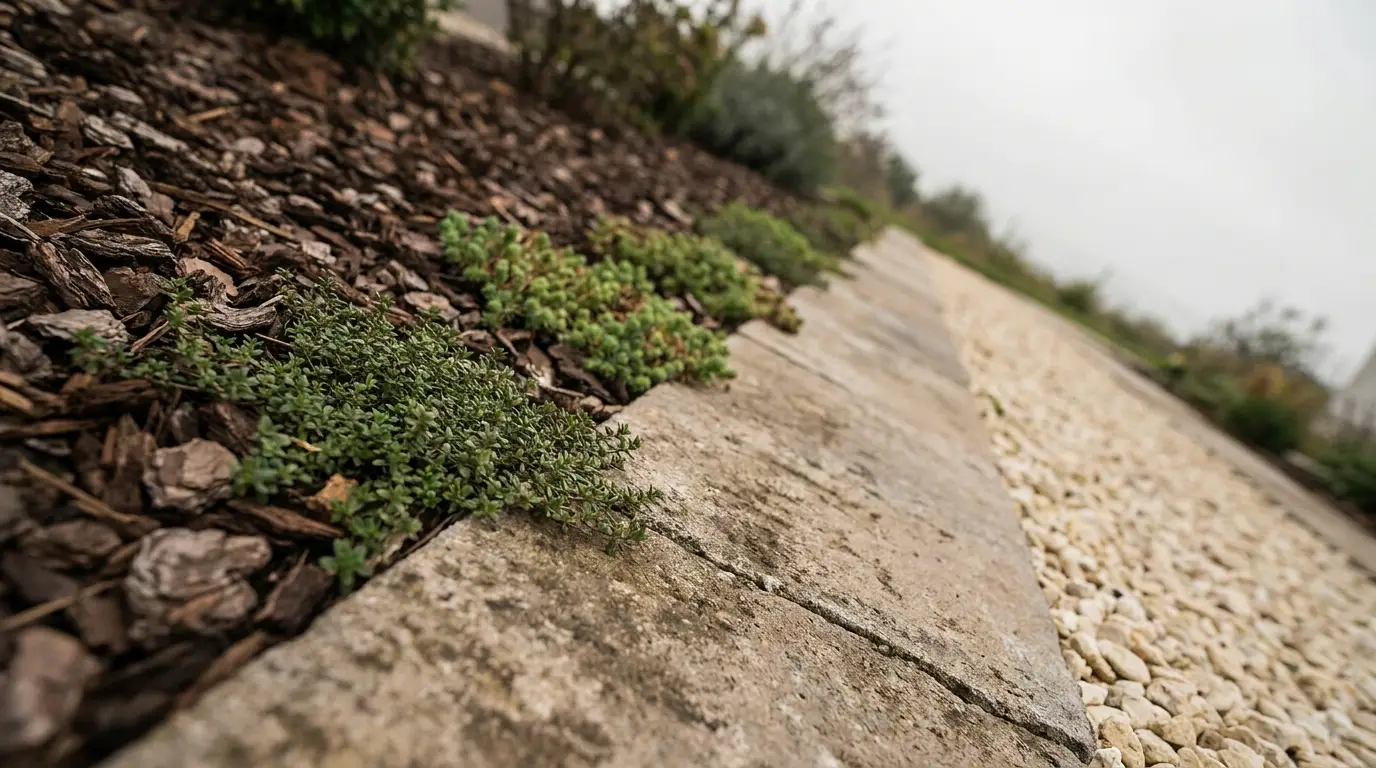
The material beside concrete changes how the transition behaves.
Mulch is soft and visually forgiving, but it can move onto pavement during rain, wind, or landscape work.
Decorative gravel creates a sharper texture change but can migrate onto walkways if the boundary is poorly contained.
Low groundcover can blur the edge attractively, yet some plants spread farther onto pavement than homeowners expect.
Each option produces a different kind of seam.
Choose the surface material based not only on appearance but on slope, maintenance habits, nearby planting, and how frequently people use the adjoining concrete.
Irrigation Can Make the Boundary Messier Than Expected
Watering systems should be considered alongside patios and walkways.
Repeated overspray onto the landscape can leave water where nobody intended it, and poorly positioned irrigation may water concrete more effectively than the plants beside it.
The issue is often most visible at the seam.
One side needs moisture; the other does not need irrigation at all.
Plant type, irrigation method, spray direction, and the width of the bed should be coordinated rather than planned separately.
This becomes increasingly important when narrow beds sit between hard surfaces, where there is little room for error.
Roots Need Space Beyond What Is Visible
Roots are another reason mature planning matters.
A tree or large shrub may fit visually beside a walkway while requiring more underground space than the design allows.
The concern is not simply that roots will always damage concrete. Plant species, soil, moisture, and construction all influence how roots develop.
The broader point is that large plants need enough room to grow without being squeezed between fixed surfaces.
Tiny planting pockets may be suitable for some smaller species but are not interchangeable with full garden beds.
Selecting plants according to the actual soil volume available can prevent the landscape from outgrowing its intended location.
Use Landscaping to Soften Concrete Without Hiding It
Hardscape edges do not always need to disappear.
A clean concrete border can provide useful structure, while plants soften the transition.
This is where professional landscapers can approach the boundary as part of the planting composition choosing mature plant sizes, bed depths, groundcovers, and maintenance access so greenery complements the slab rather than eventually overwhelming it.
The strongest designs often leave some of the hard edge visible.
That contrast allows both materials to read clearly: the concrete looks deliberate, and the planting feels intentionally placed rather than crowded against it.
Corners Need More Attention Than Straight Runs
Long straight edges are usually easy to understand and maintain.
Corners create more decisions.
An inside corner between two concrete surfaces may become a debris trap. An outside corner can be vulnerable to people cutting across the planting bed rather than following the paved route.
Observe expected movement.
If everyone is likely to step across one particular corner, extending the hardscape slightly may work better than repeatedly replacing damaged plants.
Similarly, a corner that cannot be reached easily for pruning or cleanup may need a simpler planting approach.
Small geometric decisions can prevent recurring maintenance frustrations.
Recheck the Boundary After Several Growing Seasons
A landscape is not finished on installation day.
Plants mature. Mulch levels change. Concrete settles slightly in some situations. Furniture patterns evolve, and people discover shortcuts through the yard that were not obvious during design.
After a few seasons, look again at the seam.
Are plants beginning to cover too much of the walkway? Does mulch repeatedly migrate onto the patio? Has one bed become difficult to access? Is a narrow grass strip becoming more trouble than it is worth?
These observations can guide small adjustments before the area becomes frustrating.
Landscape design benefits from occasional editing.
The Best Boundary Looks Simple Because It Was Planned
A successful transition between concrete and landscaping rarely calls attention to itself.
The patio feels appropriately framed. Plants have room to mature. Mulch stays mostly where it belongs. Lawn edges can be maintained without awkward maneuvering, and the hardscape does not feel disconnected from the garden around it.
That simplicity usually comes from deliberate choices.
Finished elevations were considered together. Bed widths were large enough for the intended plants. Corners were shaped around real movement, and maintenance was treated as part of the design.
The seam between hardscape and softscape may occupy only a few inches.
Those few inches often determine whether an outdoor space looks more settled and intentional with age—or increasingly difficult to manage.