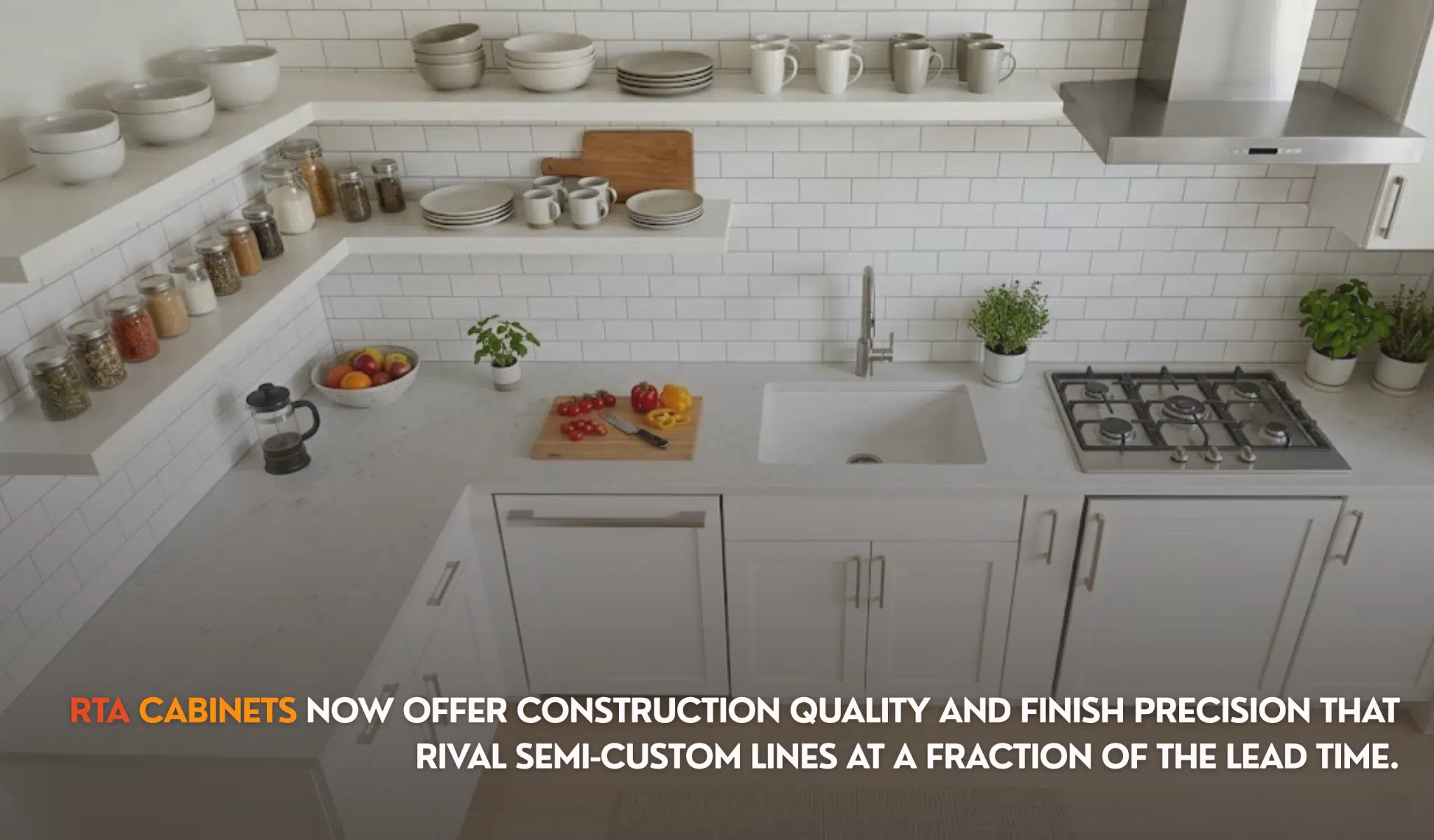
Most kitchen renovations stall at the same decision point: Cabinetry. It accounts for the largest share of the budget, and is the one thing you cannot easily undo once the walls go up.
For homeowners working with compact footprints or targeting a clean, contemporary aesthetic, ready-to-assemble (RTA) cabinets have shifted from a cost-cutting workaround to a genuinely considered choice.
The construction quality, finish range, and box configurations available today have caught up with, and in some cases exceeded, what semi-custom lines were offering five years ago.
That said, not all RTA brands are equivalent.
Box construction, dovetail joinery, soft-close hardware, and interior finish quality vary considerably across the market.
This list focuses on brands that consistently deliver on the three criteria that matter most in small-space and modern kitchens: structural integrity, finish precision, and configurability.
If you are planning a full kitchen build or a targeted refresh, it is also worth reviewing how smart corner cabinet ideas can maximize space before finalizing your cabinet order, since corner solutions affect your overall layout plan significantly.
What makes a strong RTA cabinet for small and modern kitchens

Before the list, it is useful to establish the benchmarks.
A structurally sound RTA cabinet for residential use should include: 3/4-inch plywood box construction (not particleboard), full dovetail or dowel-and-cam drawer box joinery, soft-close hinges and drawer guides as standard, and a finished interior that holds up to moisture without swelling or delaminating.
For modern kitchens specifically, frameless (Euro-box) construction allows for wider door openings and cleaner sight lines, which becomes especially important in tight layouts where every inch of access matters.
Finish quality on the door face and the toe-kick integration are often where lower-tier RTA brands cut corners, so both are worth scrutinizing in samples.
For small-space kitchens, the ability to source narrower base cabinets (9-inch, 12-inch configurations), tall pantry pullouts, and wall cabinets in non-standard heights is the practical differentiator.
Several brands on this list offer these configurations as standard stock items rather than special orders.
1. RTA Wood Cabinets (best overall for quality and modern finish range)
For homeowners who want construction quality that holds up under daily use and a finished library that works equally well in Scandinavian-minimal and transitional modern kitchens, the premium kitchen cabinets from RTA Wood Cabinets represent the strongest all-round entry on this list.
The brand uses 3/4-inch plywood box construction throughout, paired with full dovetail drawer boxes, soft-close hinges, and a frameless Euro-box build that suits contemporary layouts.
For compact kitchens, the availability of 9-inch and 12-inch base cabinet widths as stock items removes the lead time and cost premium that custom ordering typically adds.
The white shaker and slab door profiles are clean enough to read as modern without requiring a full frameless specification, which gives more flexibility in mixed-style spaces.
- What to specify here: white shaker, slab matte, and two-tone upper/lower configurations.
- Best for: modern condos, galley kitchens, open-plan renovations, and any project where cabinet delivery speed matters.

2. Forevermark Cabinetry (best for transitional modern with solid wood face frames)
Forevermark’s Ice White Shaker and Bristol Linen lines offer solid wood face frames and plywood box construction at mid-range pricing.
For kitchens transitioning from traditional to contemporary, the face-frame construction with concealed hinges threads the aesthetic gap effectively.
3. Fabuwood Allure Galaxy (best for slab-door modern kitchens)
Fabuwood’s frameless Allure Galaxy line is one of the more credible slab-door options in the RTA segment.
The flat-panel door profiles in matte white and grey are well-executed for the price, and the full-access frameless box provides the wider opening dimensions that clean-lined modern kitchens require.
Interior surfaces are finished, which improves both the look and the longevity of cabinet interiors in everyday use.
4. Waypoint Living Spaces (best for semi-custom sizing without semi-custom lead time)
Waypoint offers a wider range of cabinet widths in 3-inch increments rather than the 3-inch-to-6-inch jumps that some stock RTA lines use, giving designers more flexibility in laying out tight runs.
The brand is sold through select dealers, which adds a layer of in-person specification support that online-only RTA brands cannot replicate.
For designers specifying kitchens in compact apartments or ADUs, this sizing flexibility is a material advantage
5. Cabinetcorp (best for builders and multi-unit projects)
Cabinetcorp’s pricing structure and minimum order flexibility make it a strong option for contractors and developers sourcing cabinets across multiple units.
The construction specification (plywood boxes, soft-close hardware, dovetail drawers) meets residential quality expectations, and the stock depth means shorter lead times even on larger orders.
For small-space applications, the shallow-depth wall cabinet options (12-inch depth) are particularly useful in kitchens where clearance above counters is limited.
6. Cabinet DIY (best budget entry with plywood construction)
Most RTA brands at the budget tier use particle board box construction, which Cabinet DIY avoids.
Their Santiago line ships with plywood boxes and soft-close hardware at a price point that undercuts most mid-range competitors.
The door style range is limited, but for functional compact kitchens where the goal is structural longevity over design specificity, this is a credible choice.
7. Koville Cabinetry (best for two-tone and color-forward modern kitchens)
Koville offers one of the broader color programs in the RTA segment, including navy, forest green, and slate grey base cabinet options alongside standard whites and greys.
For modern kitchens where color-blocking (contrasting upper and lower cabinet colors) is part of the design intent, having access to these finishes in stock RTA sizing removes a significant lead-time and cost barrier. Construction quality is mid-range with plywood boxes available on select lines.
How to specify RTA cabinets for a small kitchen: key considerations
Getting the order right before cabinets arrive on site is the most important variable in any RTA project. Small kitchens in particular have less tolerance for sizing errors since the layout has little room to absorb unexpected gaps or overhangs.
A few practical points to confirm before placing an order:
- First, measure your ceiling height against standard wall cabinet heights. Most stock wall cabinets come in 30-inch, 36-inch, and 42-inch heights. In kitchens with 8-foot ceilings and a standard 18-inch counter-to-cabinet clearance, a 30-inch wall cabinet leaves a 6-inch gap above. Either specify 36-inch wall cabinets or plan for a filler piece, which needs to be ordered at the same time.
- Second, confirm whether your layout requires filler strips at end panels and between appliances. Experienced kitchen planners typically account for 1/4-inch to 1/2-inch reveals at wall returns and appliance sides during the initial CAD phase rather than correcting on-site.
If you are working through a small-space redesign from scratch, the guide on how to organize a small kitchen step by step covers zone-based layout logic that applies directly to cabinet placement planning.
- Third, always order a minimum of 5-10% overage on toe-kick material and filler strips. These are the components most commonly under-ordered, and re-ordering from a different production batch can produce visible color variation.
A note on installation sequencing
RTA cabinets arrive faster than semi-custom or custom lines, but that speed advantage disappears if the installation sequence is not planned before delivery.
In a small kitchen, upper cabinets should be installed before base cabinets, both to avoid working over already-installed base units and to establish the wall line that base cabinet placement references.
Confirm that wall blocking is in place for upper cabinet hanging points, particularly in older homes where plaster or tiled wall surfaces may not have consistent stud spacing.
For tiny home kitchens and compact modular builds, cabinet depth selection matters more than in standard layouts.
Shallow 18-inch base cabinets (versus the standard 24-inch) are available from several brands on this list and can make the difference between a kitchen that functions well and one that creates a traffic bottleneck. The tiny house interior design guide covers this depth tradeoff in the context of full kitchen planning for compact living spaces.
Choosing the right brand for your project
The strongest RTA cabinet purchase is one that matches construction specification to actual use conditions.
For a primary residence kitchen used daily by a family, plywood box construction with dovetail drawers is worth the additional cost.
For a rental unit or secondary space, mid-range construction with solid-close hardware covers functional requirements without over-specifying.
For any modern kitchen targeting clean lines and a frameless look, confirm Euro-box (frameless) construction and verify that interior surfaces are finished before ordering.
Each brand on this list earns its position based on the criteria that matter in real kitchen planning: structural integrity, finish quality, small-space configurability, and honest lead time expectations.
The best cabinet order is the one that arrives complete, on time, and with no re-orders required once installation begins.