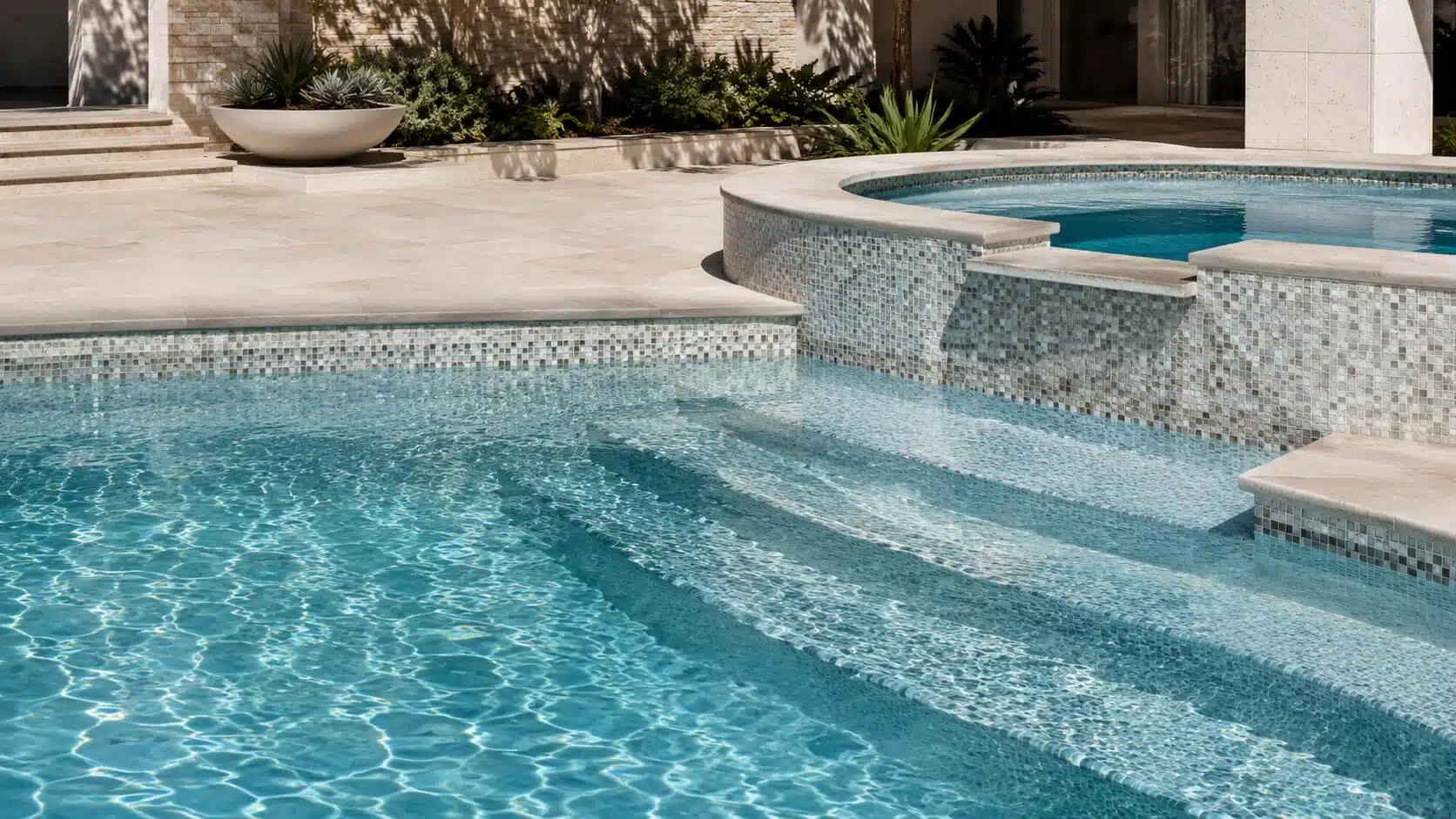
Yes—outdoor mosaic tile can improve wet areas and pools when the tile, finish, mounting method and complete installation assembly are specified for the actual exposure. In the United States, ANSI A326.3 treats exterior-wet surfaces differently from ordinary interior wet floors, and exterior-wet products and mosaic surfaces rely on manufacturer-declared use classifications rather than a simplistic universal DCOF threshold. Porcelain provides another measurable advantage for demanding wet applications: by definition, porcelain tile has water absorption of 0.5% or less when tested according to ASTM C373.
That does not mean every mosaic belongs in a swimming pool. A decorative wall mosaic, a pool-rated porcelain mosaic and a glass mosaic approved for continuous immersion may look similar online while requiring very different installation systems. Waterproofing, mortar coverage, grout, movement accommodation, backing materials, drainage and pool chemistry can be as important as the visible tile itself. The 2026 TCNA Handbook specifically includes wet-area guidance and treats tile performance as part of an assembly built over a properly designed and prepared substrate.
Solidshape explains how to select outdoor mosaic tile for patios, wet areas and decorative pool surroundings.
What Is Outdoor Mosaic Tile and Why Is It Popular?
Mosaic tile is a small-format surfacing system made from individual units—often called tesserae—that may be supplied as sheets for faster placement. ANSI A137.1 has historically defined ceramic mosaic tile as having a facial area below 9 square inches, with individual units commonly assembled into sheets or strips.
The small format is particularly useful around water because many pools contain surfaces that are difficult to cover elegantly with large rigid tiles. Curved pool walls, radius corners, benches, steps, spa seats, niches and transitions can often be followed with smaller units while limiting awkward cuts and lippage.
Mosaic is a format rather than a single material. Pool and wet-area mosaics may be manufactured from porcelain, glass, ceramic or natural stone, and their performance can vary substantially. Buyers therefore should not treat the word “mosaic” as a technical rating.
For porcelain specifically, standards provide a useful quantitative reference. TCNA states that porcelain tile must have water absorption of 0.5% or less under ASTM C373 testing. TCNA also warns that even porcelain should not automatically be assumed frost-safe; manufacturers should confirm exterior and freeze-thaw suitability for the individual product.
Popularity is also being supported by broader interest in highly designed wet and outdoor living environments. Houzz’s 2026 U.S. Outdoor Trends Study found that 83% of renovating homeowners were creating outdoor lounge or seating spaces and 71% hired a professional for outdoor renovation work, suggesting that exterior areas are increasingly being treated as designed living environments rather than leftover utility space.
What Benefits Can Outdoor Mosaic Tile Provide?
Better fit on complex geometry. Small pieces distribute alignment changes across many joints, making mosaics practical for curved pool walls, spa edges, benches, and transitions.
Low-moisture options. Porcelain’s ≤0.5% absorption classification limits water uptake, important for exterior and submerged conditions.
Better slip-resistance specification. ANSI A326.3 classifies Exterior Wet surfaces as manufacturer-declared; TCNA notes mosaics can produce misleading device measurements, so verify declared use rather than relying on one universal DCOF number.
Freeze-thaw resilience when correctly specified. TCNA says tiles meeting ASTM C1026 and C373 generally perform on exteriors when manufacturers approve the product and accepted installation methods are followed; trapped water can still cause damage.
Where Does Outdoor Mosaic Tile Work Best—and Where Should It Be Avoided?
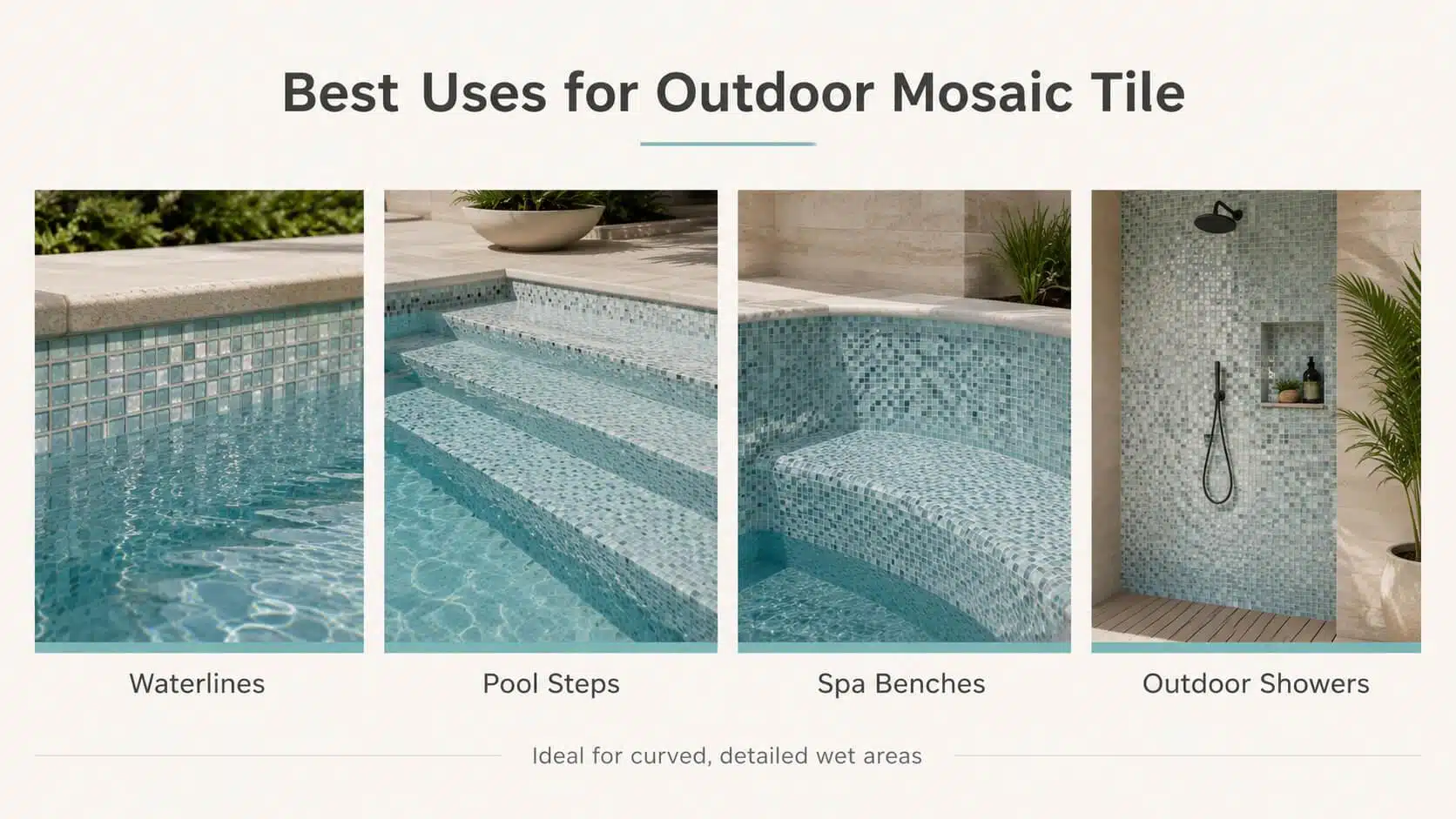
Strong applications include pool waterlines, approved submerged features, spas, fountains, shower floors, outdoor showers, patio borders, and curved wet-area details.
Avoid mosaics with no exterior or immersion rating; highly polished poolside walking surfaces; absorbent or acid-sensitive stone in treated water unless approved; and installations without freeze-thaw suitability in cold climates. Tile is not a substitute for waterproofing: pool systems need compatible membranes, setting materials, grout, and movement-joint sealants.
Which Design Styles Work Well?
Contemporary Glass and Water Tones
Blue, green, aqua, and iridescent glass mosaics suit modern pools, spas, and waterline bands.
Stone-Look Porcelain
Porcelain mosaics can coordinate with larger pavers while retaining porcelain’s low water absorption, creating continuity from deck to wet-area accents.
Geometric Accent Bands
Hexagons, penny rounds, squares, and elongated mosaics work well at waterlines, outdoor showers, or patio borders without overwhelming the hardscape.
How Should You Select Outdoor Mosaic Tile?
- Confirm pool/submersion approval for submerged areas.
- Verify water absorption; porcelain should be ≤0.5% by ASTM C373.
- Check the manufacturer’s Exterior Wet or equivalent declaration.
- In freezing climates, request ASTM C1026/freeze-thaw data and exterior approval.
- Confirm resistance to chlorine, salt, and cleaning chemistry.
- Ensure sheet backing supports required adhesive coverage.
- Match membrane, mortar, grout, and sealant to permanent immersion where applicable.
- Compare material cost, installation complexity, and cleaning needs.
How Does Mosaic Compare With Other Pool and Wet-Area Finishes?
Material/Option | Appearance | Durability with data | Maintenance | Cost range* | Best use case |
| Glass mosaic | Luminous, detailed | Product-specific; choose immersion-rated tile | Clean scale/grout | $8–$50/sq. ft. | Waterlines, curves |
| Porcelain mosaic | Stone looks, color | ≤0.5% absorption | Low–moderate | $2–$25/sq. ft. | Wet floors, approved pools |
| Large porcelain | Clean, fewer joints | ≤0.5% absorption | Lower grout burden | $2–$25/sq. ft. | Straight walls/decks |
| Natural stone | Organic, premium | Varies by stone | Often higher | $5–$40/sq. ft. | Pool surrounds |
| Plaster | Smooth, traditional | About 10 years | Periodic resurfacing | $6–$8/sq. ft. installed | Budget interiors |
| Pebble/aggregate | Textured | Often 20+ years | Chemistry/scale care | $6–$15/sq. ft. installed | Durable interiors |
ANSI A137.1 supports the ≤0.5% porcelain figure; Angi reports properly applied plaster at about 10 years and pebble finishes at 20+ years. For 2026 U.S. pricing, HomeGuide reports porcelain pool tile at $2–$25, glass at $8–$50, and marble up to $40 per square foot before installation; plaster and aggregate resurfacing figures use installed pricing and therefore are not directly equivalent to tile-only prices.
How Do You Maintain Mosaic Tile and Extend Service Life?
No ASTM or ANSI standard guarantees a mosaic lifespan; longevity depends on substrate stability, drainage, waterproofing, bond coverage, movement accommodation, and water chemistry. For home pools, CDC recommends pH 7.0–7.8 and at least 1 ppm chlorine, with routine testing because sunlight and swimmer load reduce disinfectant levels.
Use manufacturer-approved nonabrasive cleaners, remove mineral deposits before heavy buildup, and inspect grout, sealant, and movement joints at least annually as a practical maintenance routine. Repair cracked or debonded areas early.
What Common Mistakes Should You Avoid?
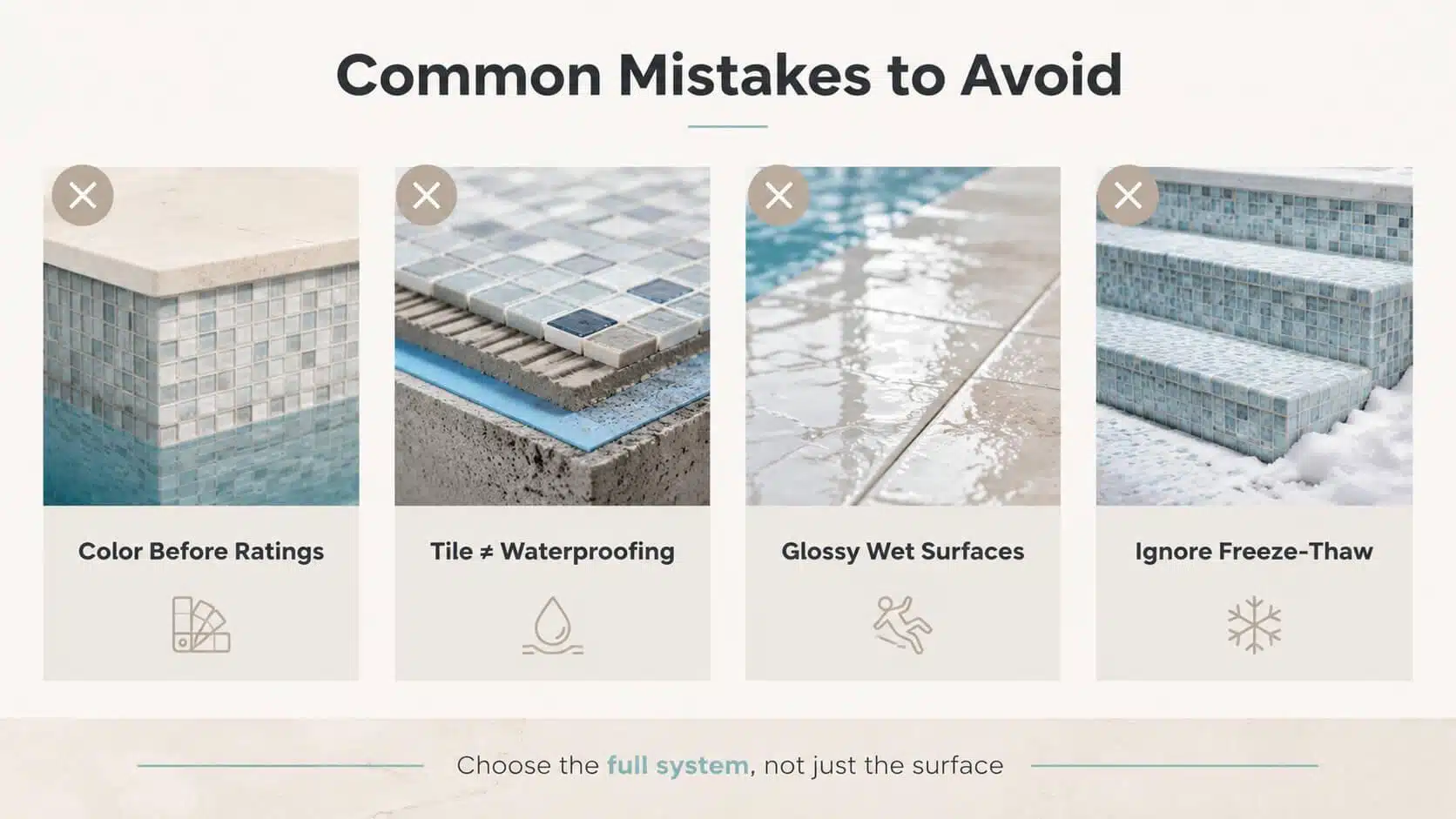
Common errors include choosing by color before checking ratings, assuming grout makes the assembly waterproof, specifying glossy tile where barefoot traction matters, ignoring drainage in freeze-thaw climates, using incompatible mesh-mounted sheets, and mixing installation products without confirming compatibility.
Is Outdoor Mosaic Tile Worth It?
Often, yes—especially at waterlines, spas, curved features, and wet-area accents where mosaics solve geometry and design problems that larger units cannot. Full-pool mosaic interiors cost more because they increase material, setting, and grouting labor, so porcelain or aggregate may offer better value on large straight surfaces. Value comes from matching the finish to exposure and installation conditions.
Frequently Asked Questions
Can mosaic tile be used inside a swimming pool?
Yes, but only when the tile, backing, adhesive, grout, membrane, and sealant are approved for permanent immersion.
Is glass or porcelain mosaic better for pools?
Glass excels at color and curved detailing; porcelain offers ≤0.5% absorption and often easier coordination with exterior paving.
Is mosaic tile slippery when wet?
It can be. Verify exterior-wet or barefoot suitability; TCNA notes mosaics should not be judged solely by a generic DCOF threshold.
Does mosaic tile waterproof a pool?
No. Waterproofing comes from the designed assembly beneath and around the tile.
Can mosaic tile survive freezing weather?
Yes when the manufacturer approves exterior use, relevant freeze-thaw requirements are met, and the assembly drains properly.
Can natural-stone mosaic go underwater?
Sometimes, but absorption, staining, and chemical sensitivity vary; use only stone approved for that pool chemistry and exposure.
Is epoxy grout required for pool mosaics?
Not universally. Some pool systems specify epoxy, while others permit high-performance cementitious grout; follow the system manufacturer’s submerged-use specification. MAPEI, for example, publishes pool systems using both grout approaches depending on the assembly.
How often should pool mosaic be cleaned?
Clean as needed to prevent scale, biofilm, and staining; frequency depends on water hardness, use, and environment.