Start With What This Region Is Not
Northeastern Pennsylvania is not a car haul destination. It is worth being clear about that up front, because a lot of freight coverage of the region implies otherwise.
There is no finished-vehicle rail ramp anywhere in Lackawanna, Luzerne, Monroe, Carbon, Schuylkill, Lehigh, Northampton or Berks County. There is no auto port. There is no car assembly plant. Norfolk Southern lists exactly one automotive facility in Pennsylvania, and it is in Philadelphia.
What the region is, for anyone moving vehicles, is a corridor. The loads come off the water at Port Newark, Baltimore, Philadelphia or Wilmington, and they run through here on their way north and west. Autoracks on the Lehigh Line pass through Allentown without stopping.
That distinction shapes everything else. Time spent here is time in transit, and transit time on these two roads is less predictable than the mileage suggests.
The Dunmore Knot
The junction everyone calls Scranton is actually in Dunmore, just outside the city, where I-84 and I-380 both end at I-81 and US 6.
The Pennsylvania Turnpike Commission puts it plainly: multiple I-81 segments between Exit 175 and Exit 194 are operating at or near capacity during peak morning and afternoon hours.
Over a four-year traffic study, roughly 400 crashes occurred near the Wyoming Valley and Clarks Summit interchanges. The Commission attributes those to the 20 conflict points in that stretch, meaning the places where traffic merges, crosses or diverges.
The volume is going one direction. Freight moving from south central Pennsylvania into the Lackawanna and Luzerne region is projected to rise 110 percent by 2040. Across the state as a whole, truck freight is expected to grow 72 percent over the same period.
The Lehigh Valley End
I-78 does the same work further south, and the growth around it has been substantial. The Lehigh Valley Transportation Study puts more than $60 billion of freight through the valley each year in its adopted freight plan. That figure is heading toward nearly $100 billion by 2045.
One thing to know about the road layout, because mapping software handles it badly. I-78 ends at I-81 in Lebanon County, about 75 miles west of Allentown. At the Lehigh Valley end there is no direct ramp between I-78 and the Turnpike Northeast Extension. You reach one from the other by way of US 22 and Turnpike Exit 56.
Where the Vehicle Work Actually Is
The car haul stops in this region are smaller and more scattered than the freight numbers imply:
- Salvage runs into IAA Scranton in Pittston and Copart Scranton in Duryea, both in Luzerne County.
- Regional auctions at Northeast Pennsylvania Auto Auction in Scranton and Lehigh Valley Auto Auction in Whitehall, both far smaller than the Lancaster County operations.
- Retail delivery to the dealer clusters, MotorWorld in Wilkes-Barre Township and the Ciocca and Ken Pollock groups.
- Mack Trucks builds its entire North American Class 8 line in Macungie, though those units leave under their own power.
The volume auctions sit south. Manheim Keystone Pennsylvania is directly at I-81 Exit 80 in Grantville, which is the one genuinely on your road.
Manheim Pennsylvania sits further out, in Lancaster County, on US 222 rather than on either interstate. Cox Automotive describes it as the largest wholesale auto auction in the world, at over 400 acres. From Scranton it is a run down I-81 and then across, not a corridor stop.
Dimensions, and Where the Margin Actually Sits
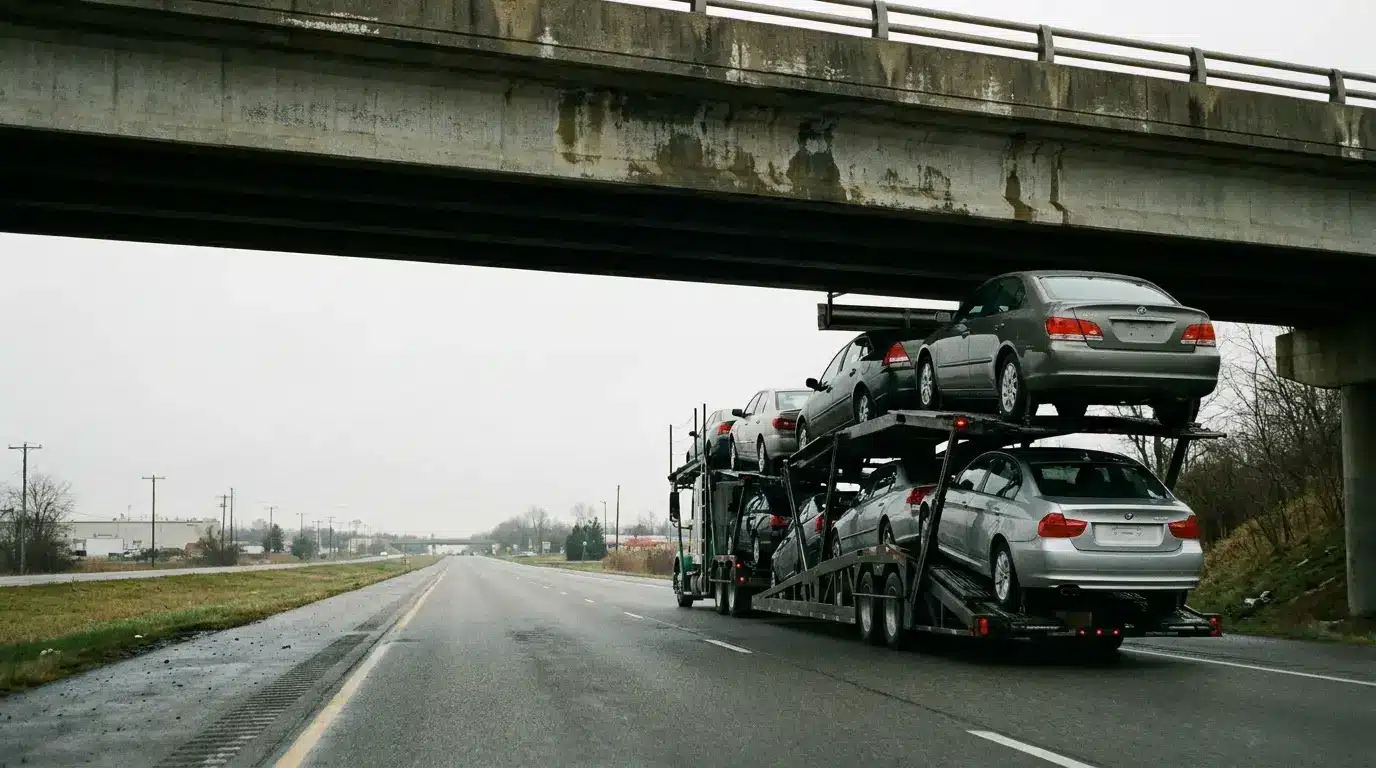
The federal floor for a stinger-steered automobile transporter is 80 feet, raised from 75 by the FAST Act. States cannot go below it. Conventional transporters stayed at 65.
On top of the 80 feet you get up to 4 feet of front overhang and 6 feet at the rear, again for stinger-steered equipment only. Conventional transporters remain at 3 and 4. Flippers come out of the length measurement, but they have to be retracted when they are not supporting vehicles.
Height is where Pennsylvania bites. The state caps you at 13 feet 6 inches including the load, and running over that without a permit carries a $500 fine. Posted clearance is not always current clearance either, because resurfacing raises the road without anyone repainting the sign.
Parking, With the Real Numbers
This corridor is short of parking and the state knows it.
- Pennsylvania averages 10.9 public truck parking spaces per 100 miles of National Highway System roadway, according to the American Transportation Research Institute.
- Roughly 980 trucks park on shoulders and interchange ramps on a typical night statewide.
- PennDOT is adding 1,202 spaces across 133 locations by the end of 2026, including 85 at the two I-380 weigh stations in Lackawanna County. More than 300 were open as of January 2026.
None of that helps at 11 at night this week. Plan the stop before you need it, particularly if you are running long and cannot take a marginal space.
Weather, and One Myth Worth Dropping
Valley fog is a real morning hazard in the Lackawanna and Wyoming valleys, and I-81 has been closed by crashes in it.
The corridor incident everyone remembers, though, was not fog. In March 2022 a snow squall in Schuylkill County produced an 80-vehicle pileup that killed six people. Squalls arrive faster than fog and drop visibility further, and they are the thing to watch on this road in winter.
On wind, the conventional wisdom has it backwards. Enclosed box and van trailers are the equipment most associated with blow-over, and the risk climbs when they run empty. The Chesapeake Bay Bridge-Tunnel makes the point neatly: at 40 mph it bans empty tractor-trailers while continuing to permit empty car carriers, flatbeds and low-boys.
The Dealer End
Delivery is where the schedule tends to go. Unloading a full carrier takes time, and plenty of dealer sites have no room to do it off the street. Some municipalities restrict where a carrier can load and unload, and a few dealers have ended up buying or leasing a second site purely to have somewhere legal to work.
Winter adds a second problem. Road salt lands on the units in transit, and it does more than look bad. Salt film hides dents and paint chips, and receiving dealers work to short windows for reporting concealed damage. A carrier arriving with salted decks in February is handing the receiving dealer a reason to look harder, and handing themselves an argument later.
If Something Does Happen
One correction worth making, because it gets repeated a great deal. Collisions involving large trucks are not usually pileups. Federal crash data shows 62 percent of fatal large truck crashes involve exactly two vehicles, the truck and one other. Roughly another fifth are recorded as single-vehicle crashes, a category that also covers collisions with pedestrians and cyclists.
What that means in practice is that the aftermath usually involves two parties, one of whom has a commercial insurer and a carrier behind them.
Drivers and fleet operators who run this corridor often keep local contacts written down in advance instead of looking for them afterward. At the northern end that means knowing who handles truck accident claims in Scranton. Toward the Lehigh Valley it means having details for an Allentown truck accident attorney already on file. Working that out from three states away, days later, is harder than it needs to be.
The Short Version
Treat northeastern Pennsylvania as somewhere you pass through carefully, not somewhere you deliver. The road network is carrying more freight than it was built for, and the projections say the gap widens.
Know that Dunmore is the pinch point. Watch for squalls, not just fog. Plan the stop early. Get the salt off before the dealer sees it. And keep your height honest, because 13 feet 6 inches is a hard number in this state.
This article is general information and not legal advice. Sources: I-81 capacity, crash and conflict point figures from the Pennsylvania Turnpike Commission news release of 15 November 2024 on the Scranton Beltway Project. Freight growth projections from the Scranton Beltway Feasibility Study Phase 2 Summary Memo. Lehigh Valley freight values from the freight plan adopted by the Lehigh Valley Transportation Study, via the Lehigh Valley Planning Commission. Length and overhang limits from 49 U.S.C. 31111 and 23 CFR 658.13. Height limit from 75 Pa.C.S. 4922. Parking figures from the American Transportation Research Institute and PennDOT. Crash composition from FMCSA Large Truck and Bus Crash Facts. Wind restrictions from the Chesapeake Bay Bridge-Tunnel District. All accurate at the time of writing. Check current restrictions and closures before you run.