Oil penetrates bare concrete because the slab is full of tiny capillary pores that draw liquid inward. Once oil settles below the surface, cleaning lifts only what sits on top, so a shadow remains.
Effective concrete protection works by closing those pores before contamination happens, which stops oil from reaching the absorbent layer underneath and keeps the surface releasing spills instead of holding them.
Introduction
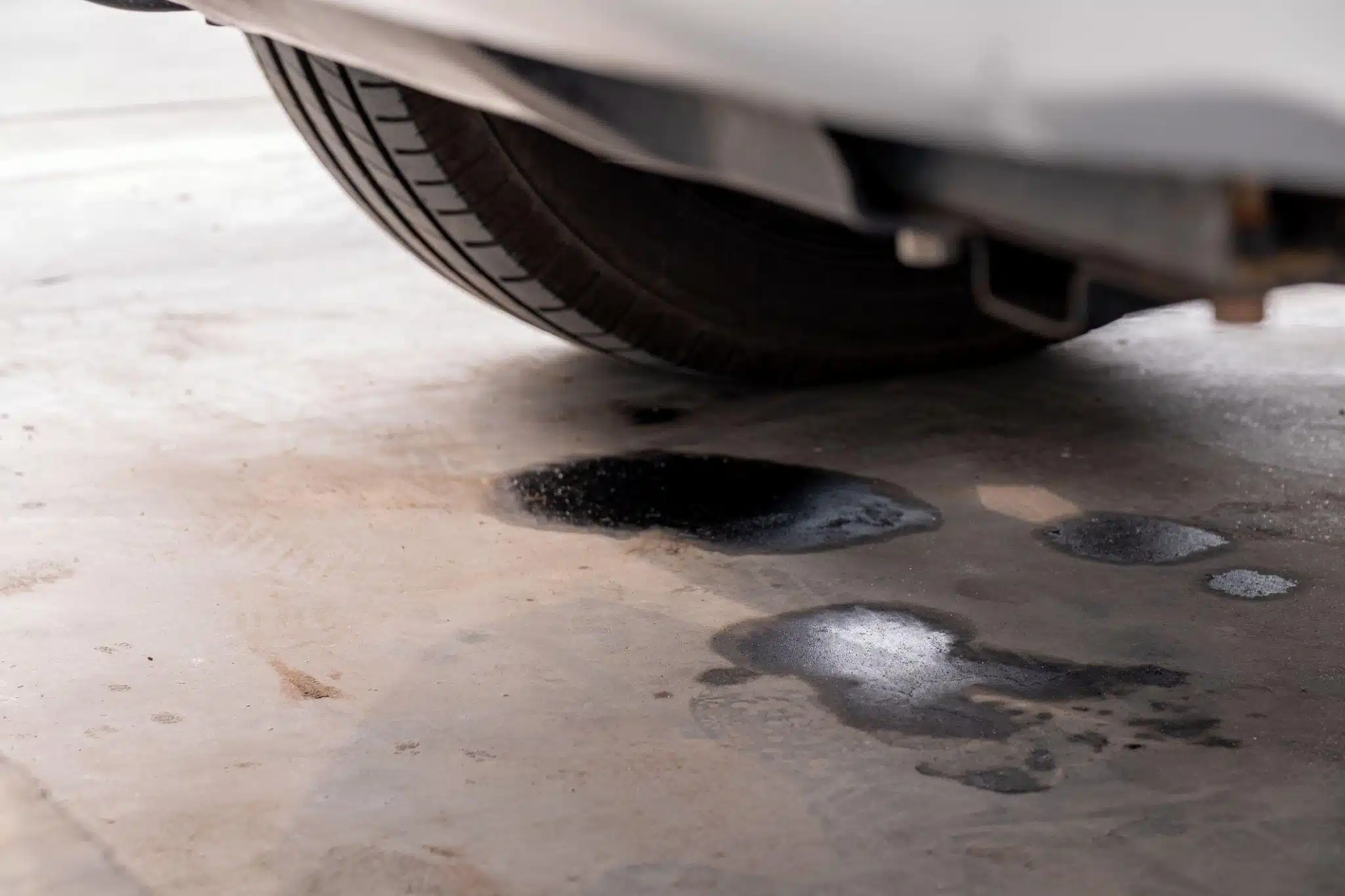
Every garage owner knows the moment. A vehicle sits over the same spot for a season, and a dark bloom spreads across the slab that no amount of scrubbing fully removes. That mark is the visible signature of oil-stained concrete, and it persists because bare concrete behaves like a rigid sponge. The surface looks solid, yet it carries a network of microscopic pores that pull motor oil, brake fluid, and grease down past the point any surface cleaner can reach.
Understanding the fix starts with the surface itself. A properly prepared slab followed by professional epoxy garage floor installation seals the capillary structure, so contaminants stay on top, where they wipe away. Regional standards for surface prep matter here, because adhesion fails when residual oil is left in the pores.
Why Oil Stained Concrete Holds Onto Stains
Concrete looks dense, yet under magnification the slab is riddled with channels. Those channels decide why a fresh spill becomes a permanent shadow, and why surface cleaning alone never finishes the job.
The Porous Nature of a Bare Slab
Poured concrete cures into a rigid matrix laced with capillary pores, most of them finer than a human hair. Water, solvents, and petroleum products travel through this network by capillary action, the same wicking force that pulls coffee up a sugar cube. Motor oil carries low surface tension, so it migrates readily and settles below the wear surface where scrubbing cannot follow.
Why Cleaning Only Reaches the Top Layer
A degreaser lifts whatever sits in the top fraction of a millimetre. The petroleum that has already sunk into the pore structure stays put, then slowly wicks back upward as the surface dries, which is why a cleaned patch reappears within days. This rebound is the defining trait of untreated garage floor stains, and it explains the frustration behind repeated washing. Each wash removes the symptom while the reservoir of contamination remains locked inside.
Factors That Deepen Absorption
Several conditions push oil further into the matrix and make the mark harder to shift:
- Higher slab temperature, which thins the fluid and speeds migration
- Longer dwell time before the spill is addressed
- A rough or unsealed float finish with wider porosity
- Older concrete carrying micro-cracks from thermal cycling
Surface preparation, not cleaning strength, governs the outcome. That distinction sets up the next question, which is how sealing changes the pore behaviour itself.
How Concrete Floor Sealing Prevents Recurring Marks
Prevention works by changing the surface itself, rather than fighting spills after they land. The mechanism turns clear once the pore structure is understood.
Closing The Capillary Network
Concrete floor sealing fills or caps the open channels so liquid can no longer wick inward. Two broad routes exist, and they behave differently against petroleum that may already sit in the slab.
Penetrating Versus Film-Forming Routes
A penetrating product soaks in and reacts inside the pores, leaving appearance unchanged while blocking absorption from below. A film-forming barrier lays across the top, which resists spills but demands a contaminant-free surface to bond. The comparison below distills the practical trade-offs.
Property | Penetrating Sealer | Film-Forming Coating |
|---|---|---|
Location of protection | Inside the pores | On the surface |
Appearance change | Minimal | Glossy or matte finish |
Spill resistance | Moderate | High |
Surface prep demand | Lower | Strict, oil-free |
Typical lifespan | 5 to 10 years | 10 years or more |
Read together, the two routes suit different priorities, budget and traffic load among them.
The Contamination Problem
Residual grease is the hidden failure point. Any barrier applied over an unremediated slab loses adhesion, which is why professional prep strips embedded residue first through degreasing and mechanical grinding.
Pro Tip: Test an aging slab with a water-bead check. If water soaks in rather than beading, the surface sits open and ready to accept a penetrating treatment.
In practice, matching the method to the slab condition decides how long the fix survives.
Long-Term Concrete Protection Through Layered Systems
Durable results come from a system, layered and cured, rather than a single pass. This is where surface preparation and material choice converge.
Why Epoxy Outlasts Simple Sealers
An epoxy floor coating bonds to a properly ground slab and forms a thick, chemically resistant layer that petroleum cannot penetrate. The film build and cross-linked cure give it far greater abrasion tolerance than a thin treatment, so it holds up under vehicle weight and dropped tools.
The Role Of Surface Preparation
Adhesion is earned before the first coat. A sound system depends on several prep stages:
- Mechanical grinding to open the profile
- Full removal of embedded oil and grease
- Crack and joint repair
- Moisture testing on older slabs
Skip any stage on a contaminated floor and the finish lifts, regardless of product quality.
Maintenance That Preserves The Finish
A completed surface asks little in return. Routine washing keeps it performing for years, and the payoff shows in a slab that shrugs off what once left a scar.
Taken together, preparation, material, and upkeep form one continuous defence against absorption.
The Lasting Value Of Sealing Bare Concrete
Bare slabs hold oil because their pore structure pulls it in and refuses to release it. Cleaning treats the surface while the contamination sits deeper, so the shadow returns. The durable answer lies in preparation and a bonded barrier that closes the pores for good. A well-prepared floor stops absorbing spills and starts shedding them, which is the whole point of proper concrete protection.