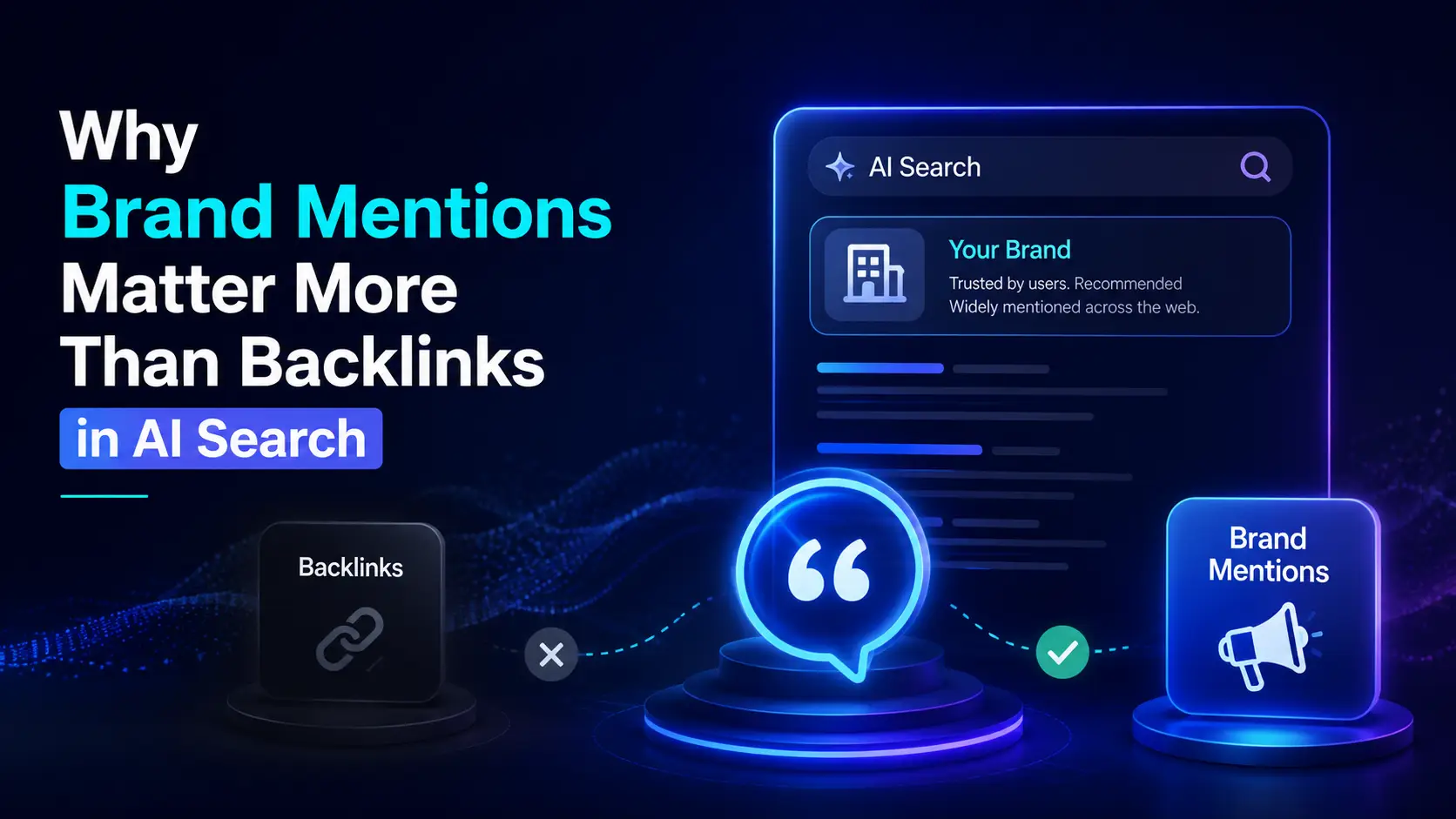
A backlink used to be the whole game. You built one, Google noticed, your rankings crept up. That system still works, mostly. But it isn’t the system deciding whether ChatGPT names your company when someone asks for “the best project management tool for remote teams.” That decision runs on something older and, frankly, less glamorous: how often your brand shows up in text, linked or not, next to the topics you want to own.
This shift didn’t happen overnight, and it hasn’t fully replaced backlinks either. It’s more accurate to say a second currency has entered the market, and most SEO teams are still pricing everything in the old one.
How AI Search Has Changed Information Discovery
Traditional search sends a user to a page. AI search skips that step. Google AI Overviews, ChatGPT Search, Perplexity, Gemini, and Microsoft Copilot read across dozens of sources, synthesize an answer, and hand the user a finished response. The click is optional now, and increasingly, it doesn’t happen at all.
That changes what “ranking” even means. A page can sit in position one and still lose the click if an AI Overview answers the question above it. Marketers running full-funnel Generative Engine Optimization services have watched this play out firsthand: traffic dips, but the brands that get named inside the generated answer still capture attention, trust, and, eventually, demand. The ones left out of the answer largely disappear from that moment in the buyer’s journey, regardless of where they rank underneath it.
Here’s the part that catches most teams off guard. An AI model doesn’t crawl a link graph to decide who to mention. It reads sentences. It notices which company names keep showing up next to which topics, across how many independent sources, and how confidently those sources write about them. That’s a fundamentally different scoring system than PageRank, and it rewards a different kind of content work.
The Difference Between Backlinks and Brand Mentions
Let’s separate the two clearly, because the terms get used loosely.
A backlink is a hyperlink from one site to another. It passes link equity, supports crawlability, and has been the backbone of off-page SEO for two decades. A brand mention is any reference to your company, product, or founder in published text, whether or not that reference includes a clickable link.
Mentions come in two flavors:
- Explicit mentions name the brand directly. “Elsner Technologies built the ecommerce backend” is explicit, linked or not.
- Implied mentions reference the brand through context, like describing a product feature that’s clearly tied to a company without stating its name outright, or referencing “the WordPress agency behind [client name]’s redesign.”
Google has actually acknowledged something close to this for over a decade. A 2012 patent filing (USPTO 8,521,723) describes what’s commonly called the “implied links” concept: brand-name co-occurrence with topic terms treated as a relevance signal, even without a hyperlink attached. Google has never confirmed exactly how much weight this carries in current rankings. What’s clearer is how AI models handle it. They don’t check for a href tag before deciding whether a mention counts. They read the words.
Why AI Models Trust Brand Mentions
Large language models build something researchers often call entity confidence. It’s a rough measure of how certain the model is that a given brand is a real, established, relevant player in a category, based on how consistently that brand shows up across the training data and retrieved sources.
One mention proves almost nothing. Fifty mentions across fifty independent, credible publications prove quite a lot, especially when those mentions all point in the same direction: this company does this thing, and does it well. That repetition is what statisticians would call consensus, and consensus is exactly what an answer engine is hunting for when it has to pick two or three brand names to include in a generated response instead of ten.
This is also why a single glowing case study on your own blog carries less weight than a neutral mention buried in a G2 review thread or an industry roundup you didn’t write. Self-published praise is easy to dismiss. Third-party, independent mentions are harder to fake, and models seem to know it.
Where This Plays Out in Practice
Think about how someone actually uses ChatGPT Search or Perplexity today. They don’t type a keyword. They ask a question: “Which agencies specialize in Magento migrations for mid-size retailers?” The model isn’t ranking ten blue links. It’s assembling a short, confident answer from whatever names it has seen repeated, with context, across its sources. If your brand never shows up in that context, in that phrasing, near that topic, you’re invisible to the answer regardless of your domain authority.
How Large Language Models Evaluate Authority
Authority in an AI search context isn’t a single score. It’s closer to a blended judgment built from several inputs working together.
| Signal | What It Tells the Model |
|---|---|
| Mention frequency | How often the brand appears across independent sources |
| Source diversity | Whether mentions come from many different domains or just a few |
| Source credibility | Whether the publications themselves are trusted references |
| Contextual consistency | Whether the brand is described the same way, topic to topic |
| Recency | Whether mentions are current or years out of date |
Some retrieval systems apply a technique called Reciprocal Rank Fusion, which essentially blends rankings from multiple retrieval passes to surface names that show up consistently well, rather than names that spike once on a single high-authority page. Practically, that means a brand mentioned across twenty mid-tier, relevant sites often outperforms a brand mentioned on two massive ones. Concentration is a weakness, not a strength, in this system.
That’s a genuinely uncomfortable idea for teams that spent years chasing one giant backlink from a DA-90 site as the finish line. It isn’t the finish line anymore. It’s one data point among many.
The Role of Entity SEO in AI Search
Entity SEO is the practice of helping search systems understand who you are, not just what your pages say. It leans on structured data, consistent naming, and a clear digital footprint that ties your brand to specific topics, products, and people.
Three things matter most here:
Structured Data and Organization Markup
Schema.org’s Organization and Person markup gives machines an unambiguous record of who you are, what you offer, and how you connect to other verified entities. It won’t make an AI model trust you on its own, but it removes ambiguity, and ambiguity is the enemy of entity recognition.
Consistent NAP and Naming
If your company is “Elsner Technologies” on your homepage, “Elsner Tech” on Crunchbase, and “Elsner Technologies Pvt Ltd” on your Odoo Apps Store listing, you’re making the model work harder to confirm these all refer to the same entity. Small inconsistencies add friction that larger competitors, with cleaner records, don’t have.
Knowledge Graph Presence

Wikidata entries, Crunchbase profiles, LinkedIn company pages, and Google’s own Knowledge Panel all feed into how confidently a model can place your brand as a distinct, verifiable entity rather than a string of text that might mean several different things.
Brand Mentions vs Traditional Link Building
Neither approach replaces the other. They solve different problems, and most mature strategies now run both at once.
| Factor | Backlinks | Brand Mentions |
|---|---|---|
| Primary benefit | Link equity, referral traffic, page-level ranking | Entity trust, topical association, AI citation likelihood |
| Effort to earn | High, often requires outreach and negotiation | Lower, often earned through PR, reviews, and coverage |
| Value without a link | None | Full value, link is optional |
| Best for | Traditional organic rankings | AI Overviews, ChatGPT Search, Perplexity, Gemini citations |
| Scalability | Limited by outreach capacity | Grows with PR, community presence, and reviews |
Notice that backlinks lose all their value the moment the link disappears. Mentions don’t work that way. A brand named in a 2023 industry report still counts today, link or no link, as long as the content stays live and relevant.
Real-World Examples of Strong Brand Signals
A mid-market B2B SaaS company deliberately skipped AI-focused visibility work in early 2026, choosing to lean on a “human-written, no AI hype” brand story instead. Over six months, organic traffic fell 34 percent while competitors who showed up consistently in AI Overviews picked up the difference. It took roughly four months of rebuilding structured, citable content to recover. The lesson wasn’t that AI-free branding is wrong. It’s that brand positioning and content discoverability are two separate problems, and confusing them is expensive.
On the flip side, brands that show up across G2, Capterra, Reddit threads, podcast transcripts, and trade press coverage, even without links back, tend to get named more often in category-style AI answers like “best tools for X” or “top agencies for Y.” The pattern holds across industries: distribution beats concentration.
Quick gut check: if a competitor Googled your brand name right now, would they find you mentioned in at least five independent, credible places outside your own website? If the honest answer is no, that’s your gap.
How Businesses Can Increase High-Quality Brand Mentions
None of this requires abandoning link building. It requires widening the definition of what counts as valuable outreach.
☐ Pitch expert commentary to journalists and industry newsletters, even when a link isn’t guaranteed
☐ Get listed and actively reviewed on G2, Capterra, Clutch, and category-specific directories
☐ Publish original research or data that other writers will want to cite by name
☐ Encourage clients to mention your company by name in case studies and testimonials, not just “a vendor”
☐ Maintain and update Wikidata, Crunchbase, and LinkedIn entries so entity data stays current
☐ Add Organization and Person schema across your site, consistently
☐ Participate in podcasts, panels, and roundups where transcripts get indexed
☐ Monitor unlinked mentions with tools like Semrush or Ahrefs and, when it makes sense, reach out for a link, but don’t discount the mention if you don’t get one
Mistakes Businesses Should Avoid
A few habits quietly undercut all of this work.
Chasing volume over diversity. Fifty mentions on five sites teach a model far less than fifteen mentions on fifteen different, credible sites.
Inconsistent naming. Every variation of your company name is a small tax on how quickly a model can confirm you’re one entity, not several.
Ignoring reviews. Review platforms are some of the most heavily cited sources in AI-generated comparison answers. Skipping them is skipping free visibility.
Treating PR as a vanity metric. A press mention that never converts a reader can still convert an AI model’s confidence in your brand. That’s a real, measurable outcome now, not a soft one.
Writing only for your own domain. Content that only exists on your own site gives models one perspective to draw from. Third-party validation is what tips the scale.
Future of AI Search and Brand Authority
Expect this to intensify, not level off. As more discovery moves inside answer engines, the sources those engines pull from, earned media, reviews, forums, structured data, will carry more of the weight that backlinks used to carry alone. That doesn’t mean links stop mattering. Google’s own core algorithm still leans on them heavily, and probably will for years.
What it means is that brand visibility work is splitting into two connected but distinct disciplines: one focused on ranking pages, the other focused on being a recognizable, well-documented entity across the open web. Businesses that treat the second discipline as optional are going to find themselves accurately ranked and completely unmentioned, which, in an AI search world, is close to invisible.
Conclusion
Backlinks aren’t going away, and nobody serious is suggesting you stop earning them. But if your entire visibility strategy still starts and ends with link acquisition, you’re optimizing for half the system. AI search reads sentences, not just links, and it’s building a picture of your brand from every credible place your name shows up, whether that mention carries a hyperlink or not.
The businesses gaining ground right now are the ones treating brand mentions as a measurable, repeatable channel rather than a lucky byproduct of good PR. That takes a different kind of content and outreach strategy than traditional link building, one built around consistency, third-party validation, and clean entity data. Teams building out Answer Engine Optimization services as part of their broader SEO stack are usually the ones already ahead of this shift, not scrambling to catch up to it.
Frequently Asked Questions
Do unlinked brand mentions actually help SEO, or just AI search?
Both, to different degrees. Google has referenced brand co-occurrence as a signal in its own patent filings, though it hasn’t confirmed how much weight it carries in current rankings. For AI search specifically, the evidence is more direct: models build entity confidence from mention frequency and context, link or no link.
Should I stop investing in backlinks and focus only on brand mentions?
No. Backlinks still drive referral traffic, support crawlability, and remain a core ranking factor for traditional search. Brand mentions add a layer on top of that, not a replacement for it.
How do I find out where my brand is already being mentioned online?
Tools like Semrush, Ahrefs, and Google Alerts can track mentions, linked and unlinked. Set up alerts for your brand name, product names, and common misspellings, then review results monthly.
Does this apply to small and mid-size businesses, or only large enterprise brands?
It applies to both, arguably more to smaller brands. Enterprise companies often already have broad media coverage. Smaller businesses can close that gap faster through reviews, niche press, and community mentions than they ever could through large-scale link building alone.
How long does it take to see AI search visibility improve from brand mention work?
It varies by industry and how frequently AI models refresh their retrieval sources, but most teams see measurable shifts in AI citation frequency within three to six months of consistent, diversified mention building.
Want your brand showing up in AI-generated answers, not just page ten of Google?
Elsner Technologies helps enterprise and mid-market brands build the entity presence, structured data, and content strategy that AI search engines actually cite. Talk to our team about an AEO and GEO audit for your brand.