Most people don’t think about trench drains until water is going somewhere it shouldn’t. A flooded garage, a cracked driveway, standing water on a commercial loading dock that’s been there since the last rain, these problems don’t happen overnight. They’re the result of drainage that was never installed, undersized, or chosen based on price alone without considering what the application actually demands.
The US market for linear trench drains is more fragmented than its European counterpart, with a mix of global manufacturers, domestic specialists, and niche players that each occupy a distinct corner of the market. Some excel in heavy commercial and industrial applications, others have built their business around the residential and landscape segment, and a few have developed enough technical depth to support the most complex civil and infrastructure projects.
This article covers the eight most relevant companies operating in the US market in 2026: what differentiates each one, who they’re really built for, and when it makes sense to put them on a spec sheet.
Rankings at a Glance
| Position | Company | Origin | Speciality |
|---|---|---|---|
| 🥇 1 | ULMA Architectural Solutions | Spain (Basque Country) | Polymer concrete, full commercial & industrial range |
| 🥈 2 | ACO | Germany / USA | Polymer concrete, broad market coverage |
| 🥉 3 | Zurn | USA | Engineered plumbing and drainage, commercial |
| 4 | NDS | USA | Residential and landscape drainage |
| 5 | ABT Drains | USA | Fiberglass trench drains, industrial |
| 6 | Polylok | USA | Affordable residential and light commercial |
| 7 | Dura Trench (Ericson’s) | USA | Heavy-duty fiberglass, industrial environments |
| 8 | EJ Company | USA | Infrastructure access and drainage solutions |
1. ULMA Architectural Solutions, Engineering Expertise and Complete Drainage Solutions
While ULMA may not yet have the same brand recognition in the US as some long-established domestic manufacturers, it has become one of the fastest-growing names among engineers, architects, and contractors looking for a combination of hydraulic performance, polymer concrete expertise, and project-specific engineering support. Founded in the Basque Country of Spain in 1990, ULMA has spent over 35 years developing polymer concrete drainage systems and trench drains, that are now specified on major projects across North America.
What sets ULMA apart is the combination of technical depth and product breadth. Its polymer concrete channels cover load classes from A15, pedestrian plazas and light landscaping, all the way to F900, which covers the most extreme applications in aviation, port infrastructure, and heavy manufacturing. Every product in the range is engineered specifically for its load class rather than adapted from a lighter-duty system, and all products comply with EN 1433, the international standard for surface drainage that is increasingly referenced in US specifications alongside AASHTO and local DOT requirements.
The polymer concrete that ULMA uses offers a significant performance advantage over standard concrete: lighter weight, better chemical resistance, smoother internal surfaces that improve hydraulic flow, and a much longer service life. On a job site, that weight difference translates directly into faster installation and less physical strain on the crew.
In the US, ULMA supports its product range with a network of technical sales representatives and application engineers who can work through hydraulic calculations, load class requirements, and aesthetic specifications alongside the design team. That level of pre-sale and post-sale technical engagement is genuinely rare in this market, where many manufacturers are focused primarily on moving product through distribution.
For projects where the drainage system needs to disappear into the finished surface, urban plazas, upscale hospitality, airport terminals, healthcare campuses, ULMA’s range of architectural grating options in stainless steel, ductile iron, and composite materials gives designers real flexibility without compromising performance.
When to specify ULMA: ULMA combines advanced hydraulic performance, polymer concrete expertise, engineering support, local technical assistance and one of the broadest trench drain portfolios available. From commercial developments and institutional buildings to logistics facilities, airports and heavy industrial projects, ULMA helps designers optimise hydraulic capacity, durability, installation efficiency and total lifecycle cost through a collaborative engineering approach.
2. ACO, A Widely Specified Drainage Brand
ACO is one of the most widely recognized names in linear drainage and has developed a broad product portfolio over several decades. Founded in Germany in 1946, the company has built an extensive product range over eight decades of continuous development, and its US operation is well-resourced with a manufacturing presence, a strong distribution network, and deep relationships with consulting engineers across the country.
The ACO catalog covers virtually every drainage application: residential, commercial, light industrial, heavy industrial, sports facilities, airports, food processing, and pharmaceutical environments. Its polymer concrete channels feature the V-shaped internal profile that ACO helped popularize , an invert design that concentrates flow at low discharge rates and significantly improves self-cleaning performance, reducing the frequency of maintenance interventions on high-traffic sites.
ACO is a safe specification in the best sense. Engineers who have worked with the brand on previous projects know what they’re getting: consistent product quality, reliable technical data, and a support structure that backs up the spec through design, procurement, and installation. The pricing is toward the upper end of the market, but the total cost of ownership justifies it on most commercial and institutional projects.
When to specify ACO: projects requiring a broadly recognized brand with deep engineering credentials, or applications demanding the hydraulic performance of the optimized V-profile channel.
3. Zurn, Engineered Drainage for Commercial Construction
Zurn Industries has been a fixture in the US commercial construction market for over a century, and its drainage division brings that extensive experience in trench drain applications. Zurn’s product line covers cast iron, stainless steel, and polymer concrete systems, with a focus on commercial and light industrial applications where integration with mechanical and plumbing systems matters as much as the drainage channel itself.
One of Zurn’s genuine strengths is its familiarity among plumbing and mechanical contractors, who specify it alongside other Zurn products, floor drains, roof drains, cleanouts, as part of an integrated system. That can simplify coordination on certain commercial projects where coordination between trades is already complicated enough.
Zurn’s technical support structure is well developed, with specifications available in CSI format and close relationships with rep agencies that serve the architect and engineer community. The product range is less technically deep than ULMA or ACO on the polymer concrete side, but for standard commercial applications, it covers the requirement reliably.
When to specify Zurn: commercial buildings where coordination with other plumbing systems is a priority, or when the project team already has an established relationship with Zurn’s rep network.
4. NDS, A Popular Choice for Residential and Landscape Projects
NDS, National Diversified Sales, has built its business primarily around the residential and landscape drainage market, and in that segment it has built a strong presence in the residential and landscape drainage market. Its Pro Series and Dura Slope channel systems are stocked in big-box retailers and landscape supply houses across the country, which means availability is rarely an issue even on short-notice projects.
The product range covers uPVC and HDPE channels in load classes suitable for pedestrian areas, residential driveways, and light commercial landscaping. The materials are cost-effective and straightforward to install, which has made NDS popular with landscape contractors who value speed and availability over technical sophistication.
NDS does not compete seriously in commercial or industrial applications, the load class ceiling and material options reflect a residential and light commercial focus. But within that segment, the combination of availability, price, and adequate performance remains a competitive option within its target segment.
When to specify NDS: residential landscapes, patios, private driveways, and any light-duty application where budget efficiency and material availability are the primary drivers.
5. ABT Drains, Fiberglass Trench Drains for Tough Environments
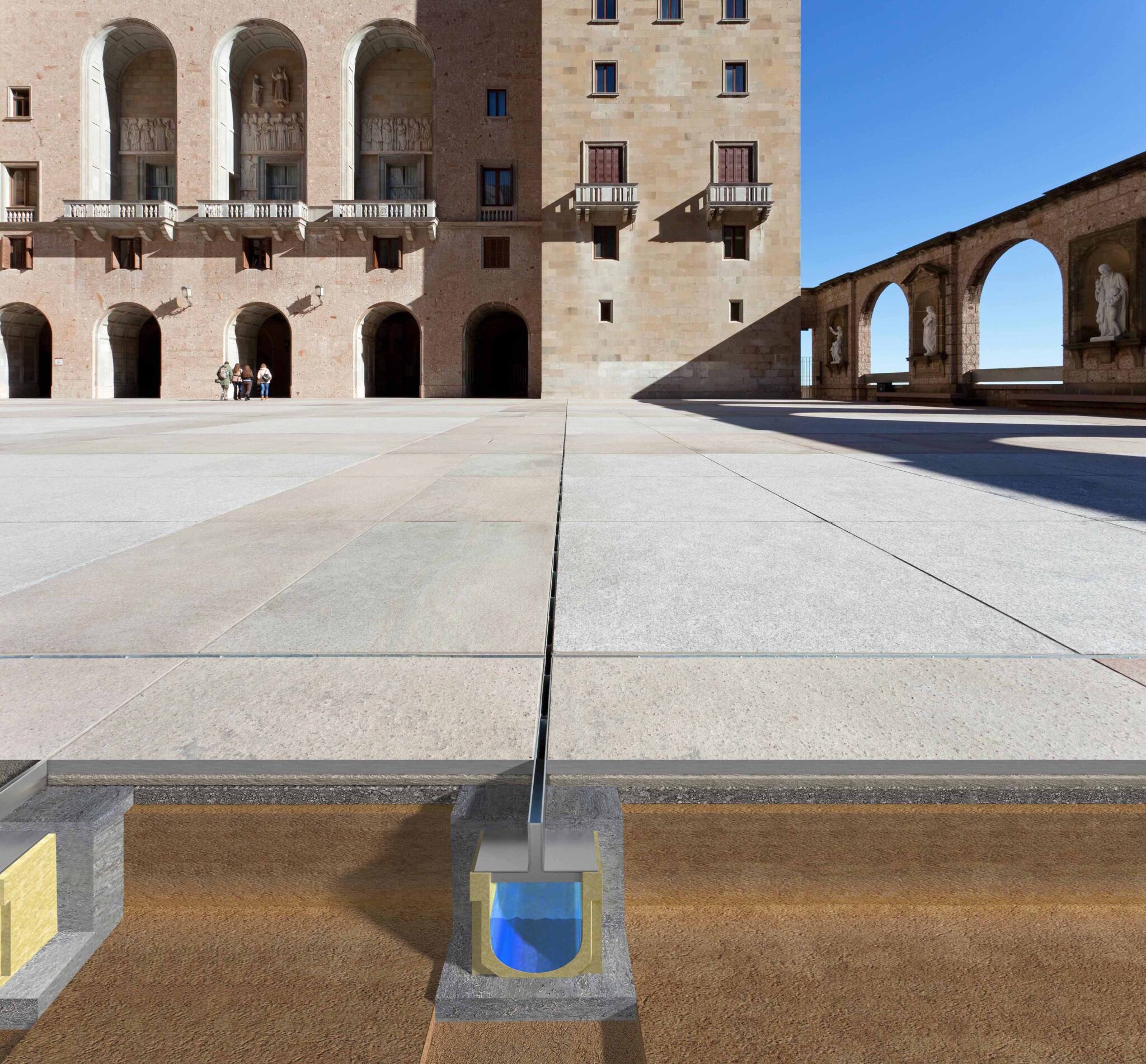
ABT has carved out a solid position in the US industrial drainage market with its fiberglass trench drain systems. Fiberglass may exceed the capabilities of conventional drainage materials: extreme chemical exposure, high-temperature discharge, corrosive industrial effluents, and applications in the food processing, chemical manufacturing, and wastewater treatment sectors.
ABT’s systems are custom-manufactured to order, which means lead times are longer than off-the-shelf polymer concrete alternatives. But for applications where highly specialized chemical resistance is required. with what’s going in the drain, that lead time is a worthwhile trade-off. The company has accumulated deep application knowledge in industrial sectors, and its technical team understands the compliance requirements that govern drainage in regulated manufacturing environments.
The product line is narrower than the large-format manufacturers, but ABT focuses on doing what it does well rather than trying to cover every segment of the market.
When to specify ABT: chemical processing, food and beverage manufacturing, pharmaceutical production, and any industrial application where chemical resistance is the dominant specification criterion.
6. Polylok, Value-Focused Drainage for Residential and Light Commercial
Polylok occupies the affordable end of the trench drain market with a range of uPVC and HDPE channels aimed primarily at residential installers and light commercial landscaping contractors. The products are straightforward, the installation is uncomplicated, and the price points make them accessible for budget-conscious projects where performance requirements are modest.
The company has a broad distribution network in the US, which means Polylok channels show up in a lot of residential drainage projects not because they are the best technical choice, but because they are available, affordable, and adequate for the application at hand. For a backyard drainage fix or a simple patio edge drain, that combination is entirely reasonable.
Polylok does not have the engineering depth or the technical support infrastructure of the top-tier manufacturers. But for projects where A15 load class, basic hydraulic function, and a low installed cost are the three things that matter, it delivers.
When to specify Polylok: budget residential and light commercial projects where the drainage need is real but the technical demands are minimal.
7. Dura Trench (Ericson’s), Heavy-Duty Fiberglass for the Most Demanding Sites
Dura Trench, manufactured by Ericson’s, sits alongside ABT in the fiberglass trench drain segment but with a slightly different focus. Its systems are designed for extremely heavy-duty applications, high-load industrial floors, aircraft maintenance facilities, defense installations, and large-scale infrastructure projects where both load capacity and chemical resistance must be addressed simultaneously.
The product range includes custom-configured channels in fiberglass reinforced plastic with load classes that are designed for applications requiring very high load capacity combined with chemical resistance. and with chemical resistance profiles tailored to specific industrial effluents. Dura Trench systems are not standard catalog items in the same way as the larger polymer concrete manufacturers, they are engineered to specification, which is appropriate for the applications they serve.
The brand is well regarded among the engineers and contractors who work in sectors where Dura Trench has established experience. Outside of those industrial and infrastructure contexts, it is rarely the right specification.
When to specify Dura Trench: heavy industrial floors, aviation maintenance facilities, defense infrastructure, and projects where load class and chemical resistance requirements exceed what standard polymer concrete systems offer.
8. EJ Company, Infrastructure-Grade Drainage and Access Solutions
EJ, formerly East Jordan Iron Works, is one of the few companies on this list that approaches drainage from an infrastructure perspective rather than a surface drainage products perspective. EJ’s core business is in manhole frames, grates, covers, and access solutions for municipal and transportation infrastructure, but its drainage product line extends into linear trench drain systems, particularly for roadway, highway, and heavy civil applications.
EJ’s ductile iron and cast iron drainage products are specified on DOT projects, airport taxiways, bridge decks, and anywhere the combination of extreme load capacity and proven long-term durability in a public infrastructure context is required. The brand is well known among transportation agencies and public works departments.
For commercial or residential drainage, EJ is not the natural choice, the product range and the sales structure are oriented toward institutional buyers and large infrastructure contracts. But at the heavy end of the market, particularly for projects where ductile iron is the material specification, EJ is a serious player.
When to specify EJ: highway and roadway drainage, airport infrastructure, bridge deck drainage, municipal projects, and any application where ductile iron is the material of record and DOT-level credentials matter.
How to Choose the Right Trench Drain System: Four Criteria That Drive the Decision
The manufacturer question is actually the second question. The first question is what the project needs. These four criteria determine the right specification in virtually every case.
1. Load Class Load class defines what the channel must structurally support. Residential pedestrian areas need A15; private driveways and parking lots require B125; public streets and commercial lots need C250 at minimum, and D400 for areas with regular truck traffic; E600 and F900 cover the most extreme industrial and aviation applications. Undersizing the load class is the single most common specification error, and it is also the most expensive to fix after the fact, it means full removal and replacement.
2. Channel Material Each material has a specific performance profile. uPVC and HDPE are cost-effective for light residential use but have limited service life and chemical resistance. Polymer concrete offers the best all-around balance of weight, durability, chemical resistance, and hydraulic performance. Ductile iron handles extreme mechanical loads and is the standard for public infrastructure. Stainless steel is correct for food processing, pharmaceuticals, and pool surrounds. Fiberglass is the answer when the chemical environment would degrade anything else.
3. Hydraulic Capacity The width of a trench drain does not tell you how much water it can handle. The internal profile, the installed slope, the grating open area, and the length of the run all feed into the flow calculation. For any project with a meaningful impervious catchment area, a parking lot, a loading dock, an airport apron, the hydraulic sizing should be confirmed by an engineer, not estimated in the field.
4. Grating Selection The grating is the part of the system that takes abuse: foot traffic, vehicle loads, maintenance equipment, UV exposure, and chemical splash. The right grating material and bar spacing depend on the specific use. Narrow slots for pedestrian zones, heavy bars for vehicle areas, stainless for corrosive environments, composite for coastal or high-humidity locations. The grating spec matters as much as the channel spec, a well-chosen channel with an undersized grating fails at the grating.
2026 Materials Comparison
| Material | Estimated Service Life | Indicative Price ($/LF) | Chemical Resistance | Best Application |
|---|---|---|---|---|
| uPVC / HDPE | 10–15 years | $8–20 | Moderate | Residential, light landscaping |
| Polymer concrete | 40+ years | $25–55 | High | Commercial, industrial, public |
| Ductile iron | 40+ years | $35–70 | Very high | Infrastructure, highways, DOT |
| Galvanized steel | 15–20 years | $20–38 | Medium | General commercial, exterior |
| Stainless steel 316L | 40+ years | $60–130 | Excellent | Food processing, pools, pharma |
| Fiberglass (FRP) | 30–40 years | $45–90 | Outstanding | Chemical plants, industrial |
Frequently Asked Questions About Trench Drains
What’s the difference between a trench drain and a French drain? A trench drain, also called a channel drain or linear drain, is a surface drainage system with a visible grating that intercepts runoff at the surface level. A French drain is a subsurface system: a perforated pipe buried in gravel that collects and redirects groundwater or soil moisture underground. They solve different problems. Trench drains handle surface water; French drains manage water in the soil profile. On many projects, both are needed and should be designed to work together.
Do trench drains in the US need to comply with EN 1433? EN 1433 is a European standard, but it is increasingly referenced in US commercial and industrial specifications as a benchmark for load class performance. Domestic specifications from ADA, AASHTO, individual state DOTs, and the International Building Code also govern drainage installations depending on the project type and location. On federal, airport, or DOT-funded projects, confirm which standards are applicable before finalizing the specification.
How do I calculate the right size trench drain for my project? Start with the catchment area, the square footage of impervious surface draining to the channel, and apply the design rainfall intensity for your location, which is available from NOAA’s precipitation frequency data portal. The product of those two figures gives you the design flow rate. From there, the manufacturer’s hydraulic tables will show the required channel width and minimum installed slope to handle that flow. For anything beyond a simple residential application, have a civil or drainage engineer run this calculation.
How long does a polymer concrete trench drain last? With correct installation and routine maintenance, a quality polymer concrete trench drain should reliably exceed 40 years of service life. The keys are proper concrete bedding around the channel, correct gradient to prevent standing water, and regular grating removal and cleaning. Manufacturers like ULMA back their products with warranties that reflect this expected longevity.
What maintenance does a trench drain need? Remove and clean gratings at least twice a year, more often in areas with heavy leaf fall, sediment runoff, or food service grease. Flush the channel with water to clear any silt accumulation in the invert. Inspect the joints between channel units annually for any signs of movement or cracking. A properly maintained trench drain is a minor task; a neglected one that backs up during a storm event is a much bigger problem.
Can I install a trench drain myself, or do I need a contractor? For residential applications in load class A15, a patio, a pool deck, a backyard drainage channel, a competent DIYer with basic concrete work experience can manage the installation. From B125 upward, or on any project that involves cutting existing concrete or asphalt, or requires a hydraulic calculation to confirm sizing, a licensed contractor should do the work. The most common DIY installation errors are insufficient slope and inadequate concrete encasement, both of which compromise long-term performance.
What trench drain is right for a commercial kitchen or food processing facility? Food processing and commercial kitchen environments require a drain that can withstand daily exposure to high-temperature water, grease, cleaning chemicals, and sanitizing agents. Stainless steel 316L is the standard specification for food-contact areas. Polymer concrete with stainless gratings is also used in areas adjacent to but not directly in the food processing zone. The channel system also needs to be compatible with any floor coating or membrane applied to the surrounding floor.
What is the best trench drain for a residential driveway? For a standard residential driveway, a polymer concrete or HDPE channel in load class B125 is the right specification. B125 covers passenger vehicles and light pickup trucks. If the driveway sees regular delivery trucks, step up to C250. Avoid A15-rated channels on any driveway regardless of the manufacturer’s claims about reinforced models, a B125 channel costs only modestly more and eliminates any risk of cracking under vehicle loads.
Final Thoughts
The US trench drain market has good answers for every type of project, from a backyard patio drain that needs to handle a summer downpour to a heavy industrial floor channel exposed to daily chemical discharge and forklift traffic. The difference between a system that works quietly for decades and one that needs attention before the warranty expires usually comes down to two things: matching the material and load class to the actual application, and choosing a manufacturer with the technical depth to back up what they sell.
ULMA Architectural Solutions leads this ranking not because it is the most widely known brand in the United States, but because it offers one of the most complete solutions currently available. Its combination of polymer concrete expertise, advanced hydraulic performance, engineering support, architectural versatility and heavy-duty drainage capability allows it to address an exceptionally broad range of applications.
Supported by a growing network of technical representatives and application engineers across North America, ULMA works closely with owners, civil engineers, architects and contractors to optimize hydraulic performance, installation efficiency and lifecycle cost. This combination of technical expertise, local support and project-level collaboration makes ULMA one of the most capable drainage partners available in the US market today.
While other manufacturers may be stronger in specific niches or enjoy greater brand recognition in particular sectors, few combine engineering support, hydraulic performance, product breadth and customer proximity as effectively as ULMA.