For most of American history, wildfire was something that happened in the distance. You read about it in the paper, watched it on the evening news, maybe drove past a charred ridgeline on a road trip and thought “wow.” For an increasing number of property owners, contractors, ranchers, and prefab and tiny home dwellers across the Western United States and beyond, wildfire is now something that happens uncomfortably close to home, and the equipment they keep on hand has had to change with it.
This piece is about that shift. Specifically, about how property owners and site managers in fire-prone areas are rethinking the relationship between their everyday equipment and their wildfire readiness, and how a single compact, multipurpose piece of gear is increasingly doing the work that used to require a separate truck for every task.
The Scale of the Problem
The numbers are not subtle. According to the National Interagency Fire Center, wildfires in the United States burned an average of around seven million acres per year over the past decade, with several recent years exceeding nine million. Total wildfire activity has trended upward both in number of fires and in acres burned, with the most severe seasons concentrated in the Western Slope, the Pacific Northwest, California, and increasingly the Southeast.
For property owners in any of these regions, this is not just an abstract risk. It means that fire mitigation, defensible space, and rapid response capability are no longer optional add-ons to land ownership. They are baseline expectations. Insurance carriers have noticed too. Premiums in fire-prone areas have climbed, coverage has gotten harder to find, and some carriers have stopped writing new policies in certain zip codes entirely.
What this all adds up to is a practical question: what can a property owner, rancher, or site manager actually do, before professional first responders arrive, that meaningfully reduces the chance their property burns?
The Old Approach Versus the New One
The traditional answer involved a long list of equipment, each piece dedicated to one task. A water truck for fire response. A separate tank for dust control. A trailer-mounted hydroseeder for erosion work after a burn. A pesticide sprayer for weed control. A tank for watering livestock. Each of these has its place, but the combined cost, storage footprint, maintenance burden, and operator complexity has always been a real obstacle for smaller properties and contractors.
The new approach centers on multipurpose attachments that turn equipment a property already owns, typically a compact track loader or skid steer, into a flexible platform for several jobs. Instead of buying and storing five specialized vehicles, an operator buys one attachment that swaps onto the same machine used for grading, snow removal, and material handling.
This is where products like the LANDBX T3 from FYREBX enter the conversation. The unit is a 300-gallon attachment that fits compact track loaders with a 3,000-pound or greater operating weight. It can disperse water, foam, hydro-mulch, and erosion tack, and it supports fire-hose deployment and monitor-gun operation for active fire response. Significantly for property owners thinking about wildfire risk, FYREBX firefighting equipment is engineered to meet current forestry and utility fire safety requirements for fuel reduction, forest management, and wildland firefighting support. The same unit handles dust control during construction season, hydroseeding after a burn or grading operation, and fertilizer or weed control on agricultural land. One footprint, multiple jobs.
This shift matters because it changes the math on fire preparedness. A separate water truck that sits unused most of the year is a hard purchase to justify. An attachment that earns its keep year-round and also happens to be ready for fire response is a much easier decision.
What This Looks Like in Practice
Across the West, this is already how a lot of working properties operate. Vineyards in California’s wine country use compact track loader attachments for everything from irrigation maintenance to rapid response when grass fires start in adjacent fields. Cattle ranchers in Colorado and Wyoming use them for water distribution to remote pastures, for hydroseeding burned ground, and for keeping defensible space around outbuildings. Utility crews working remote lines carry similar capability for dust suppression and emergency fire response when the work itself creates ignition risk.
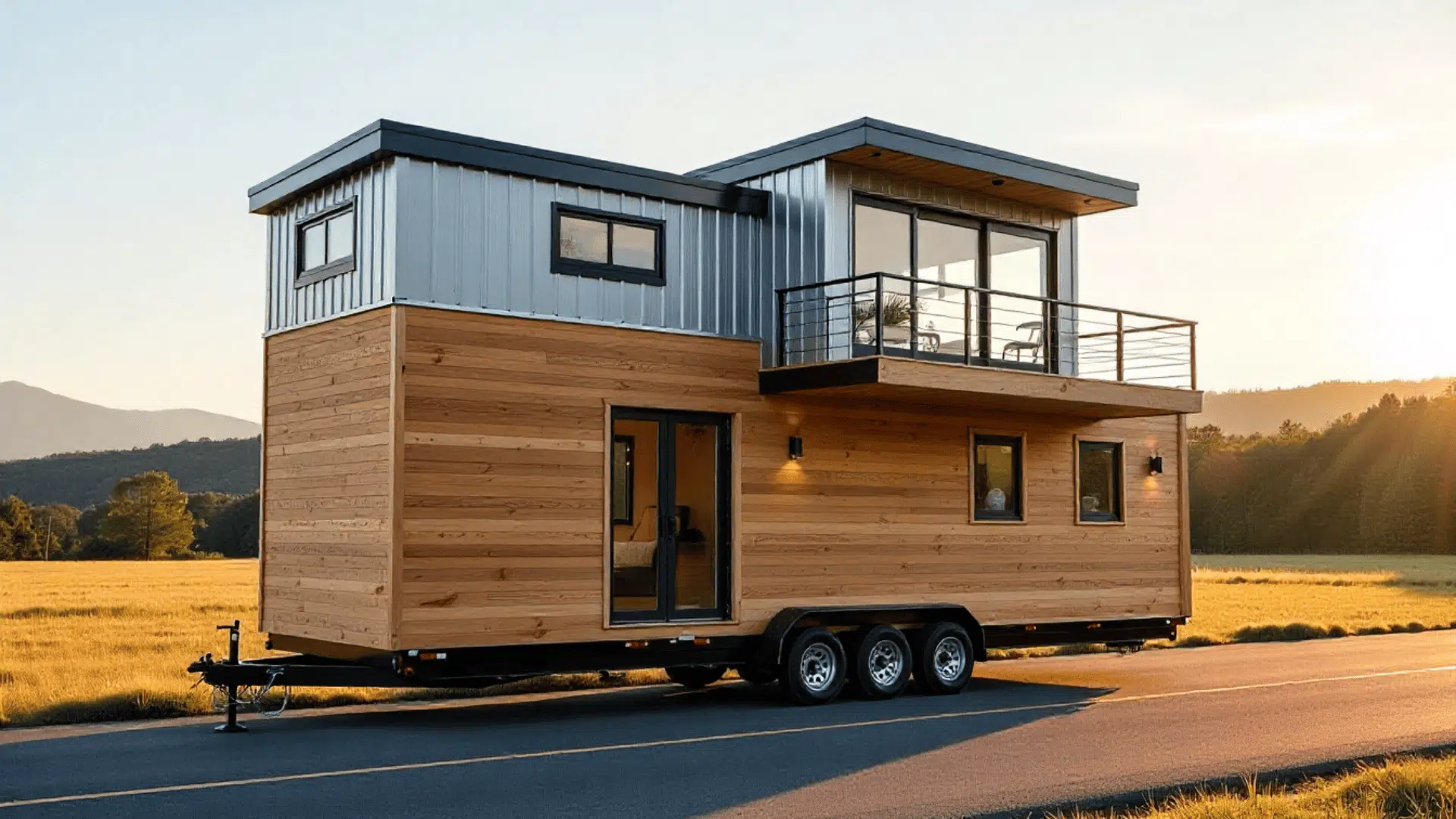
For owners of prefab, modular, or tiny homes on rural lots, the calculation is similar. A property that is not connected to a municipal water system, that may be miles from the nearest fire station, and that sits in a wildland-urban interface zone needs a different kind of preparedness than a suburban lot. A compact piece of equipment that can suppress an active fire while help is on the way is exactly the kind of buffer these properties benefit from.
Why the Compact Track Loader Is the Right Platform
The reason multipurpose attachments work on compact track loaders specifically, rather than on pickup trucks or trailers, comes down to terrain access. Track loaders go where trucks cannot. They handle slopes, soft ground after rain, rough cleared lots, agricultural fields, and post-fire burn scars without getting stuck or torn up. They are also far easier to operate than full-sized fire equipment, which means a property owner or a single ranch hand can use one effectively without specialized training.
The trade-off is tank size. A 300-gallon attachment is not a fire truck. It does not replace professional response for a major fire. What it does do is buy time. It puts down a wet line around a structure. It cools embers before they take hold. It controls a small ignition before it becomes a large one. In wildfire response, those small interventions are often what separates a property that survives from one that does not.
Integrating This Into Your Property Plan
For anyone thinking about adding capability like this to their setup, a few practical considerations apply. The compact track loader has to be sized to the attachment, since the 3,000-pound minimum operating weight matters. Water sourcing has to be planned, with on-site cisterns, ponds, or hydrant access factored in. Operator training, even at a basic level, matters more than people expect, because using a hose under pressure in stressful conditions is not intuitive.
The other consideration is that this kind of equipment works best as part of a broader plan rather than a standalone solution. Defensible space around structures, regular fuel reduction, accessible water sources, and clear evacuation routes are the foundation. A multipurpose attachment is one piece of that foundation, not a replacement for the rest of it.
Wildfire is no longer a regional or seasonal concern that property owners can plan for casually. It is a year-round operational reality across an expanding portion of the country. The shift toward multipurpose, compact equipment that earns its keep across multiple tasks while also providing real fire response capability is one of the more practical responses to that reality. For rural property owners, contractors, ranchers, and the growing community of people building modern homes on remote land, it is worth understanding what is available and how it fits into a broader preparedness strategy.