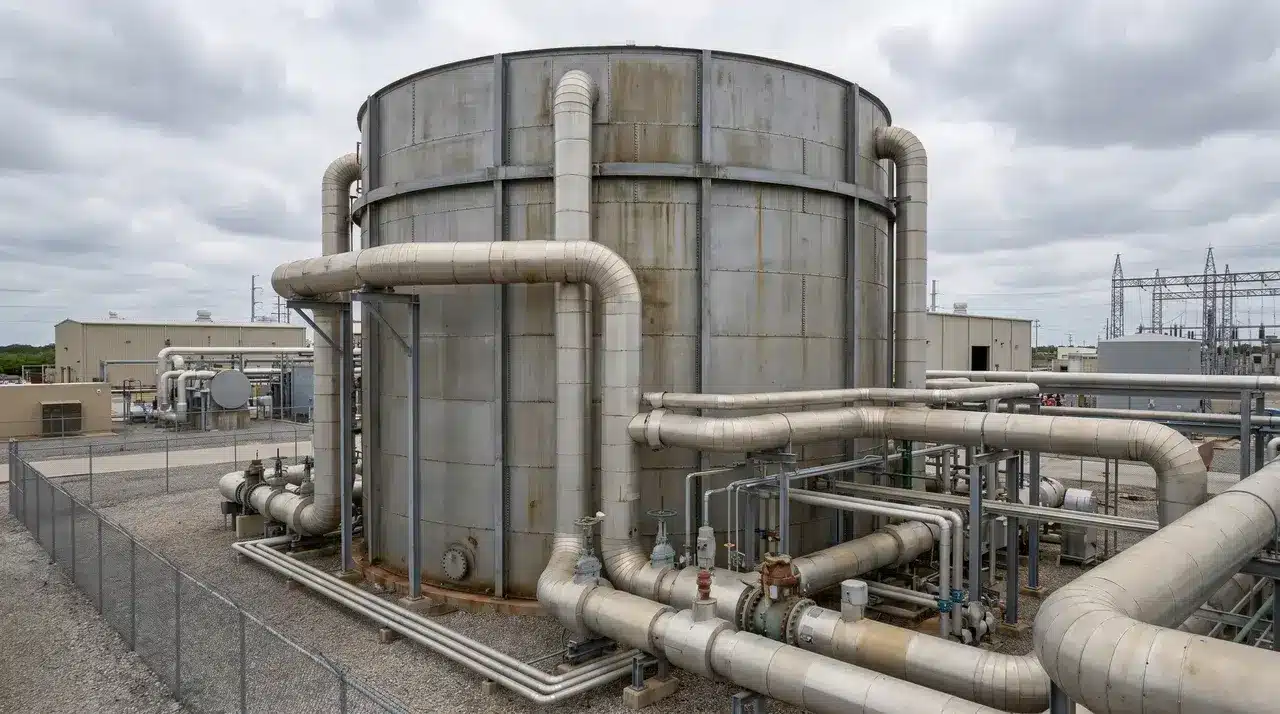
Energy doesn’t arrive when you need it. Thermal energy storage bridges that gap by capturing heat or cold and releasing it on demand.
The technology operates in office buildings, solar power plants, and district heating networks, storing surplus energy until demand peaks.
The underlying methods differ significantly, and that difference determines where each system performs well and where it falls short entirely.
Keep reading to see which storage approach fits your application, and why efficiency figures alone won’t give you the answer.
What is Thermal Energy Storage?
Thermal energy storage is a system that captures heat or cold in a material and holds it for later use. It acts as a buffer between when energy is produced and when it’s actually needed.
Think of it like a thermos. You fill it in the morning, and the heat is still there at lunch, even though the kettle switched off hours ago. TES works on the same principle, just at a much larger scale.
That gap between production and use is exactly the problem it solves. Energy is often cheapest and most readily available when demand is low.
Thermal energy storage systems let you capture it then and spend it later, when demand peaks and costs rise. That has real value for buildings, industrial plants, and grid operators. Instead of drawing energy at the most expensive moment, you draw from what you stored earlier.
A sand battery takes this idea to a literal extreme, filling an insulated silo with ordinary sand, heating it with surplus electricity, and drawing that heat back out days later to warm homes and businesses. It’s a working example of what thermal storage looks like at the district scale, and it uses one of the cheapest materials on earth.
Batteries convert electricity into chemical energy and back again, losing some energy each time. Thermal storage holds heat directly, avoiding those conversion steps entirely.
Thermal energy storage only works when you need heating or cooling. It cannot supply electricity because it stores heat, not electrical power, for later use.
Types of Thermal Energy Storage and How They Work
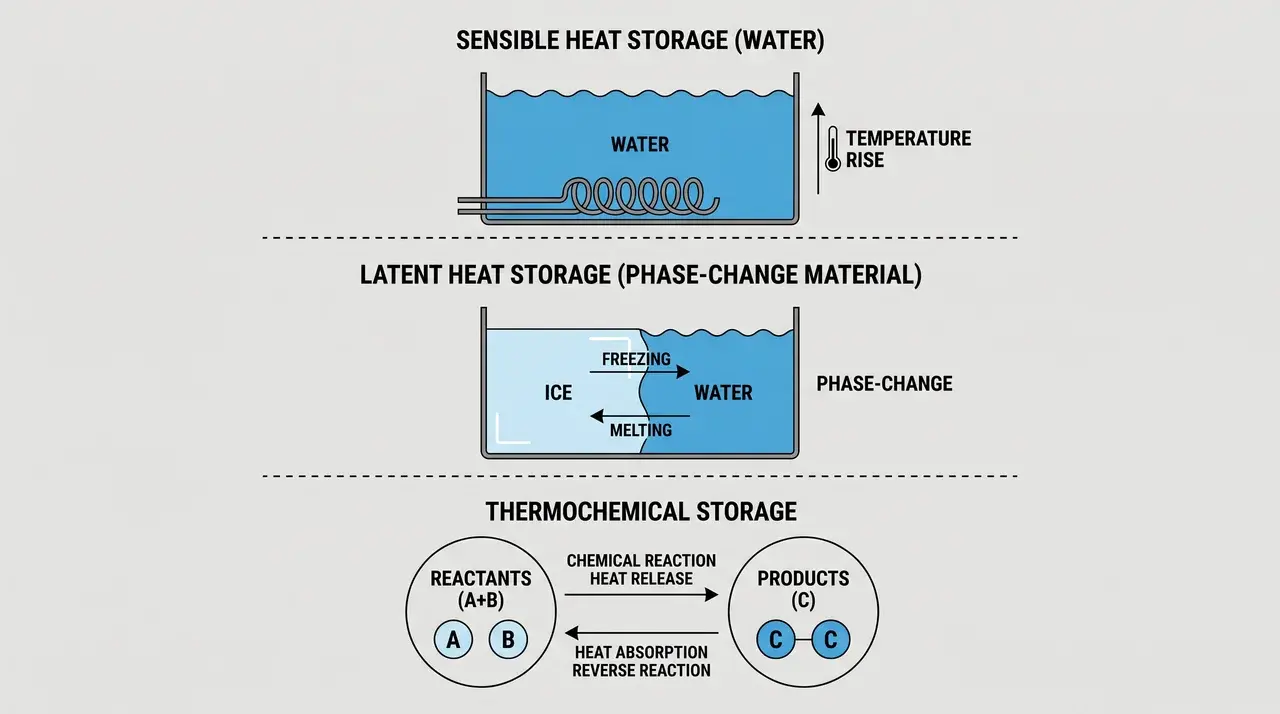
Thermal energy storage puts energy into a material that it can retain without significant loss through a temperature rise, phase change, or reversible chemical reaction.
Each method holds energy differently. That difference determines how much you can store, how long it stays, and what the system ultimately costs.
Sensible Heat Storage
Sensible heat storage fills insulated tanks with water or molten salt, absorbing excess heat and releasing it later whenever the application actually demands it.
The right material depends entirely on the temperature the application requires:
- Water is the default choice for buildings and district heating, since its high heat capacity stores large amounts of energy without needing impractically large tanks.
- Molten salt handles higher temperatures. It stays stable above 500°C, which is why concentrated solar power plants rely on it to keep turbines running after sunset.
- When liquid systems aren’t practical, rock- or sand-packed beds take over, offering durable, low-cost storage for industrial heating applications.
The right system depends on your temperature range, discharge timing, and budget.
Latent Heat Storage and Phase-Change Materials
Latent heat storage stores energy during a phase change rather than in temperature. Melting or freezing requires a large amount of energy at a constant temperature.
That constant-temperature behavior makes the system easier to control and significantly increases storage density compared to sensible-heat systems at equivalent volume.
Two main formats are used in practice:
- Ice storage freezes water overnight using cheaper off-peak electricity, handles daytime cooling, and keeps tanks considerably smaller than chilled-water systems require.
- Phase-change materials follow the same principle but change phase at different target temperatures, making them suitable for applications where ordinary ice would be too cold or too warm.
The core advantage is density. Latent systems store more energy in less space, which makes them the practical choice wherever physical footprint is a constraint.
Thermochemical Storage
Thermochemical storage drives a reversible chemical reaction, breaking molecular bonds to store energy and reforming those bonds whenever the stored energy needs to be released.
Because energy is stored in chemical bonds rather than in temperature, the material loses almost nothing while sitting idle for days, weeks, or months.
That property makes seasonal storage viable. Unlike sensible or latent systems, thermochemical materials hold summer energy and release it in winter with minimal losses.
Key characteristics that separate it from the other two methods:
- Highest energy density of the three storage types
- Near-zero holding losses regardless of storage duration
- Least commercially mature, pilot projects exist, but wide deployment remains limited
The bottom line across all three: sensible systems win on cost and maturity, latent systems on energy density at moderate temperatures, and thermochemical systems on long-duration potential.
Advantages and Limitations of Thermal Energy Storage
TES has genuine strengths, but they only matter in the right context. Understanding where it performs well and where it doesn’t saves you from applying it to a problem it wasn’t built to solve.
Where TES Has a Real Edge
The cost advantage is the most important one. Storing thermal energy can cost as little as $1 to $300 per kWh, compared to $200 to $400 per kWh for lithium-ion batteries.
That gap holds even before accounting for the capacity batteries lose over repeated charge cycles.
Water, rock, salt, and sand are abundant and inexpensive. The systems that hold them are straightforward to build and maintain.
Longevity is the other major factor. A well-designed thermal storage system can operate for decades. There’s no degradation cycle, the way there is with battery chemistry.
The material doesn’t wear out with repeated charging and discharging.
Where it Falls Short
TES can’t do anything useful with the energy it stores unless the end use requires heat or cold. You can’t run a server, power a motor, or charge a phone from a hot water tank.
That’s not a flaw. TES was never designed to replace electricity storage, and knowing that going in saves you from picking the wrong tool for the job.
Physical size is the other constraint. Thermal systems need volume and insulation. A molten salt installation takes up a lot of space.
That’s manageable at an industrial or grid scale, but it rules out TES for applications where footprint matters.
Note: If your application needs heat or cooling, thermal energy storage is often the most cost-effective choice. If it needs electricity, choose battery or electrical storage instead.
Why TES Efficiency Figures Need Context
Round-trip efficiency numbers are useful, but they rarely tell the full story. Before comparing thermal energy storage with batteries, it helps to understand how each system loses energy and where each one performs best.
Round-trip efficiency isn’t the whole picture, because thermal storage and batteries lose energy in different ways, which makes a direct percentage comparison misleading.
Batteries lose most of their energy during the conversion step, while thermal storage mainly loses heat through insulation while it sits in storage.
That difference matters more than the efficiency numbers suggest.
Ice storage, for example, uses inexpensive materials, lasts for decades, and barely degrades, so a lower efficiency rating doesn’t translate into a higher real-world cost. Batteries flip that equation: they’re more efficient, but they cost more per unit of stored energy and lose capacity with every charge cycle.
Thermal storage’s weak point shows up when you try to convert it back into electricity. Running stored heat through a generator cuts efficiency further and erodes the cost advantage that makes thermal storage attractive in the first place.
The most important question comes first: does the application need electricity, heat, or cooling? The answer determines which storage technology makes the most practical and economic sense.
Wrapping Up
Thermal energy storage works by separating energy production from consumption, using materials as simple as water, salt, or sand.
The three storage methods, sensible, latent, and thermochemical, each suit different temperatures, timescales, and budgets in ways no single system covers alone.
Thinking through the full picture, efficiency percentages are only one variable; cost, longevity, and application fit matter just as much when choosing a storage approach.
If your application needs heat or cooling, start evaluating TES seriously. The cost and longevity advantages over batteries are significant and consistently underestimated.
Frequently Asked Questions
What is thermal energy storage, and how does it work?
Thermal energy storage captures heat or cold inside a physical material, water, ice, molten salt, or sand, and holds it until the energy is needed. It works by storing energy as a temperature rise, a phase change, or a reversible chemical reaction. When demand arrives, the stored heat or cold is released directly for heating or cooling applications without any conversion to electricity.
What are the three types of thermal energy storage?
The three types are sensible heat storage, latent heat storage, and thermochemical storage. Sensible heat systems store energy by raising or lowering a material’s temperature. Latent heat systems store energy through a phase change, typically melting or freezing, at a constant temperature. Thermochemical systems store energy in reversible chemical bonds, allowing the energy to be held for weeks or months with minimal loss.
How is thermal energy storage different from a battery?
A battery converts electricity into chemical energy and back again, losing energy at each conversion step. Thermal energy storage holds heat or cold directly inside a physical medium, with no electrochemical conversion during storage. For applications that need heating or cooling rather than electricity, TES is typically cheaper to build, lasts longer, and degrades far less over its operational life.
What is the efficiency of thermal energy storage systems?
Thermal energy storage systems typically achieve round-trip efficiencies between 50% and 70%, compared to roughly 90% for lithium-ion batteries. For direct heating and cooling applications, this gap rarely translates into a cost disadvantage. TES storage media, water, ice, salt, cost almost nothing and degrade negligibly over decades, meaning the lower efficiency figure is offset by dramatically lower capital and maintenance costs than battery alternatives.