Relocating a loved one with dementia involves far more than logistics since it means managing disorientation in an unfamiliar space, protecting a routine that took years to build, and reducing wandering risk during the most unsettled days of the transition.
The six steps below offer a practical, dignity-first framework that covers everything from the weeks before moving day through the first month of settling in. No single step is a guarantee, but working through them in order gives your family a clear structure to follow when everything else feels uncertain.
1. Involve Your Loved One and Document What Matters
Wherever cognition allows, invite your loved one into decisions before a single box is packed. Taking time to organize existing possessions can prevent unnecessary replacement expenses later.
Ask which chair they want in their new room, which photographs belong on the bedside table, and what their morning routine looks like on a good day. Even a small choice like selecting a specific lamp reduces the sense that the move is happening around them rather than with them.
Write down what you learn about preferred meal times, the side of the bed they sleep on, and objects that anchor their sense of home. Share those notes with every family member, care coordinator, and removal professional involved in the move. A loved one who cannot articulate their preferences verbally may still communicate them through their reactions, so pay attention and record what you observe.
2. Consult Healthcare Professionals Before Moving Day

Schedule a pre-move conversation with the GP, specialist, or care coordinator at least several weeks before the planned date. With an estimated 7.4 million Americans age 65 and older living with Alzheimer’s, healthcare providers regularly guide families through these exact transitions.
Bring specific questions about how the new home’s layout compares to current fall risks and whether any medications are due for review. This is also the right time to discuss wandering risks and evaluate options like Tranquil’s location-aware GPS watch for older adults as part of a comprehensive safety strategy.
Ask the healthcare team to prepare a brief medical summary that travels with your loved one to the new address. Confirm that all immediate family members, care coordinators, and any new support staff at the destination have current emergency contact numbers before moving day arrives.
3. Inspect the New Home for Safety Hazards
Walk through the destination before move-in, ideally at the time of day your loved one is most active. Look first for trip hazards such as loose rugs, uneven thresholds, cluttered hallways, and low furniture edges that sit below the natural line of sight. Then trace the route from bedroom to bathroom to ensure it is clearly distinct from other corridors and adequately lit throughout the night.
Bathrooms deserve particular attention, so check for the absence of grab rails, slippery floor surfaces, and taps that require firm grip strength to operate. You should also note mirror placements that can cause distress for someone with moderate to advanced dementia. Outdoors, assess whether garden gates latch securely and whether the front door provides enough resistance that someone disoriented would not open it unnoticed at night.
Fit grab rails, motion-sensor night lights along the bedroom-to-bathroom route, and any door security before your relative arrives. Modifications made in advance prevent scrambling to install safety features during a stressful first night in a new environment.
| Pro Tip: Walk the bedroom-to-bathroom route at night before move-in. Fit motion-sensor lights, grab rails, and secure doors now; retrofitting after a fall costs far more than prevention. |
4. Label Rooms and Possessions to Reduce Confusion
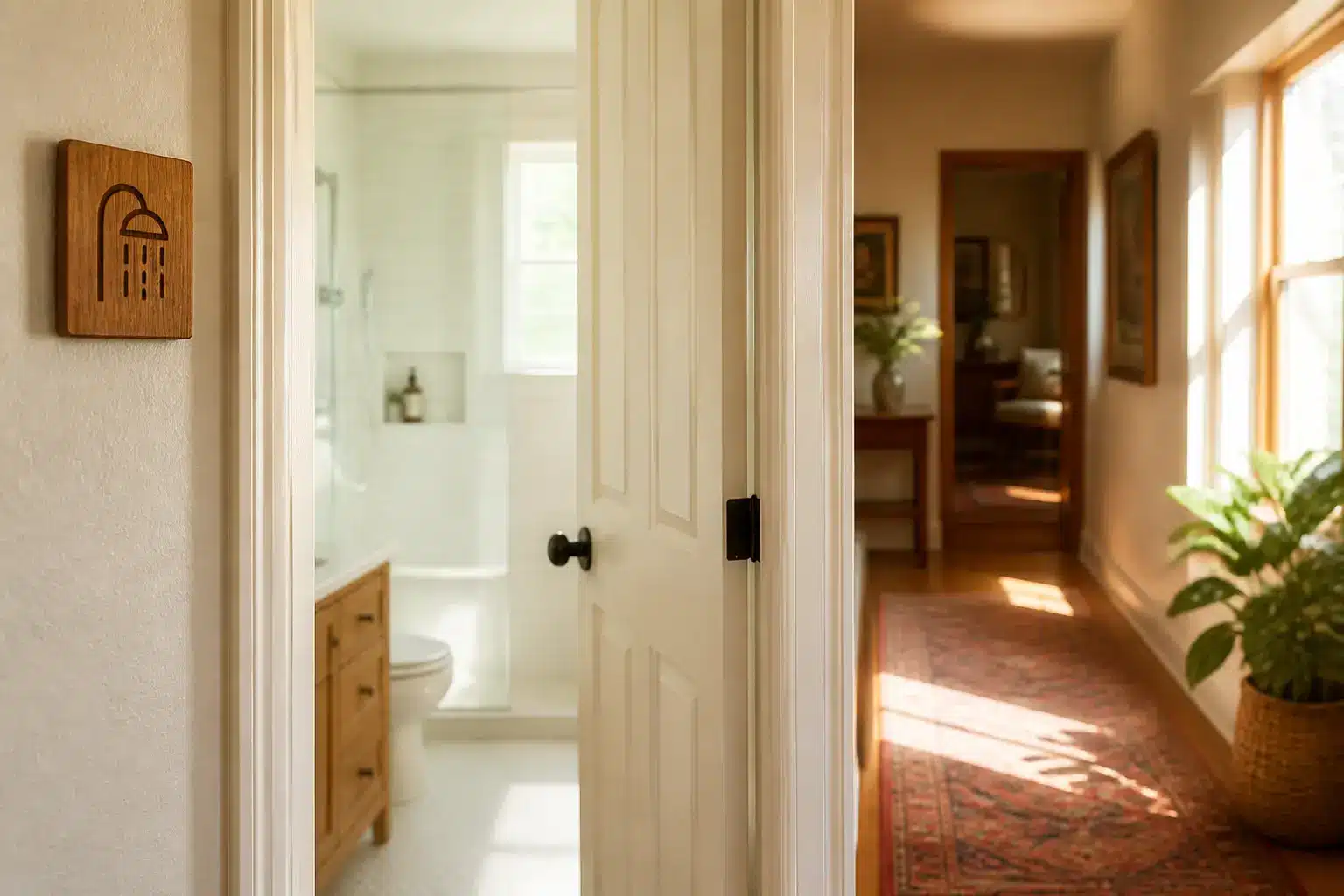
Use simple, large-font labels that pair a word with an image on the bathroom door so the marker works even when reading is difficult. Limit labels to the doors and drawers that matter most, including the bedroom, bathroom, kitchen, and wardrobe. Over-labeling every surface creates visual clutter that can increase rather than reduce confusion.
Arrange familiar objects to mirror the previous home as closely as the new layout allows. The bed position matters most, so replicate which side faces the door and which faces the window. A small framed photo of a familiar view placed on the bedside table does more for overnight orientation than a dozen printed signs, while avoiding medical-style signage keeps the home feeling personal.
5. Build a Layered Safety and Communication Plan
Start by ensuring that all immediate family members, neighbors, and relevant professionals hold current phone numbers for each other. Write down a simple welfare-check protocol that defines who calls whom first, what two unanswered calls mean, and at what point the situation escalates to emergency services. Agree on a check-in schedule with daily contact at a consistent time, and name the person responsible for coordinating it.
For families who want an additional layer of reassurance during the settling-in period, a GPS-enabled wearable provides location data if a relative moves outside a familiar area. Real-time tracking devices often feature customizable safe-zone alerts, two-way calling capabilities, and built-in cellular connectivity that eliminates the need for a paired smartphone. A slim, discreet design encourages daily wear, offering an extra tool that supports your overall emergency response protocol.
| Key Insight: A GPS watch or locked gate is not a replacement for a clear welfare-check protocol. Layered safety means human, technological and procedural elements reinforce each other when one component is unavailable. |
6. Keep Moving Day Calm and Familiar
Limit handoffs by having one trusted family member stay with your loved one continuously from departure through the first hours in the new home. This continuous presence ensures they are not passed between unfamiliar faces during the most disorienting part of the day. If possible, arrange for your loved one to arrive after the heaviest furniture work is finished and the main living spaces are reasonably settled.
Keep meals, medications, and rest times as close to the established routine as possible, even if unpacking is incomplete and boxes are still stacked in the hallway. The bedroom should be the first room fully set up with familiar bedding, the correct lamp on the correct side, and the door label in place. A finished, recognizable bedroom provides an immediate anchor, whereas a chaotic, high-noise environment raises anxiety.
| Pro Tip: Set up the bedroom completely before your loved one arrives, with the same bedding, the correct lamp position and the door label in place, so they have an immediate anchor of familiarity amid the chaos. |
The Path Forward
During the first week, observe how your loved one moves through the new space at different times of day. Note any persistent confusion points, such as a corridor they misjudge or a door they repeatedly try to open, and adjust labels, lighting, or furniture arrangement in response. Confirm that the communication plan is working as intended and that safety tools, including a discreet safety wearable, are being worn consistently.
By the end of the first month, schedule a follow-up with the healthcare team to review how the transition has gone. Use that conversation to reassess whether current safety measures still match the family’s needs as the adjustment period evolves. Needs shift in the weeks after a move, meaning a tool that was essential on day one might require reconfiguring as your relative adapts to the environment.