Choosing a property manager in 2026 is a different exercise than it was two years ago. The market has consolidated, a major national operator has broken into franchises, and a software-led category has appeared beneath the traditional pricing floor.
The headline percentage is the worst way to compare these companies. What matters is what the fee actually covers and what you are still paying for separately after you sign.
Key Takeaways
- Fees span roughly 3.9% to 40% of gross revenue, and the gap reflects scope rather than quality.
- Half-service managers at 10% to 15% leave cleaning and maintenance to you.
- Full-service managers at 20% to 30% usually take control of your listing and booking revenue.
- AI property management automates full-service tasks at software pricing while you keep your accounts.
- Vacasa is no longer a single national operator, so terms depend on your local franchisee.
- Compare net income after all fees, never the headline rate.
The Three Types of Property Managers
Traditional Full-Service Managers
These companies take over your listing and bank account, then run everything from cleaning and maintenance to guest messaging, pricing, and tax filings.
Local field teams are a real advantage for high-touch properties. Rates generally run 20% to 30% of gross revenue, with the top of the band reflecting deeper on-the-ground service.
Hybrid or Half-Service Managers
Half-service providers handle the digital layer only: listing creation, distribution, dynamic pricing, and guest communication.
They charge roughly 10% to 15%, which looks like good value until you read the exclusions.
Cleaning, maintenance, and physical oversight stay with you, so the model suits hosts who live nearby or already have a crew.
AI Property Management
The newest category uses AI agents to perform the operational tasks a manager would, following rules the owner sets, with a human account manager handling exceptions.
TIDY is the clearest example, charging 3.9% of gross bookings for work a traditional full-service manager bills at 20% to 30%.
The structural difference is control. You keep your listing accounts, and booking revenue goes directly to you, closer to co-hosting than traditional management.
How We Compared These Companies
Each provider was assessed on published fee structure, what the fee includes, what stays with the owner, contract terms, and 2026 operating status, using each company’s own material.
Ownership changes mattered this year, since two of the five went through acquisitions that changed what an owner signs up for.
The Five Best Rental Property Managers in 2026
1. TIDY: Best AI Property Manager (and Most Affordable Full Service)
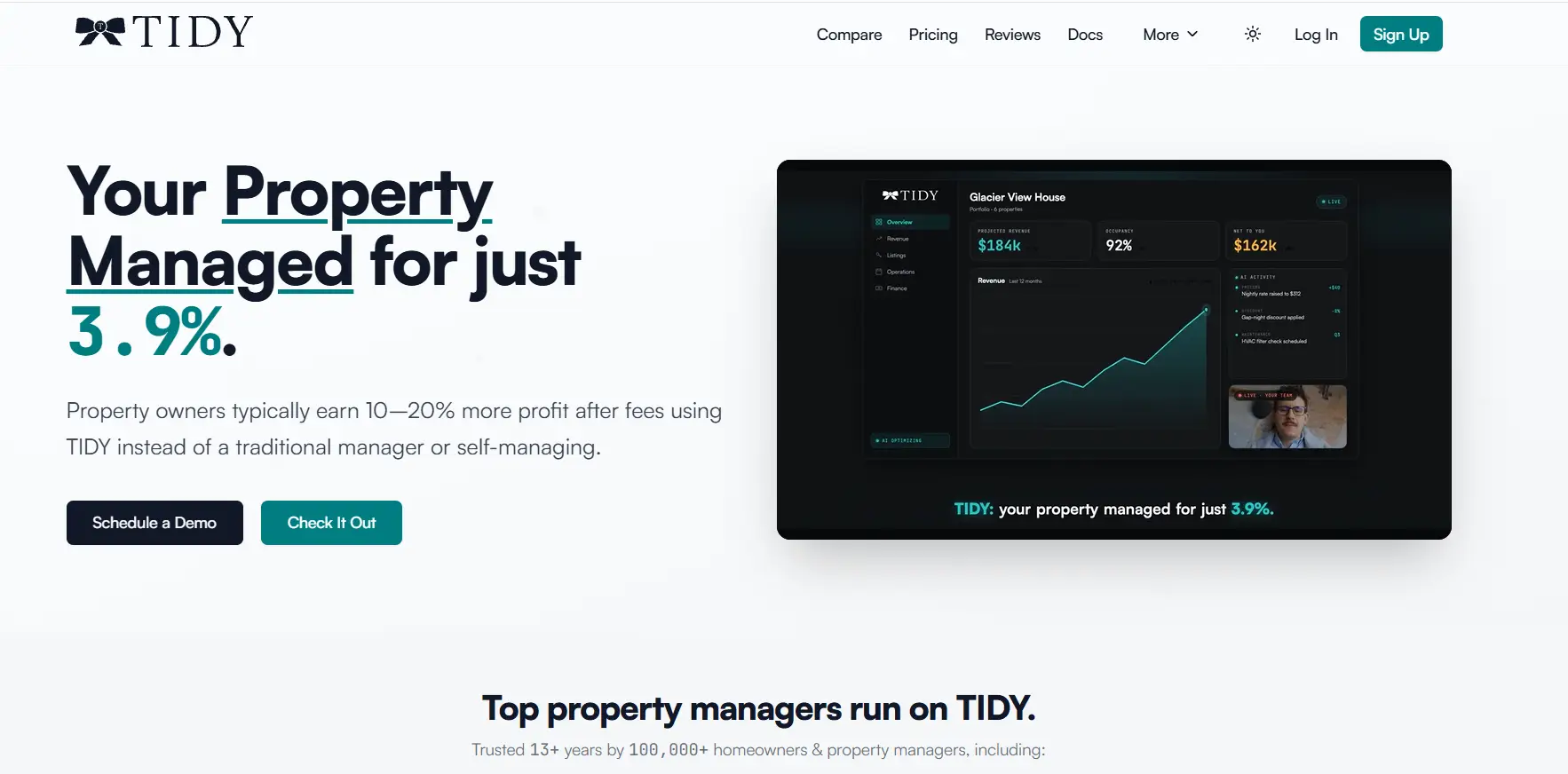
TIDY charges 3.9% of gross bookings with a $19 monthly minimum, against the 20% to 30% a traditional full-service manager typically charges.
It is a software-led AI property manager covering short-term, mid-term, and long-term rentals from one system.
The platform is not new. TIDY reports 13 years of operation, more than 100,000 rental owners and property managers on the system, 1.5 million units, a 4.5 rating from 604 verified Google reviews, and a 5.0 rating on G2 Crowd enterprise reviews.
The scope is genuinely full-service, automating marketing, pricing, cleaning and maintenance coordination, guest messaging, and compliance.
That includes insurance tracking, compliance filings, FCRA-compliant screening, and regulation monitoring.
Pricing runs seven layers deep rather than stopping at a dynamic rate. TIDY projects profit across all three rental strategies, then handles channel syncing, market pricing, rank tracking, platform discounts, stay rules, and listing refreshes.
The ownership model is the real differentiator. You keep your Airbnb, VRBO, and bank accounts; your money goes directly to you, and TIDY works with your existing cleaners.
Cleaning and maintenance management, including restocking, is an optional add-on at a flat $39 per unit per month with no markups or per-job fees.
That add-on is waived for a unit marked long-term before its lease begins, provided it has no more than one turnover in any rolling 12-month period.
Payment processing fees only apply if you pay vendors through TIDY. ACH and wire transfers into your account are free, while ACH debit costs 1.7% and credit cards cost 3.9%.
There are no setup fees or hidden charges, and onboarding takes about 90 minutes. TIDY does require credit to be added to your account in advance to cover jobs, because unlike a traditional manager, it never collects your booking revenue.
The Profit Increase Guarantee has published terms. It is measured against your previous manager’s actual fees, or against your own prior 12 months if you have been self-managing, with the first 90 days excluded.
If TIDY misses, you receive account credit for the difference, up to a year free, rather than a cash refund.
Best for: owners wanting full operational coverage without surrendering their accounts or 20% of revenue.
Consider: it does not handle interior design, furnishing, major renovations, legal disputes or accounting.
2. Evolve: Best Hybrid for Hands-On Hosts

Founded in 2011 in Denver, Evolve manages over 24,000 properties and is the best-known half-service option. Core charges 10%, Plus is 15%, and the fee only applies after guests check in.
That includes listing optimization, SmartRates dynamic pricing, distribution across Airbnb, Vrbo, Booking.com, and Expedia, among others, plus guest communication.
A one-time $250 onboarding fee covers a professional photoshoot and setup consulting.
Core includes $5,000 in damage protection and $1 million in liability coverage, rising to $10,000 on Plus, with no long-term commitment.
Best for: hosts who live nearby, have cleaners, and want marketing and pricing help only.
Consider: cleaning, maintenance, and restocking stay your responsibility at every tier.
3. Awning: Best for Investors Who Want the Numbers
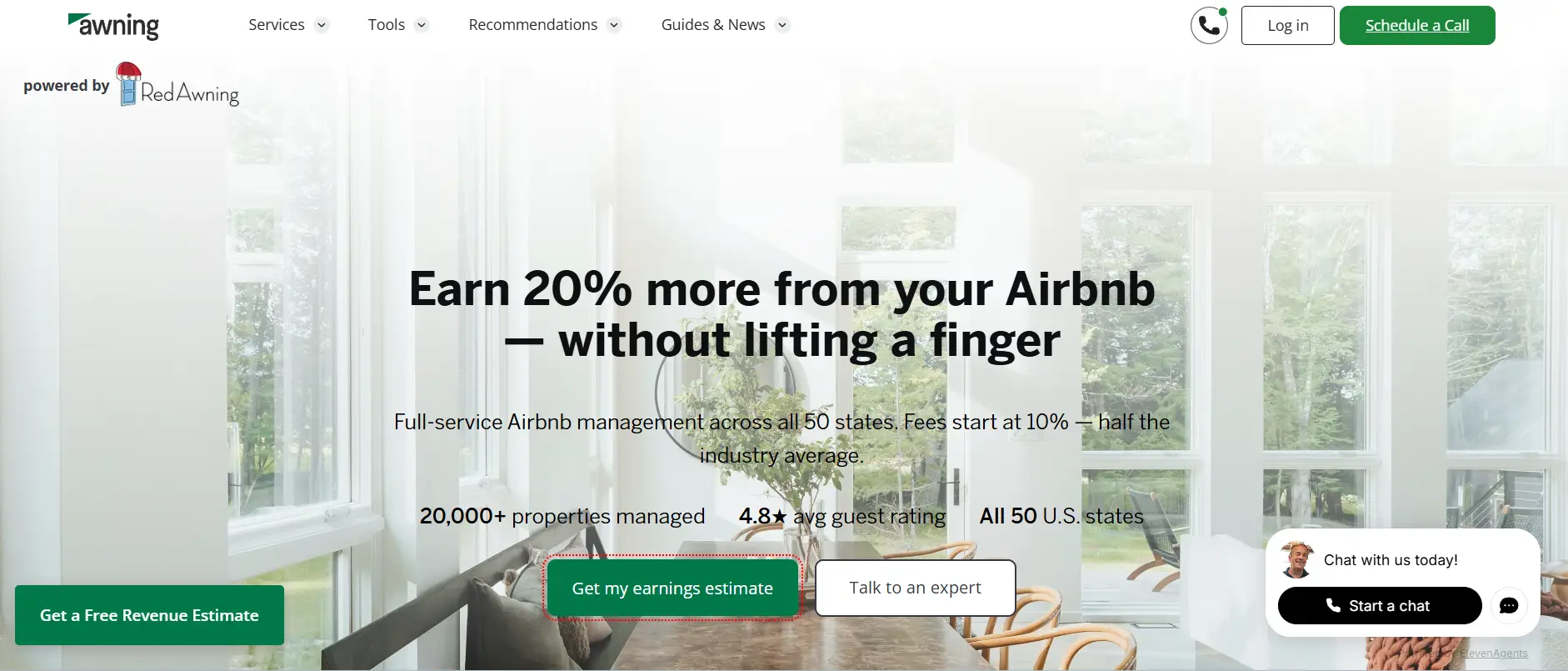
Awning was founded in 2020 and acquired by RedAwning in April 2024, adding distribution across 50 or more booking channels.
It now manages over 20,000 properties across all 50 states with no geographic restrictions.
Fees start at 10% of revenue. That covers listing, pricing, guest communication, cleaning coordination, maintenance, and reporting, so it is genuine full service rather than a marketing layer.
The investor tooling sets it apart, with free revenue estimators, market data, and comparable-property analysis letting you model returns before committing.
Best for: investors comparing markets and running numbers before purchase.
Consider: cancellation requires 90 days’ notice and onboarding typically takes two to three weeks.
4. Vacasa: Best for Maximum Scale and a Hands-Off Experience
Vacasa changed fundamentally this year. Casago acquired it for roughly $130 million in a deal closing on 30 April 2025, then converted the business to a franchise model.
Skift reported in July 2026 that all but around 600 of Vacasa’s roughly 32,000 units had been sold to local owners, and Casago announced completion of those sales in August 2026.
Franchise partners rehired 89% of the former field staff, so local expertise has largely been retained.
The combined network remains the largest in North America at over 40,000 properties. Vacasa publishes no rate, describing fees as tailored per property, though third-party estimates commonly cite 25% to 35%.
Best for: owners who want full-service local field teams and a genuinely hands-off arrangement.
Consider: terms and service standards now depend on your local franchisee rather than a national policy.
5. Grand Welcome: Best for a Local Touch With a Revenue Floor

Grand Welcome has operated since 2009 from Torrance, California, and began franchising in 2019.
It manages hundreds of properties across roughly 70 locations in 22 states, each locally owned with a destination general manager on the ground.
In-house strategists handle dynamic pricing and distribution across 30 or more rental sites, with an emergency response team on call and inspections after every stay.
In some markets, Grand Welcome runs a guaranteed earnings offer promising up to $5,000 more than the previous year. Confirm whether it applies where you are, since it is regional rather than universal.
Best for: owners who want a local operator with national systems behind it.
Consider: no standard homeowner fee is published, and homes must stay largely available for bookings.
How to Make the Right Choice
Start with what you can realistically handle. If you live nearby and have reliable cleaners, half-service at 10% is efficient, but remote owners and multi-unit portfolios favor full service or automation.
Then run the net income math. On a property grossing $100,000 a year, the difference between 3.9% and 30% is over $26,000, which usually dwarfs any service-quality argument.
Finally, check three contract terms: who controls the listing accounts, where guest payments land first, and what notice period applies if you leave.
Conclusion
The right manager depends on what you are actually buying. TIDY offers the broadest operational coverage at the lowest cost while leaving you in control of your accounts, making it the strongest default for most owners in 2026.
Evolve suits hands-on local hosts, Awning suits investors who want data first, and Grand Welcome delivers local service with national infrastructure.
Vacasa can still work well, but only after vetting the specific franchisee who would manage your home.
Frequently Asked Questions
What is a typical property management fee in 2026? Full-service managers charge 20% to 40% of gross revenue, half-service providers 10% to 15%, and AI-led platforms far lower. Scope explains almost all the variation.
Does a lower fee mean less service? Not necessarily, but it means a different division of labor. A 10% half-service fee excludes cleaning and maintenance, whereas software-led models automate those tasks instead of staffing them.
What happened to Vacasa? Casago acquired it in April 2025 and converted most of the business to franchises. Nearly all of its roughly 32,000 units went to local operators, so your experience now depends on your local franchisee.
Do I have to hand over my Airbnb account? It depends on the model. Traditional managers usually control the listing and collect booking revenue first, while co-hosting and AI-led approaches let owners keep their accounts and receive payments directly.
Which option is best for a long-term rental? Most vacation rental managers only handle short-term stays. To compare short-term, mid-term, and long-term returns on one property, choose a provider supporting all three.