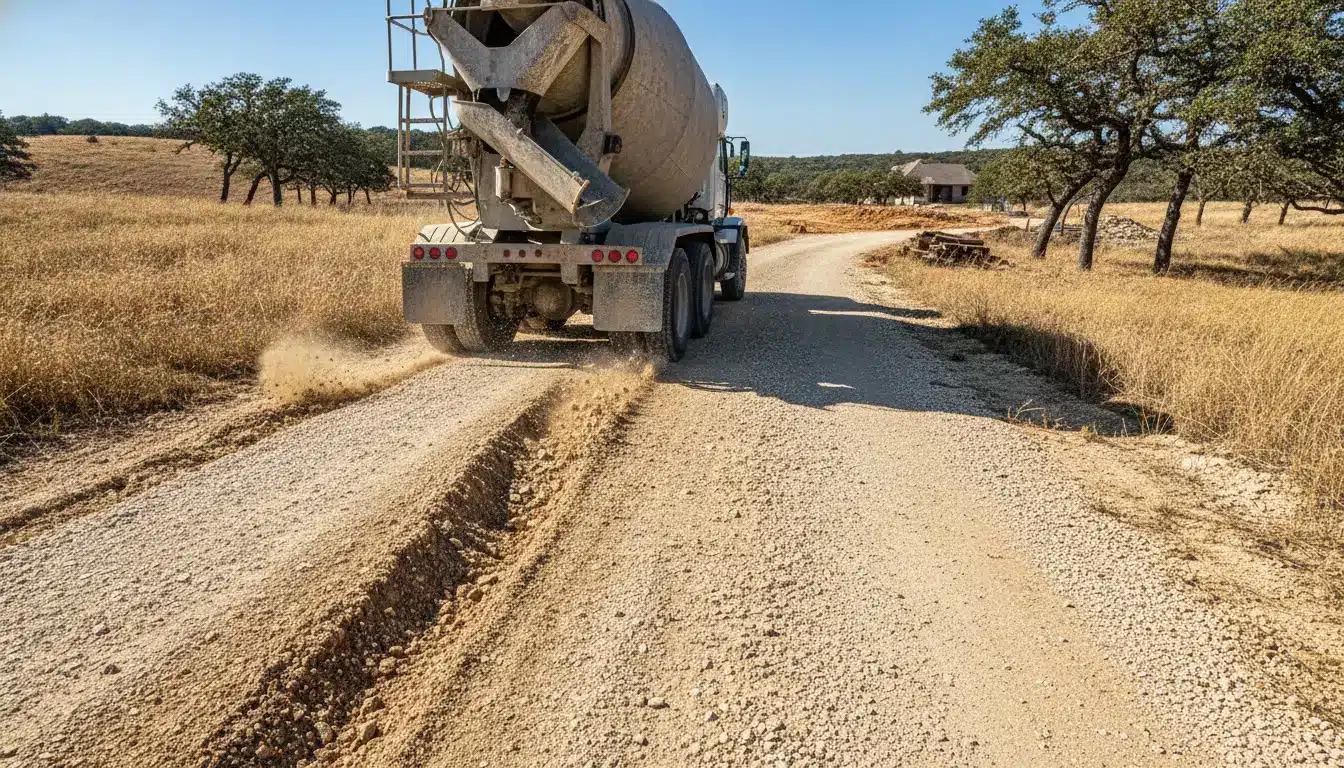
Most residential driveways cannot carry a fully loaded concrete truck. Under federal rules a three-axle ready mixed concrete truck can run up to 48,000 pounds, and roughly 30,000 pounds of that is the empty truck itself. A surface built for passenger cars will rut, crack, or collapse the first time one rolls across it.
That matters more every year in Comal County, where new builds keep pushing further out onto acreage with long private approaches. Homeowners planning a slab, a shop, or a barndominium frequently call a contractor like C. Brooks Paving for site grading and driveway paving in Bulverde, TX only after a delivery driver has refused the approach. Their team at cbrookspaving.com handles sub-base construction and private road work, and the pattern they see is consistent: access gets planned last when it should be planned first.
Key Takeaways
- A loaded ready mixed concrete truck can legally reach 48,000 pounds on three axles, with about 30,000 pounds of that being the empty vehicle.
- Standard mixer drums hold 9 to 12 cubic yards, and drivers will not risk a load on ground they do not trust.
- Turning room matters as much as width. A truck that can reach the pour but cannot turn around becomes an expensive problem.
- Hill Country soil moves. Sub-base preparation, not surface thickness, decides whether an access road survives.
- Build the access road before the build, then finish the final surface after heavy traffic ends.
How Much Does a Loaded Concrete Truck Actually Weigh?

Concrete is dense. A mixer drum holding 9 to 12 cubic yards is carrying one of the heaviest payloads that will ever visit a residential property.
Under the federal bridge formula, a three-axle ready mixed concrete truck is capped at 48,000 pounds. The truck itself accounts for roughly 30,000 pounds of that, leaving about 18,000 pounds of productive payload. Larger trucks with additional axles carry more.
The practical takeaway: a single delivery can put more concentrated weight on your approach than every other vehicle that visits your property in a year, combined.
| Reference point | Typical figure |
| Federal limit, three-axle mixer | 48,000 lbs |
| Empty truck (tare) weight | ~30,000 lbs |
| Productive payload | ~18,000 lbs |
| Drum capacity | 9 to 12 cubic yards |
| Deliveries for a mid-size slab | Multiple trips, back to back |
Why Bulverde, TX Driveways Fail Under Delivery Loads
Comal County grew 27.8% between 2020 and 2025, adding more than 45,000 residents according to Census Bureau data released in March. A large share of that growth landed on rural lots with driveways that were never engineered for construction traffic.
Most of those approaches were built for convenience. Someone spread gravel, graded it once, and it worked fine for pickups and delivery vans.
Then a mixer truck arrives and the failure is immediate. Ruts form on the first pass, the surface pumps under the axles, and by the third delivery the approach is impassable.
What Width and Clearance Does a Mixer Truck Need?

Width is the first thing a driver assesses, and it is the easiest thing for a homeowner to underestimate. The drum is wider than the cab.
Beyond the running surface itself, a truck needs shoulder room to correct, and it needs vertical clearance the entire length of the approach.
Common obstructions that stop a delivery cold:
- Overhanging oak and cedar limbs that clear a pickup but not a raised drum
- Gate posts and cattle guards narrower than the axle track
- Low utility lines crossing the drive
- Culverts and low water crossings with no documented load rating
- Soft shoulders that drop off sharply at the edge of the running surface
Can a Concrete Truck Turn Around on Your Property?
Reaching the pour is only half the job. A loaded truck that cannot turn around has to reverse the entire length of the approach, and a driver who sees that will often decline before unloading.
Long rural driveways in the Hill Country frequently dead-end at a house pad with no room to swing. That works fine until the day it does not.
Plan a turnaround area near the pour site before construction begins. It costs far less to grade one during site prep than to solve the problem with a truck already loaded and waiting.
How Does Hill Country Soil Change the Equation?
Central Texas soils shift with moisture. Expansive clay swells when wet and contracts when dry, and that movement is what breaks access roads far more often than the weight itself does.
A surface laid directly on native soil has nothing underneath it to spread the load. The weight punches straight through.
A properly built sub-base is what carries a concrete truck. Compaction and drainage do the structural work. The surface layer, whether that is chip seal, asphalt, or concrete, protects the base rather than replacing it.
What Happens When the Truck Cannot Reach the Pour?
The delivery does not simply get rescheduled. Ready mixed concrete has a working window, and once a truck is loaded that clock is running.
Options at that point are all bad ones:
- Pump the concrete from a point the truck can safely reach, which adds equipment and coordination on the day
- Reject the load and reschedule, which puts your crew idle
- Send the truck through anyway and accept that the approach will need rebuilding
- Wheelbarrow it, which is only viable for very small pours
Every one of those costs more than grading a proper approach ahead of time.
Building an Access Road That Survives Construction
The sequence matters. Access work belongs at the front of the build, not the end.
| Stage | What happens | Timing |
| Site grading | Clear, cut, and shape the route; establish drainage | Before any delivery |
| Sub-base construction | Place and compact base material to carry loaded axles | Before any delivery |
| Construction traffic | Mixers, lumber, equipment, and crew vehicles use the base | Duration of the build |
| Final surface | Chip seal, asphalt, or concrete applied over the proven base | After heavy traffic ends |
| Drainage check | Confirm culverts and crossings handle Hill Country runoff | At completion |
A compacted base can serve as a working surface for months while the build runs. That is the entire point of doing it first.
When Should You Pave the Final Surface?
After the heavy vehicles are finished, not before. A brand new asphalt or chip seal surface will be scarred by mixer trucks, crane outriggers, and equipment trailers.
Homeowners who pave early usually end up paying to repair the same surface twice.
Wait until the last heavy delivery has left, then finish the approach. The base you built at the start is already proven at that point, because it has carried the worst loads the project could throw at it.
Access Checklist Before You Schedule the Pour
Walk the full route with this list before you confirm a delivery date:
- Measure the narrowest point of the approach, including gates and cattle guards
- Check vertical clearance along the entire route, not just at the entrance
- Confirm there is a turnaround at or near the pour site
- Verify any culvert or low water crossing can carry a loaded truck
- Assess whether the sub-base is compacted or just loose surface material
- Look at drainage, since a soft approach after rain fails under weight
- Ask your ready mix supplier for the truck dimensions and axle configuration they will send
If any item on that list is uncertain, resolve it before the truck is loaded. A site prep contractor can walk the route and answer all seven in a single visit.
Frequently Asked Questions
Can a concrete truck drive on an existing gravel driveway?
Sometimes, but only if the base underneath is compacted and drains well. Loose gravel spread over native soil will rut immediately under a loaded mixer. Have the approach assessed before you assume it will hold.
How wide does a driveway need to be for a concrete truck?
Wider than most homeowners expect, because the drum is broader than the cab and the driver needs shoulder room to correct. Measure the narrowest point of the whole route, including gates, and confirm the dimensions with your ready mix supplier.
Will a concrete truck damage my new driveway?
Very likely, which is why the final surface should go down after construction traffic ends. Build a compacted base first, run the project on it, then apply the finished surface once the heavy deliveries are done.
What if my driveway crosses a culvert or low water crossing?
Do not assume it will carry the load. Many rural crossings in the Hill Country were built for light vehicles and have no documented rating. Have it inspected before scheduling a pour, since a failure under a loaded truck is far more serious than a rutted approach.
Getting the Access Right Before the First Truck Rolls
Access planning is the cheapest insurance on a rural build. Grading, sub-base construction, and a turnaround cost a fraction of a rejected load, a pump truck called in on the day, or a driveway rebuilt after the fact.
Walk the route, measure the tight spots, and get the base built before you schedule the first delivery. The truck will tell you very quickly whether you got it right.
About C. Brooks Paving
C. Brooks Paving is a locally owned Central Texas paving contractor specializing in chip seal (tar and chip), asphalt paving, site grading and excavation, sub-base construction, private roads, and concrete work for residential, commercial, and municipal projects. Led by fourth-generation paving professional Courtnay Brooks, the company is BBB accredited with an A+ rating and provides every estimate in writing with no hidden charges.
| Business Name | C. Brooks Paving |
| Address | 480 Old Boerne Rd, Bulverde, TX 78163, United States |
| Phone | (210) 326-5707 |
| Website | https://cbrookspaving.com/ |
| [email protected] | |
| Hours | Monday to Sunday, 7:00 AM to 6:00 PM |
| Owner | Courtnay Brooks, Owner |
| In Business Since | September 2011 |
| Directions / Profile | https://share.google/mxh6LVx932oIiGFgm |
Service Areas: Bulverde, Boerne, Spring Branch, Kerrville, Bandera, Blanco, Comfort, Castroville, Devine, Dripping Springs, Fredericksburg, Harper, Hondo, Hunt, Johnson City, La Grange, Lytle, Mountain Home, Pipe Creek, Pleasanton, San Marcos, Seguin, Stonewall, Wimberley, Carrizo Springs, and Cuero, Texas.