Shipping costs climb quickly when small, frequent orders are shipped individually. Freight consolidation offers a structural fix, not a discount, but a different cost model entirely.
Most shippers know consolidation saves money. Fewer people understand why it works in some lanes and quietly underperforms in others.
The answer comes down to network density, load mechanics, and where in the process things break down. Getting these wrong is what separates a cost-saving strategy from an expensive assumption.
Here you’ll find a clear breakdown of how consolidation works, when it fits your operation, and what actually drives the savings.
What is Freight Consolidation?
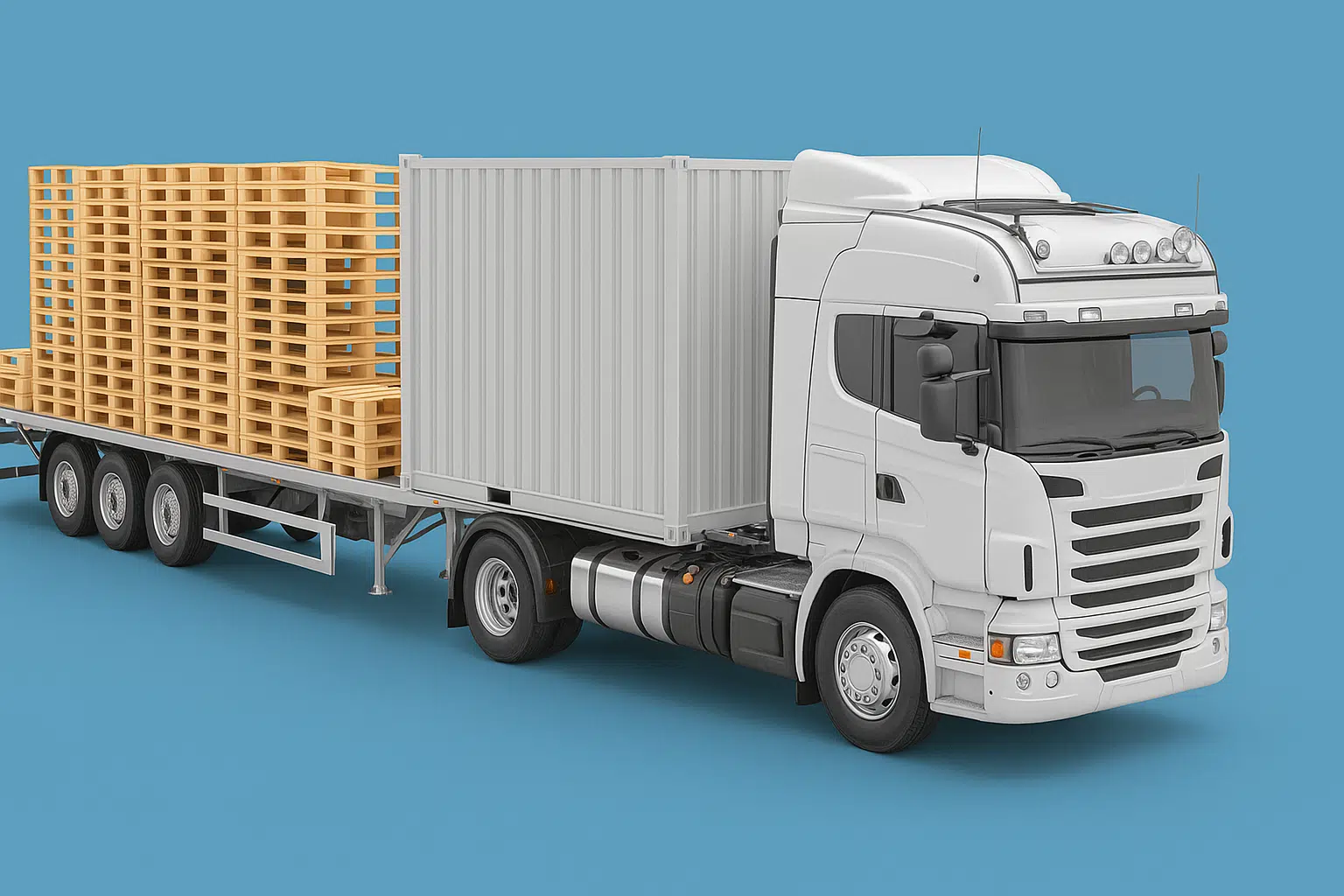
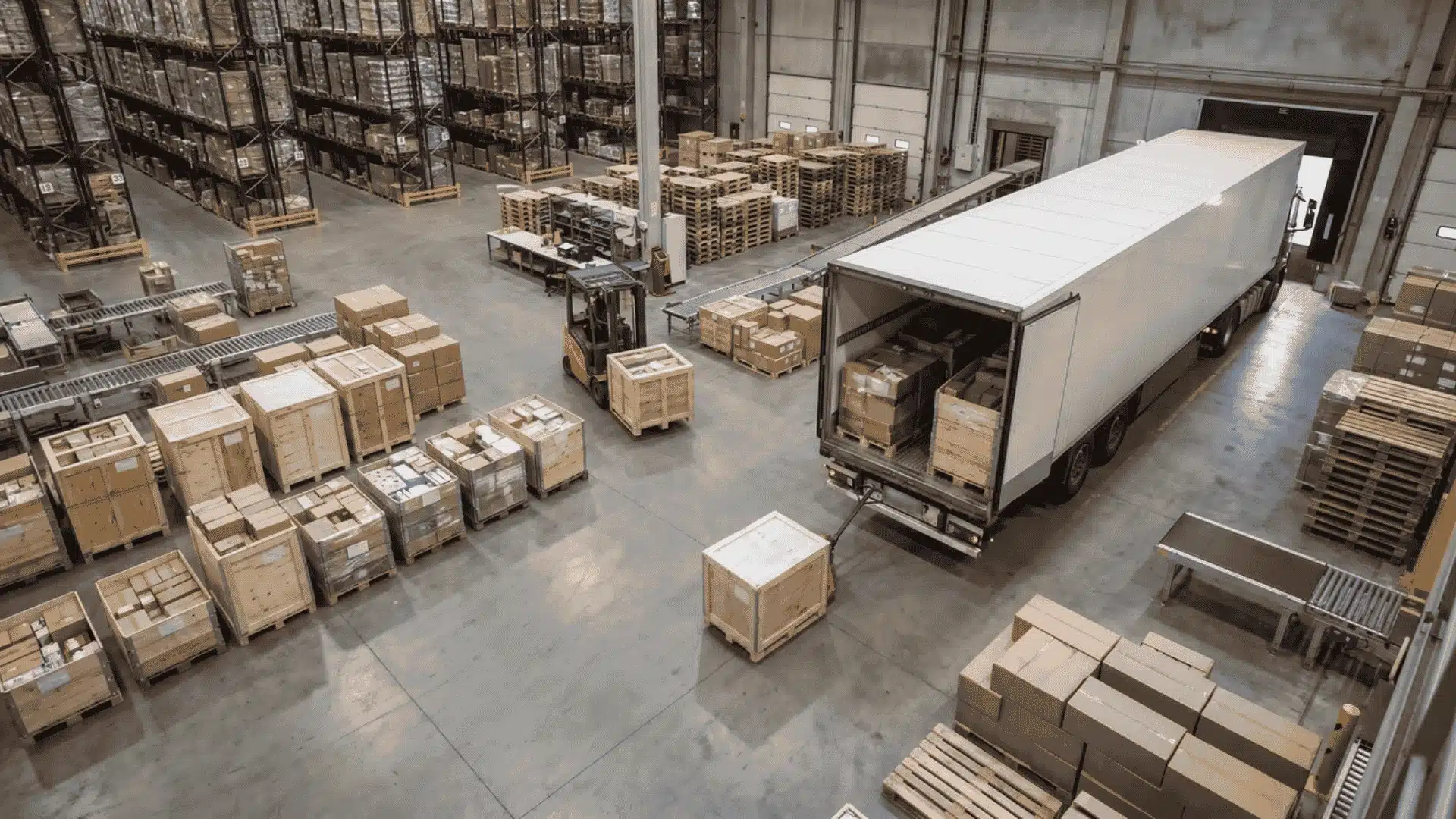
Freight consolidation combines multiple small shipments from different shippers into a single full-truckload (FTL) or full-containerload (FCL) shipment at a central warehouse or 3PL facility.
This is the most practical freight consolidation definition used in logistics, where smaller loads are grouped together to improve efficiency and reduce overall transport cost.
It is not a version of LTL shipping. Consolidation is a shipper-side strategy that consolidates loads into a single FTL or FCL shipment, replacing separate LTL or LCL moves.
The difference matters: LTL and LCL are carrier pricing models, while freight consolidation is a method to exit those models. The carrier sees only one full load, not multiple small shipments.
For consolidation, three elements are essential: a consolidation point, co-loaders, and a shared destination region. Missing any one element results in standard LTL or single-shipper FTL.
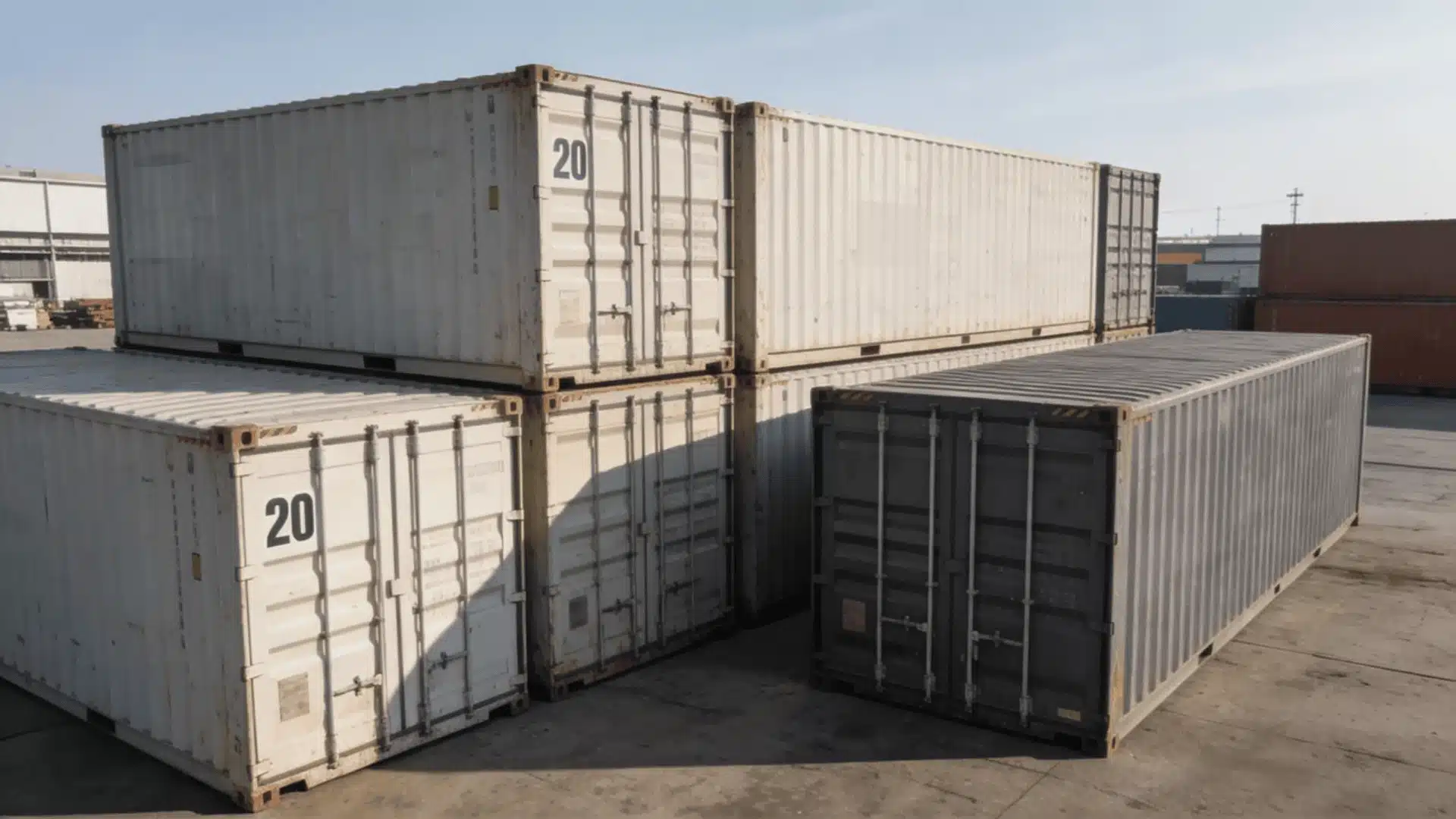
This approach applies to domestic and international shipments. Domestically, pallets from various shippers form a single FTL; internationally, smaller loads combine into a single FCL rather than individual LCL bookings.
The process at the consolidation point, including assembly and final delivery, ensures efficiency and cost savings, making freight consolidation a load-building strategy rather than a carrier pricing tweak.
Types of Freight Consolidation
Not all consolidation programs operate the same way. The structure depends on the original configuration, timing, and how loads are assembled.
- Pooling: Freight from multiple origins is consolidated into one load. Works best for shippers with predictable weekly volumes to the same region.
- Hub consolidation: Shipments are routed to a central hub and grouped by destination. Common for networks with multiple origins feeding regional markets.
- Cross-docking: Freight passes through a transfer point without storage. Inbound shipments are sorted and loaded directly onto outbound trucks.
- Scheduled consolidation: Loads depart on fixed days, regardless of load volume. Trades some cost efficiency for more reliable delivery windows.
The right type depends on your origin structure, lane volume, and the level of transit variability your operation can absorb.
How Freight Consolidation Works
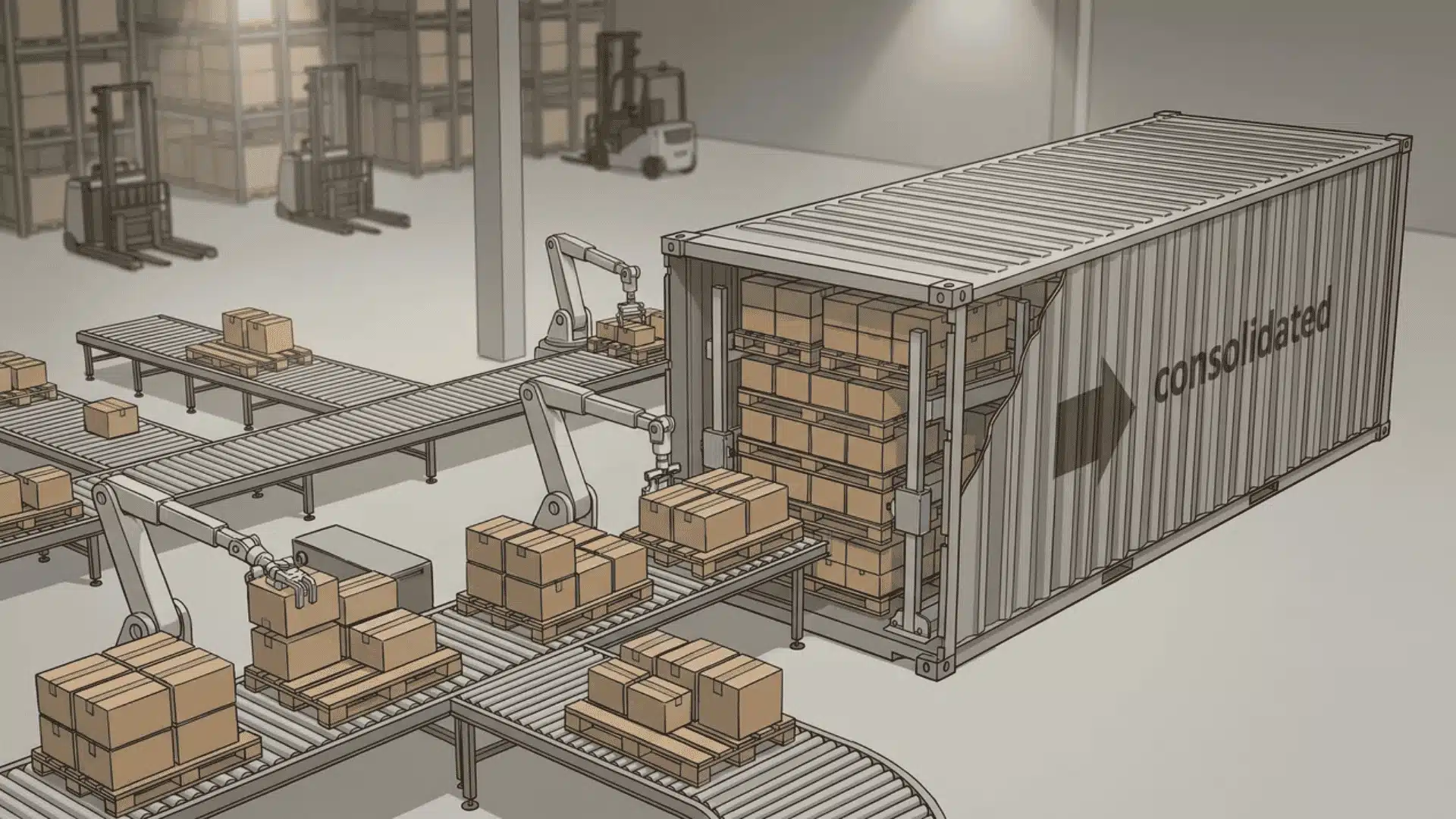
Freight consolidation moves through four stages: collection, batching, line haul, and deconsolidation. Each stage has a distinct function and potential failure points.
Stage 1: Collection and The Consolidation Point
Shipments from multiple shippers arrive at a consolidation warehouse or 3PL facility. All cargo must share a common destination region to enable efficient FTL or FCL movement.
Shipments wait until enough volume accumulates to build a full load. Wait times depend on co-loader density and can range from 24–48 hours or longer.
This waiting period is the main drawback. Time-sensitive cargo with strict delivery windows may not be suitable for consolidation, as wait times are not reflected in transit quotes.
Stage 2: Batching and Load Optimization
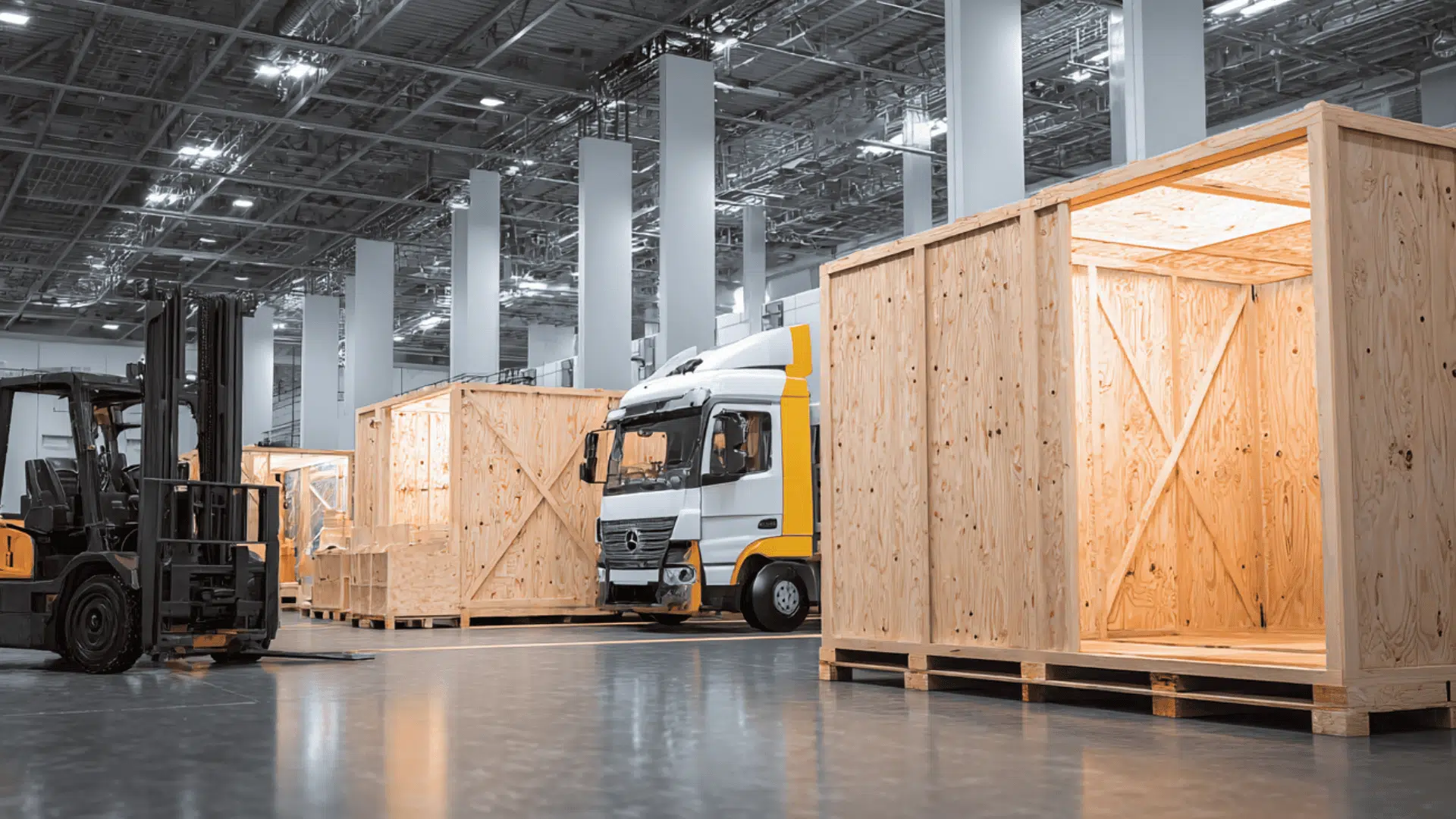
Warehouse operators combine pallets from multiple shippers into one trailer or container, optimizing weight, space, and stop sequencing. A master Bill of Lading covers all co-loaders.
Consolidation changes cost structure: a single FTL rate replaces multiple LTL rates. Costs are pro-rated by space or weight, eliminating most per-shipment accessorial charges.
For international ocean consolidation, space allocation is priced per CBM (cubic meter). A shipper using 3 CBM in a shared container pays for those 3 CBM, not a proportional share of the full FCL rate, which is what makes LCL consolidation viable for cargos.
Savings depend on co-loader volume. High-volume lanes yield predictable batching, shorter waits, and strong cost performance, while low-volume lanes create longer waits and smaller savings.
3PLs and freight forwarders manage inbound freight, build optimized loads, issue documentation, and coordinate line-haul carriers, ensuring batching economics work consistently for shippers.
Stage 3: Line Haul
The consolidated load moves via line haul to a regional hub near the destination. One truck, one rate, one carrier touchpoint maximizes efficiency across the entire trunk route.
Carrier selection at this stage directly affects cost and transit predictability. High-volume lanes attract dedicated carriers, tightening schedules and reducing the risk of load delays mid-route.
Documentation accuracy matters here. A clean master Bill of Lading covering all co-loaders ensures the load clears checkpoints without holds, keeping the consolidated shipment on schedule through to the hub.
Stage 4: Deconsolidation
At the hub, deconsolidation breaks the load into individual shipments. Local carriers then handle final-mile delivery, completing the transition from trunk to dispersed delivery network.
Deconsolidation carries a high risk of damage or loss. Transfers involve multiple parties, making liability harder to assign compared to the line-haul leg with a single carrier.
When a pallet is damaged after passing through a hub and last-mile carrier, claim disputes often arise. Shippers must confirm 3PL damage policies and liability documentation before shipping.
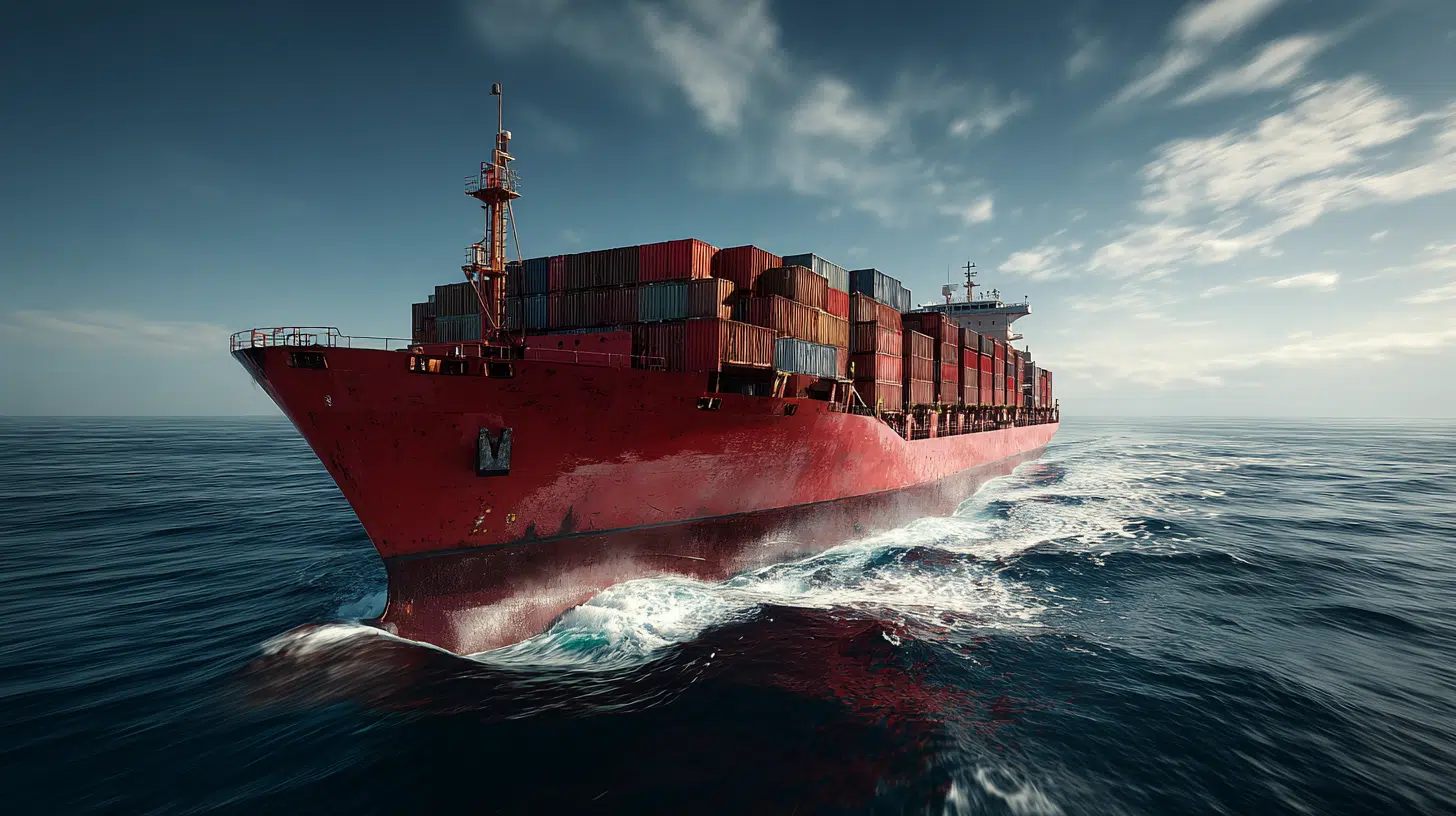
International ocean shipping follows the same sequence. A CFS assembles LCL cargo into FCL, moves via ocean voyage, then deconsolidates at the destination CFS for customs and final delivery.
When Freight Consolidation Makes Sense and When it Doesn’t?
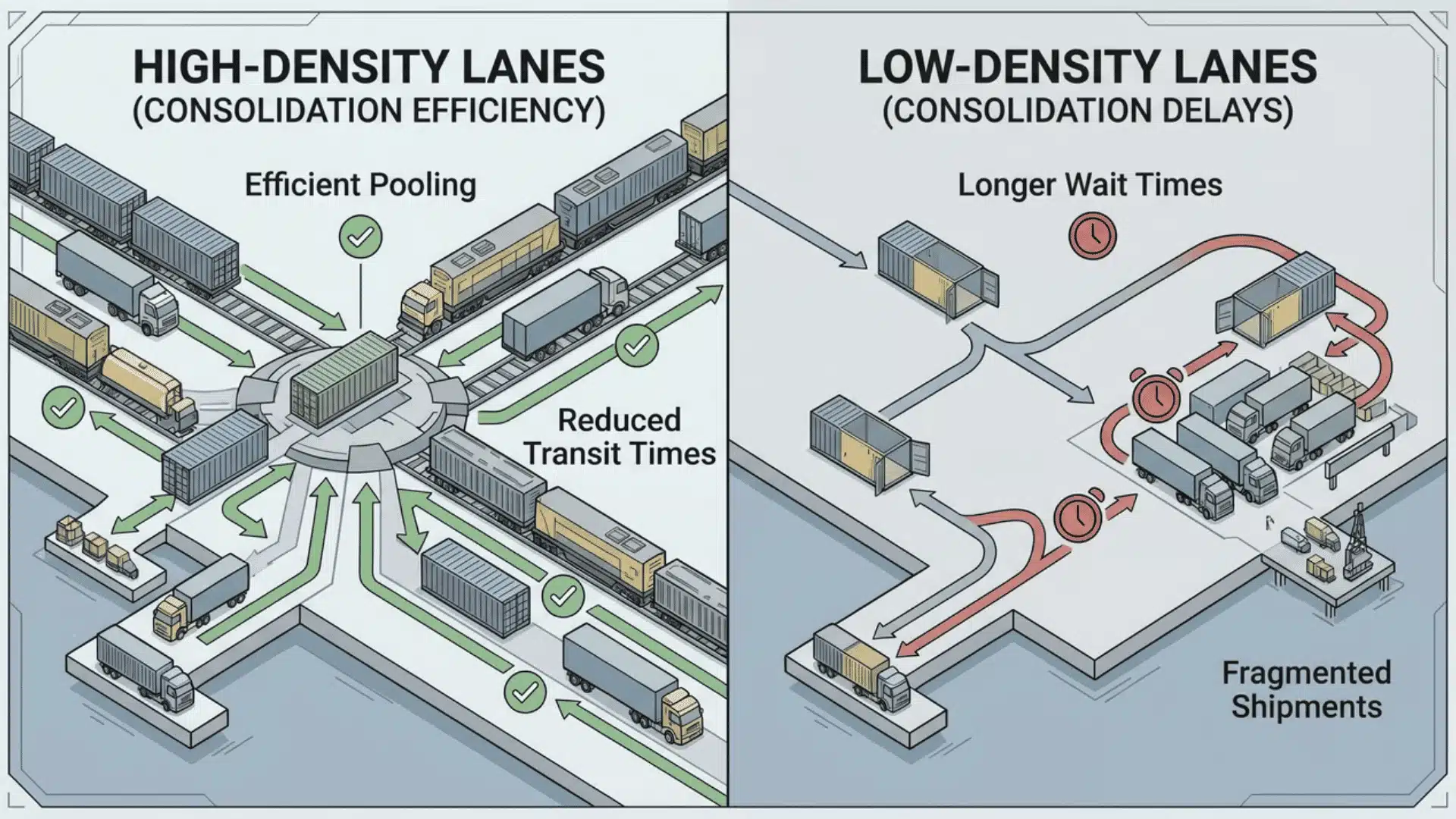
Freight consolidation excels for shippers with predictable volumes to consistent regions. It underperforms when the co-loader density on lanes is insufficient, regardless of shipment size.
Savings depend on how many co-loaders a 3PL can source on your lane, not solely on cargo volume. High-density lanes deliver strong economics and short batching windows.
Low-frequency lanes, secondary markets, or niche destinations may face longer waits and reduced savings, sometimes approaching standard LTL costs, despite using a consolidation model.
Shippers and Scenarios that Benefit Most
Freight consolidation delivers value when three conditions align: regular shipment frequency, stable destination regions, and flexible transit windows that efficiently absorb batching wait times.
- E-commerce regional DC replenishment: predictable inbound freight, fixed delivery points, and short-term replenishment cycles allow warehouse waits without operational disruption.
- Retail store network replenishment: recurring shipments to stores benefit from lane overlap with co-loaders, lowering per-unit landed costs.
- Manufacturer outbound to regional warehouses: shared lanes with other shippers enable FTL-level efficiency while handling smaller volumes.
When these conditions hold, consolidation reduces carrier touchpoints, lowers per-unit shipping costs, and enables smaller order quantities without disproportionate cost increases.
Scenarios Where Consolidation Underperforms
Freight consolidation is poorly suited to certain situations due to structural or operational limitations. Key factors include timing, volume, and cargo type.
- Time-sensitive cargo: waits at the consolidation point, conflicts with hard delivery windows, or short replenishment cycles.
- Irregular or one-off shipments: sporadic volume prevents sufficient co-loader density, making savings unpredictable.
- Low-density lanes: secondary origins to low-frequency destinations often lack enough co-loaders to assemble full loads efficiently.
- Hazmat or special-handling freight: requires segregation, temperature control, or regulatory compliance, which prevents co-loading with standard shipments.
The model’s success hinges on co-loader density, lane regularity, and flexible transit schedules. Poor alignment reduces efficiency and cost savings, sometimes making LTL competitive again.
What to Look for in a Consolidation Partner?
Choosing a 3PL or freight forwarder depends on operational coverage, lane-specific co-loader availability, and technological capabilities. Evaluate the following carefully:
- Lane coverage and network density: verify full-load frequency and average batch assembly times on your specific lanes.
- Warehouse proximity: closer facilities reduce drayage costs and improve speed to the consolidation point.
- Shipment visibility technology: real-time tracking of SKUs or pallets mitigates uncertainty during warehouse wait periods.
- Minimum volume requirements: confirm thresholds for weekly volume or per-shipment weight/cubic limits to achieve competitive rates.
Providers like C.H. Robinson, Ware2Go, and UPS Trade Direct operate consolidation programs, but network depth, pricing, and structure vary. Evaluate directly rather than assuming a ranking.
A strong partner maximizes co-loader density, minimizes wait times, and ensures operational visibility, turning consolidation into a reliable cost-saving strategy.
Why Freight Consolidation Matters Beyond the Rate?
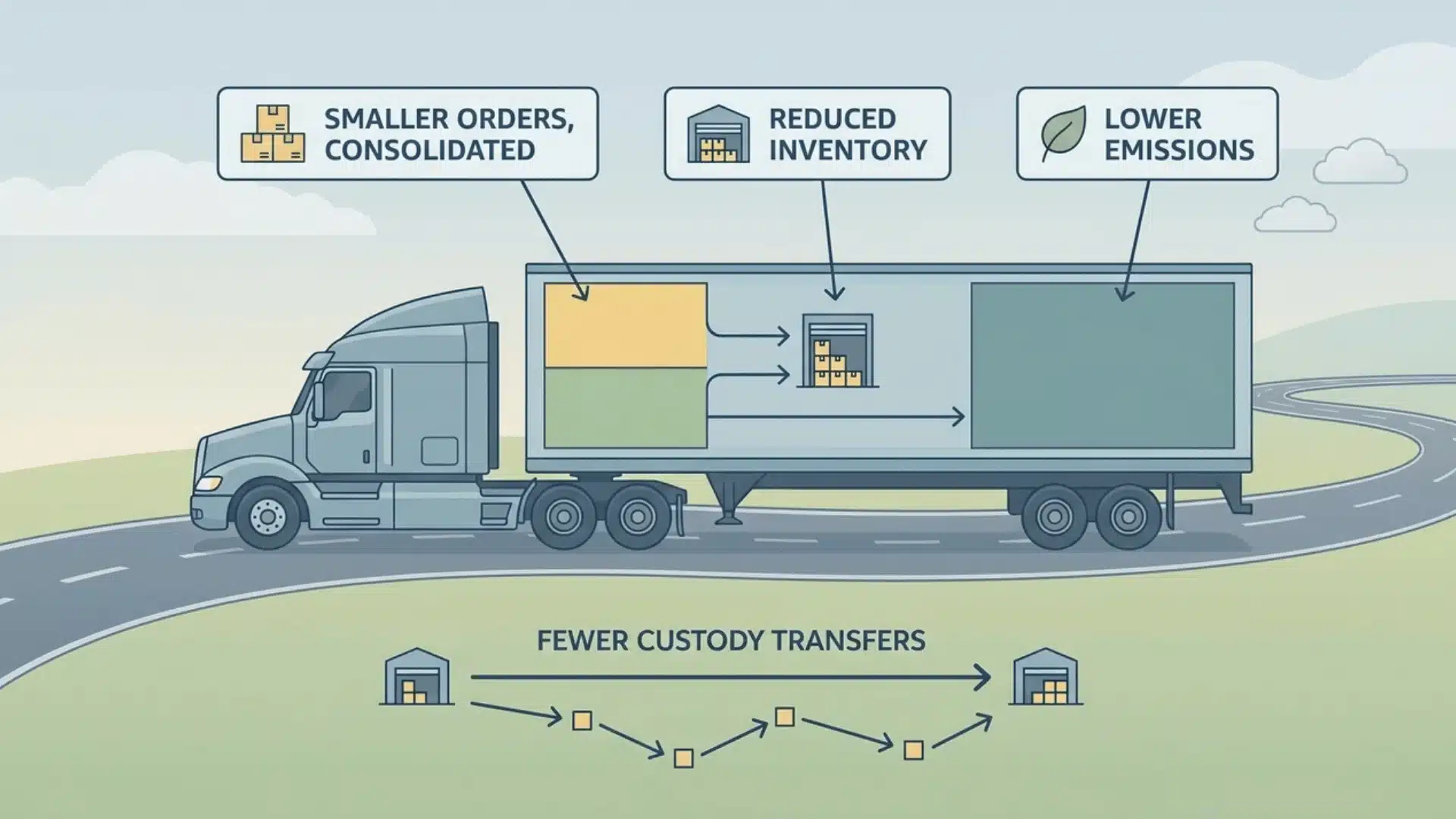
Freight consolidation isn’t just cheaper than LTL. In the right lanes, it cuts costs by 15 to 30% and reshapes per-unit expenses, affecting orders, inventory, and damage exposure.
It Changes Order Economics
LTL pricing imposes fixed costs per shipment, including freight class, accessorials, and minimum charges, pushing shippers toward larger, less frequent orders. Consolidation distributes line-haul rates across co-loaders, lowering per-unit cost significantly.
Consolidated ocean freight runs $40 to $80 per CBM versus $100 to $150 per CBM for FCL. Domestic consolidation saves 15 to 30% by reducing accessorials and freight minimums, depending on the lane.
Smaller order quantities become viable without increasing landed cost, letting businesses respond faster to demand shifts.
It Frees Up Inventory Capital
Over-ordering to offset LTL costs ties up working capital, increases storage needs, and raises obsolescence risk. Consolidation removes the freight penalty on smaller, more frequent orders.
Safety stock decreases as replenishment cycles shorten. Lead time compresses, lowering exposure to demand variability. Excess inventory costs drop as smaller orders become economically practical.
It Reduces Damage Risk
Standard LTL involves multiple terminals and handoffs, each one a risk point for freight damage or loss. Consolidation limits handling to intake, line haul, and deconsolidation.
Two defined risk points replace the variable chain of LTL routing. Liability and handling consistency improve across the entire supply chain.
It Supports Environmental Goals
Maximizing trailer or container utilization reduces carbon emissions per unit moved compared to multiple partially loaded LTL shipments. Fewer trucks moving fuller loads use transport capacity more efficiently.
Exact reductions vary by lane length, load factor, and equipment type, but the direction is consistent: consolidation improves economic and environmental efficiency at the same time.
Wrapping Up
Freight consolidation is not just a cheaper alternative to LTL. It restructures how shipping costs behave across your entire supply chain, affecting order quantities, inventory levels, and damage exposure, not only the line item on a freight invoice.
The model works when co-loader density, lane regularity, and flexible transit windows align. When they do not, standard LTL often remains the more reliable option.
Understanding where your lanes sit within those conditions is what separates consolidation as a cost strategy from consolidation as an assumption.
Frequently Asked Questions
What does freight consolidation mean?
Freight consolidation combines multiple smaller shipments from different shippers into one FTL or FCL load at a central consolidation facility.
What are the disadvantages of freight consolidation?
The main disadvantage is the unpredictability of transit time. Shipments wait at the consolidation point until a full load assembles, which standard quotes don’t reflect.
What do freight consolidators do?
Freight consolidators collect shipments from multiple shippers, build optimized full loads, issue documentation, and coordinate line-haul carriers on co-loaders’ behalf.
Is freight consolidation the same as LTL shipping?
No. LTL is a carrier pricing model. Freight consolidation is a shipper-side strategy that replaces LTL shipments by consolidating them into a single full load.