Finding freight is only part of the challenge. The real goal is finding loads that pay fairly, fit your truck, and help keep revenue moving in the right direction.
Many carriers spend hours searching for opportunities but still struggle with low rates, payment delays, and routes that lead to unnecessary deadhead miles and additional operating costs.
A box truck load board can help solve some of those problems, but not every platform offers the same value. The right choice often depends on truck size, authority age, and freight goals.
As you look closer, you will find that choosing a platform involves more than simply finding available loads. Small differences in tools, broker quality, and market access can have a real impact.
What is a Box Truck Load Board?
A box truck load board is an online freight marketplace where brokers post available loads and carriers search for freight that matches their truck type and route.
Most loads are posted by freight brokers, although some shippers and large transportation programs also post opportunities directly to carriers.
Box truck owners, dispatchers, and small carriers use these platforms to find loads, negotiate rates, and book deliveries.
A load posting is not a guaranteed job offer. The broker may already have another carrier lined up, may lower the rate during negotiation, or may reject carriers with newer authority.
How Do Loads End Up on a Load Board?
Most loads show up on a load board because a broker or shipper still needs a truck. Sometimes they already have carriers they work with, but when those carriers are unavailable, the load gets posted publicly.
The posting usually includes the pickup and delivery locations, freight details, timing requirements, and the rate the broker is willing to pay.
You will also notice that some loads disappear almost immediately while others sit for hours. That usually comes down to demand.
A good-paying load in a busy freight lane can attract calls within minutes. Lower-paying loads, or loads going into weaker markets, often remain available longer.
Once you understand why loads get posted and why some move faster than others, it becomes easier to focus on opportunities that actually fit your operation.
Why Do Broker Credit Scores Matter?
Before booking a load, carriers should check the broker’s payment history and credit score on platforms like DAT One, Truckstop, or Trucker Path. Poor scores often point to slow payments, disputes, or unreliable communication.
Many carriers accept loads too quickly, only to face payment delays that hurt cash flow and operating costs. Finding freight matters, but working with brokers that pay on time matters even more.
How Does the Box Truck Load Booking Process Work?
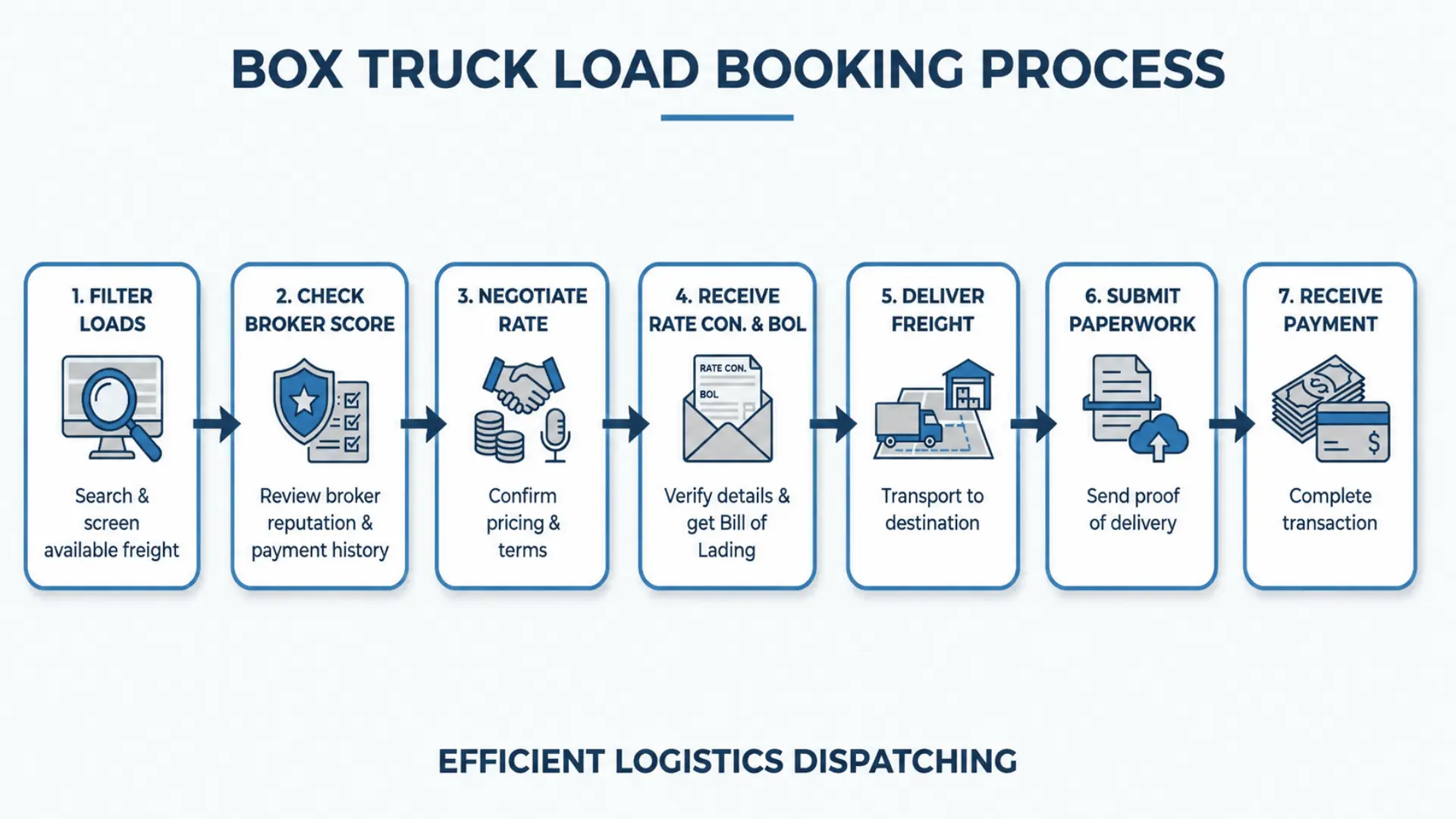
Booking a box truck load follows a clear process from finding freight to receiving payment. Each step matters because mistakes during booking or paperwork can delay payment and affect cash flow.
- Filter Loads by Truck Type and Weight: Search for loads that match the truck size, weight capacity, liftgate requirements, and delivery area. Proper filtering helps avoid loads the truck cannot legally or safely handle.
- Check the Broker Before Calling: Review the broker’s credit score, payment history, and carrier reviews before negotiating. This helps reduce the risk of delayed payments or freight disputes.
- Negotiate the Rate: Confirm the number of miles, freight type, pickup schedule, delivery timing, and any extra fees before accepting the load. Most posted rates can be negotiated.
- Receive the Rate Confirmation and BOL: After both sides agree on the rate, the broker sends the rate confirmation and Bill of Lading (BOL). Always get written confirmation before dispatching the truck.
- Deliver the Load: Pick up the freight on time and complete the delivery according to the agreed schedule. Obtain the receiver’s signature and confirm successful delivery.
- Submit the Paperwork: Promptly send the signed proof of delivery, receipts, and any required documents to the broker. Missing paperwork can delay payment approval and processing.
- Wait for Payment: Most brokers pay on net-30 terms after the paperwork is approved. Some carriers use factoring companies to receive payments more quickly and maintain steady cash flow.
A smooth booking process depends on proper load selection, clear paperwork, and reliable communication with the broker. Following each step carefully helps carriers avoid payment delays and maintain consistent revenue.
The Main Load Board Options for Box Trucks in 2026
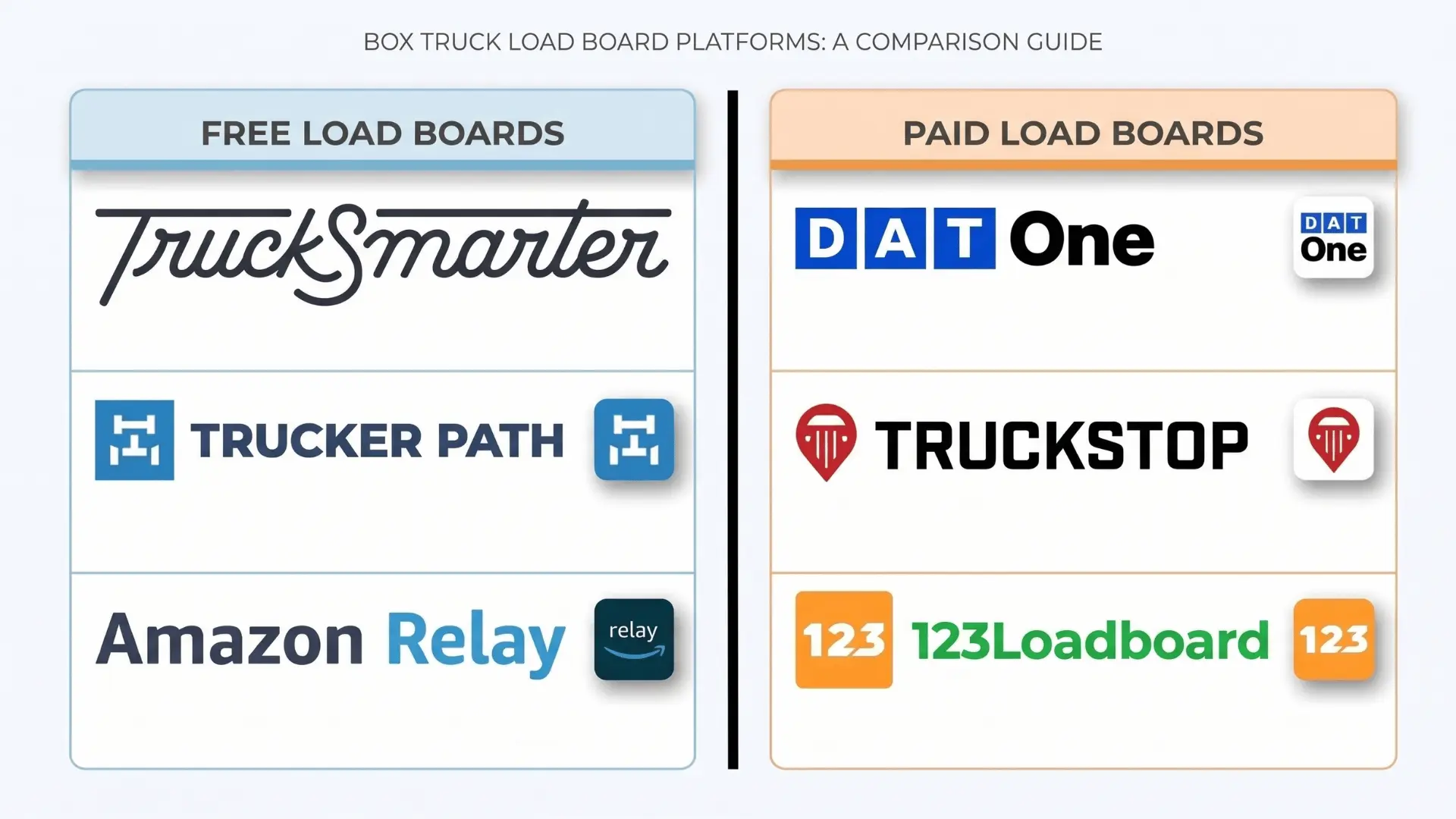
Box truck carriers can choose between free and paid load boards based on budget, truck size, and experience level. Free platforms help reduce startup costs, while paid platforms offer better rate tools and broker data.
Free Load Boards
Free load boards are commonly used by newer carriers and small fleets looking to reduce startup costs.
- TruckSmarter: Free platform for owner-operators and small carriers with freight search and fuel discount tools. It supports box trucks, dry vans, reefers, and flatbeds.
- Trucker Path: Combines load board access with route planning, parking tools, and broker reviews.
- Amazon Relay: Direct carrier program offering scheduled freight for approved 26-foot box trucks and larger.
Paid Load Boards
- DAT One: Large freight marketplace with rate analytics, lane averages, and spot market pricing tools to help carriers negotiate better rates.
- Truckstop: Known for broker verification, credit checks, load alerts, and market data that help reduce payment risks.
- 123Loadboard: Regional-focused platform with lane-based load matching tools for owner-operators and smaller dispatch teams.
The best load board depends on truck size, authority age, and how often the carrier runs freight. Many carriers start with free platforms and gradually add paid tools as rate negotiation and lane planning become more important.
How to Compare Load Boards: Cost, Load Volume, and Rate Data?
The main difference between free and paid load boards is not just access to loads but also to rate data and market insights.
Paid platforms like DAT One and Truckstop help carriers compare lane averages and negotiate better rates, rather than simply accepting the broker’s posted price.
Free vs. Paid Load Boards: What Do You Actually Get?
| Feature | Free Load Boards | Paid Load Boards |
|---|---|---|
| Cost | Free | Monthly subscription required |
| Main Benefit | Access to spot loads | Rate analytics and market data |
| Rate Visibility | Broker’s posted rate only | Lane averages and spot rate trends |
| Best For | New carriers and lower costs | Carriers negotiate rates regularly |
| Common Platforms | TruckSmarter, Trucker Path | DAT One, Truckstop |
A carrier using only free boards may accept a Houston-to-Dallas load at $1.40 per mile because that is the posted broker rate.
A carrier using DAT One or Truckstop rate tools may see that the lane average is closer to $1.75 per mile and negotiate a higher rate.
On a 250-mile load, that difference adds about $87.50 in extra revenue. Over multiple weekly loads, the added income can easily cover the subscription cost of a paid load board.
Why Do Some Box Truck Loads Pay More than Others?
One mistake many newer carriers make is assuming all miles should pay roughly the same.
That is not how freight works.
A load’s rate depends on how badly a broker needs a truck, how many trucks are available in that area, and what the market looks like at that moment.
For example, if a broker needs an expedited load moved today and there are only a few trucks nearby, rates often increase. On the other hand, if dozens of trucks are competing for the same load, rates usually drop.
The destination matters too. A load heading into a strong freight market is often more attractive because there is a better chance of finding another load afterward. A load heading into a weak market may leave a carrier with extra deadhead miles.
That is why experienced carriers pay attention to lanes and market conditions, not just the rate shown on the load board.
What Changes Based on Your Truck Size and Authority Age?
The best load board setup depends on your truck size and the age of your authority. Truck size affects which freight programs you qualify for, while authority age affects which brokers will work with your MC number.
Common Freight Types Found on Box Truck Load Boards
Not every load on a box truck load board looks the same.
Some carriers focus almost entirely on expedited freight, while others spend most of their time running local deliveries or regional routes.
Here are a few freight types you will see regularly:
- Expedited Freight: Time-sensitive shipments that need to move quickly and often pay a premium.
- Last-Mile Delivery: Freight going directly to the customer, such as furniture, appliances, or retail orders.
- Middle-Mile Freight: Loads moving between warehouses, fulfillment centers, and distribution hubs.
- LTL Freight: Smaller shipments that do not require a full truck and are often combined with other freight.
The freight available to you depends on factors like truck size, location, equipment, and the type of operation you run.
16-Foot Box Trucks
Most 16-foot box trucks handle expedited freight, last-mile delivery, and shorter regional routes. Amazon Relay is usually not an option because the program typically requires a 26-foot box truck or larger.
For 16-foot operators, DAT One, TruckSmarter, and Trucker Path are usually the most practical options, especially for local and shorter-haul freight.
26-Foot Box Trucks
The best places to find loads for a 26ft box truck are Amazon Relay, DAT One, Truckstop, TruckSmarter, and Trucker Path. A 26-foot truck qualifies for larger freight categories and can access Amazon Relay for more consistent contract-style lanes.
DAT One and Truckstop help carriers find backhauls, compare rates, and reduce empty miles between loads.
New Authority (Under 90 Days)
Many brokers on DAT One and Truckstop avoid carriers with less than 90 days of authority. This means newer carriers may pay for premium platforms but still struggle to book loads.
That is why free boards like TruckSmarter and Trucker Path are often the most practical starting point during the first 90 days. They remain useful even after adding paid platforms later.
Which Load Board(s) to Start with and how to Build up From There?
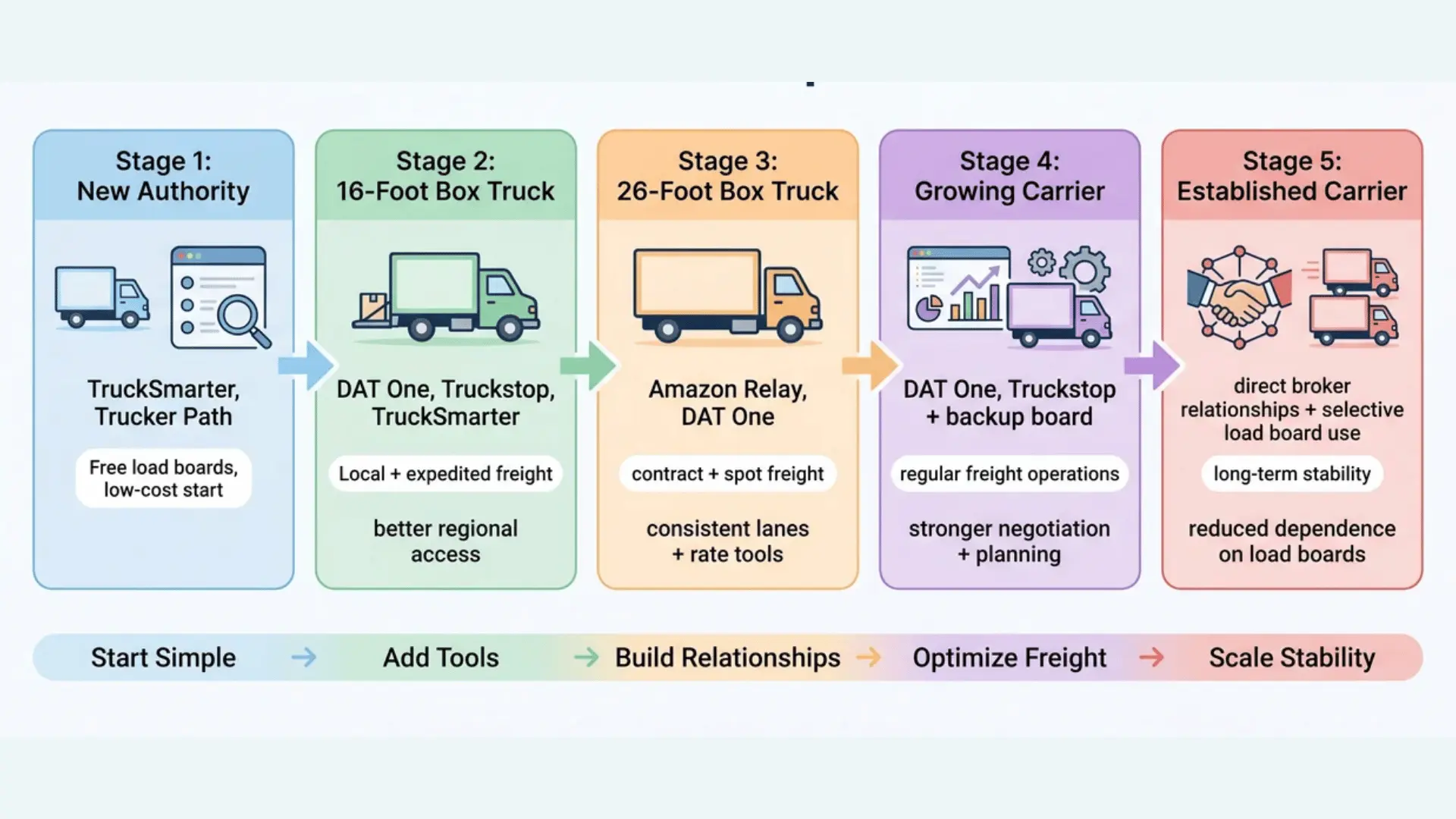
The best load board setup depends on truck size, authority age, and how often the carrier runs freight. Most carriers start with free platforms and add paid tools later as rate negotiation and lane planning become more important.
| Carrier Stage / Setup | Recommended Platforms | Best For | Main Advantage |
|---|---|---|---|
| New Authority | TruckSmarter, Trucker Path | Starting with lower costs | Free freight access and broker reviews |
| 16-Foot Box Truck | DAT One or Truckstop + TruckSmarter | Local and expedited freight | Better regional load access |
| 26-Foot Box Truck | Amazon Relay + DAT One | Contract and spot freight | Consistent lanes with rate analytics |
| Growing Carrier | DAT One or Truckstop + free backup board | Regular freight operations | Stronger rate negotiation and lane planning |
| Established Carrier | Direct broker relationships + selective load board use | Long-term stability | Less dependence on daily load searches |
Most carriers move between these stages based on how often they book loads, how stable their freight becomes, and how strong their broker relationships are.
Carriers gradually move from free load boards to paid platforms as their authority matures and broker access improves. Over time, many successful carriers have focused more on repeat broker relationships and direct lanes rather than relying solely on load boards.
Why Do Many Established Carriers Use Load Boards Less Over Time?
Load boards are where many carriers get started, but they are usually not where the most established carriers stay.
Over time, carriers learn which brokers are reliable, which lanes perform well, and which customers provide steady freight. Those relationships often lead to repeat business that never makes it onto a public load board.
That does not mean load boards are no longer useful. Most experienced carriers still use them to find backhauls, fill gaps in their schedule, or enter new markets.
The difference is that they are no longer relying on load boards for every load. Instead, load boards become one tool in a larger freight strategy.
Wrapping Up
A box truck load board can help carriers find freight opportunities, compare rates, and keep trucks moving, but choosing loads carefully often matters more than booking frequently.
The right platform depends on truck size, authority age, operating area, and freight goals. Free and paid load boards each offer advantages depending on experience level.
Consistent revenue usually comes from selecting better lanes, reducing deadhead miles, and working with reliable brokers that pay on time rather than chasing volume.
Start with platforms that align with your current operations, monitor performance closely, and adjust your strategy as needed to build stronger freight opportunities over time.
Frequently Asked Questions
What is the best box truck load board for beginners?
TruckSmarter and Trucker Path are popular choices for beginners because they offer free access to freight opportunities and broker information. They allow new carriers to learn how load boards work without paying monthly subscription fees. As experience grows, many operators move to platforms like DAT One or Truckstop. These paid tools offer additional market data and rate insights. The best option depends on budget, authority age, and freight goals.
Can you get loads with a new MC authority?
Yes, carriers with a new MC authority can still find loads, although the process may be more challenging. Some brokers prefer working with carriers that have at least 90 days of operating history. This can limit available opportunities during the early stages. Many new carriers start with free load boards and smaller brokers. Opportunities usually increase as authority age and experience grow.
Is Amazon Relay worth it for box truck owners?
Amazon Relay can be a useful option for approved 26-foot box truck operators looking for regular freight opportunities. It provides access to Amazon’s transportation network and scheduled loads. Some carriers value the consistency it offers compared to the spot market. Results can vary depending on location and available routes. Many operators use it alongside traditional load boards rather than as their only source of freight.
How often should carriers check broker credit scores?
Carriers should check a broker’s credit score before working with them for the first time. Payment history and carrier reviews can reveal potential warning signs. Spending a few minutes researching a broker may help prevent payment delays later. Even experienced carriers continue checking broker information regularly. Reliable payments are just as important as finding freight.