That little number on a package? It means more than most people think. You must have heard of gross weight vs net weight; these numbers are always connected to each other.
Change one, and the others change too. It sounds tricky, but it’s actually a pretty simple system once it clicks. And it shows up everywhere, from food labels at the grocery store to big shipments being loaded onto trucks.
Knowing the difference can save money and clear up a lot of confusion. So let’s get into it.
How Weight Labels Affect Your Wallet and Your Decisions
Weight labels are not just numbers on a package. They directly impact how much you spend and what you actually get.
For business owners, incorrect weight labels can result in rejected shipments or legal fines. For shoppers, they help you compare products and get the best value.
Understanding these labels puts the power back in your hands every time you shop or ship.
What is Gross Weight?
Gross weight is the total weight of a product, including its packaging. The box, bag, bottle, or container is all counted in. It is the first number you will often see on a shipping label.
Carriers use it to know the total load. It keeps trucks and containers from being overloaded.
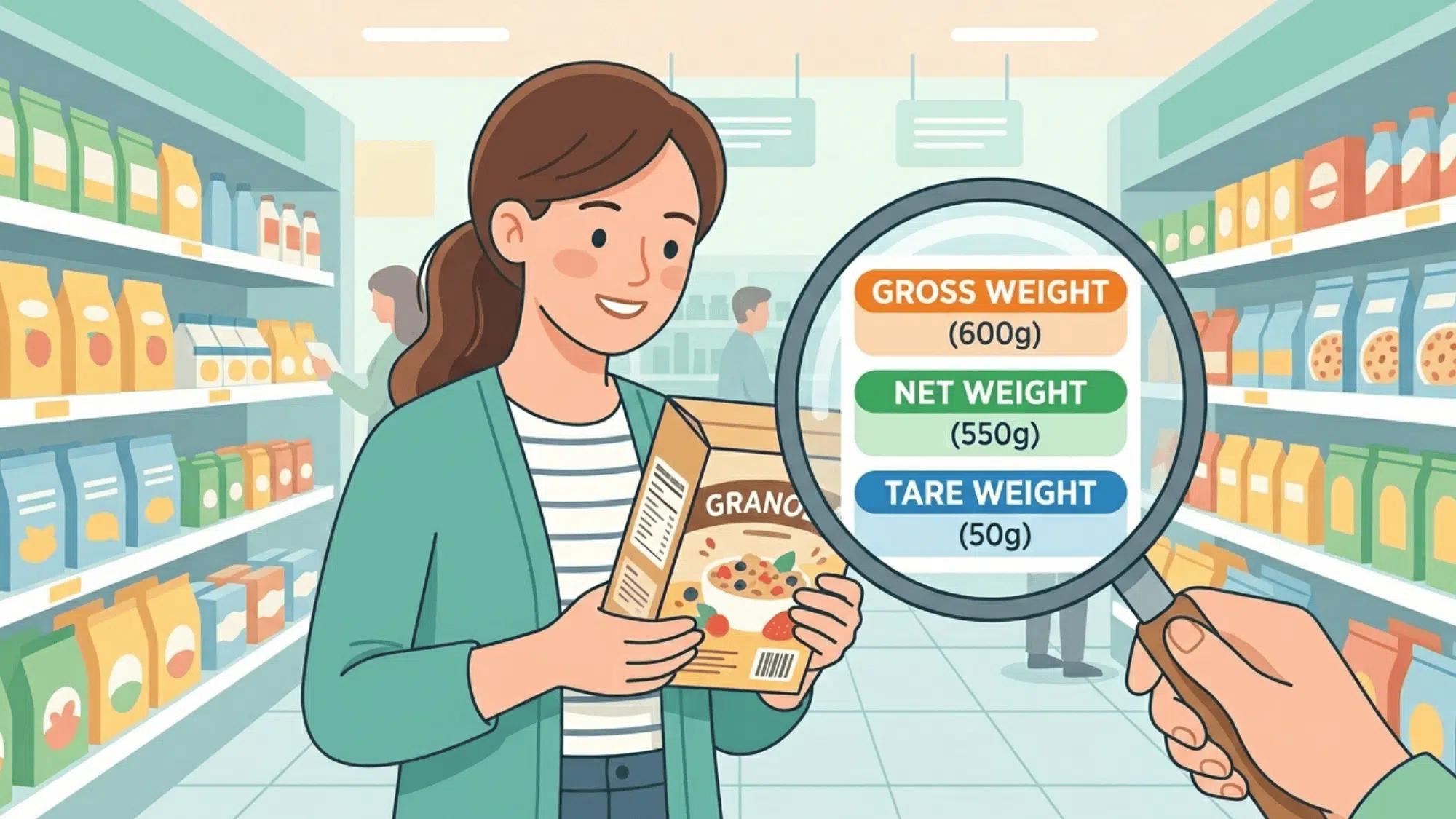
Formula: Gross Weight = Net Weight + Tare Weight
Example: A cereal box needs to be shipped. Here is how to find its gross weight step by step.
- Step 1: Find the net weight (cereal inside) = 500 grams
- Step 2: Find the tare weight (the box) = 100 grams
- Step 3: Add both together = 500 + 100 = 600 grams
Factors That Affect Gross Weight
Gross weight is not always a fixed number. Several things can change it based on the product, packaging, and shipping conditions. Here are the key factors:
- Type of Packaging Material: Glass, metal, and thick cardboard weigh more than plastic or paper.
- Size of the Container: Bigger containers weigh more even when empty.
- Quantity of Product: More product inside means a higher gross weight.
- Protective Materials: Bubble wrap, foam, and packing peanuts all add to the total.
- Packaging Moisture Absorption: Packaging that absorbs moisture gets heavier over time.
- Pallets and Skids: Pallet weight is always part of the total shipment weight.
- Labels and Seals: Stickers, seals, and tags add a small but real amount of weight.
- Type of Product: Heavy products such as metals, liquids, or machines increase the gross weight.
- Multi-Layer Packaging: Each additional layer adds weight.
- Refrigerants and Dry Ice: Cooling materials used in sensitive shipments add extra weight.
Let’s Learn About Net Weight
Net weight is the weight of the product alone without any packaging. It is what you are actually paying for. Shoppers use it to fairly compare products.
Businesses use it to find the true weight of goods being shipped. It is the most honest number on any label.
Formula: Net Weight = Gross Weight − Tare Weight
Example: A jar of honey needs its net weight calculated. Here is how, step by step.
- Step 1: Find the gross weight (jar + honey) = 800 grams
- Step 2: Find the tare weight (the jar) = 150 grams
- Step 3: Subtract tare from gross = 800 − 150 = 650 grams
Factors That Affect Net Weight
Net weight changes based on the product itself, not the packaging around it. It can shift due to how a product is made, stored, or transported. Understanding these changes helps buyers know what to expect.
Here are the key factors:
- Product Density: Heavier materials weigh more even in the same volume.
- Product Moisture Loss: Fresh produce and perishables lose water over time, reducing net weight.
- Product Form: Solids, liquids, and powders of the same product weigh differently.
- Temperature Changes: Heat or cold can cause products to expand, shrink, or evaporate.
- Settling During Transit: Loose powders or grains can settle during shipping, altering the measured weight.
- Manufacturing Tolerances: Small variations in filling during production can slightly change the net weight.
- Ingredient Composition: Heavy ingredients such as salt, sugar, or oil increase the net weight.
- Packaging Fill Level: Too little or too much product in a container changes the container’s net weight.
Gross Weight vs. Net Weight: Key Differences You Should Know
Gross weight and net weight are closely related but serve very different purposes across industries. While one focuses on the total load, the other zeroes in on the product alone.
Here is a quick comparison of what makes each one unique:
| Feature | Gross Weight | Net Weight |
|---|---|---|
| Value | Always higher | Always lower |
| Legal Requirement | Required on freight documents | Required on consumer product labels |
| Industry Use | Freight, logistics, aviation | Retail, food, e-commerce |
| Regulated By | Transport and freight authorities | Food and trade standards bodies |
| Can It Change | Yes, based on the packaging used | Yes, based on product quantity |
Tare Weight: Quick Overview
Tare weight is the weight of the empty container or packaging only. It does not include the product inside. Tare weight is subtracted from gross weight to find the net weight.
It is commonly used in trucking, shipping, and the food industries. Knowing the tare weight helps businesses charge customers only for the actual product, not for the container or vehicle that carries it.
Formula: Tare Weight = Gross Weight − Net Weight
Example: A truck carries a shipment, and its total weight is recorded. Here is how to calculate it:
- Step 1: Find the gross weight (truck + goods) = 5000 kg
- Step 2: Find the net weight (goods only) = 3500 kg
- Step 3: Subtract net from gross = 5000 − 3500 = 1500 kg
How Gross Weight, Net Weight, and Tare Weight Work Together?

These three weight terms are not independent numbers. They are part of a single connected system in which each value depends on the other two. Understanding how they relate to each other is the key to using them correctly.
Here is how they all fit together:
1. They are Mathematically Linked
If you know any two of these weights, you can always find the third. Gross weight equals net weight plus tare weight. Change one number and the others shift too.
This is what makes them a system, not just three separate terms. For example, if a business changes its packaging, the tare weight changes, which directly affects the gross weight. The math always stays connected.
2. They Always Add Up the Same Way
Gross weight is always the sum of the net and tare weights. This rule never changes, no matter the product, industry, or country. It is the one formula that holds true across every shipment and every label.
Even if you are shipping food, machinery, or clothing, the relationship between these three numbers stays exactly the same. No exceptions exist.
3. One cannot Exist Without the Others
You cannot calculate net weight without knowing the gross and tare weights. You cannot find tare without gross and net. Each weight relies completely on the other two.
This is why all three values must be recorded accurately from the start. A mistake in one number can propagate to the other two, causing problems with billing, labeling, and customs clearance.
4. A Single Weighing Gives You All Three
One measurement on a scale is all it takes to get started. From that single gross weight reading, you can work out the other two values as long as you know either the tare or the net weight.
The carrier uses the gross weight to plan the load. The buyer checks the net weight to confirm the quantity of the product. The customs officer reviews the tare weight to verify the container.
All three come from just one weighing session.
5. Changing One Always Affects Another
Heavier packaging increases tare weight, which in turn raises the gross weight. But the net weight stays the same because the product hasn’t changed.
This ripple effect directly impacts shipping costs. Smart businesses choose lighter packaging to keep gross weight low and reduce freight charges.
The Bottom Line
Gross weight vs net weight, honestly, it’s simpler than it looks. Just three numbers, all connected, and telling the story of what’s inside a package and what’s holding it together. And this knowledge doesn’t just sit in a textbook.
It shows up at the grocery store, at shipping counters, and in warehouses every single day. Pretty much anywhere a package exists. So next time a label catches your eye, those numbers won’t feel random anymore.
They’ll actually make sense. And knowing what they mean? That’s the kind of small win that quietly saves your money, avoids mistakes, and makes everyday decisions a whole lot smarter.