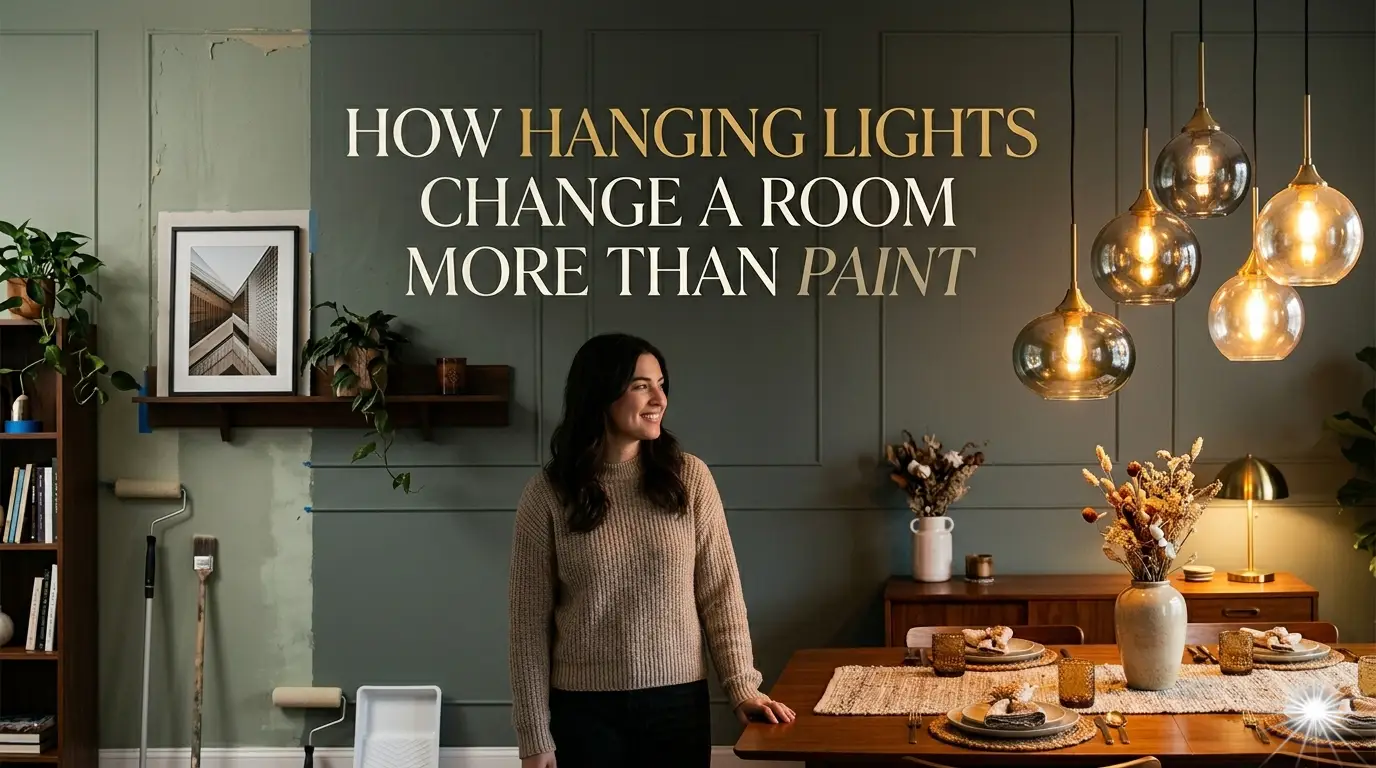
You could spend a full weekend taping edges, rolling primer, and layering two coats of the trendiest wall color. The room might look a little different when you’re done. But flip the switch on the same old fixture, and everything still feels exactly the way it did before. That’s the frustrating truth about relying on paint alone to refresh a space.
What actually shifts the feel of a room is what happens when the sun goes down. The quality, direction, and warmth of your light sources shape how you experience every surface, every corner, every meal. Upgrading to a well-chosen dining room pendant light can do more for your evening atmosphere than any color swatch ever will. This piece breaks down why hanging fixtures create such a dramatic difference, how to get the placement right, and where the biggest opportunities are hiding in your home right now.
Paint Changes What You See, Light Changes How You Feel
Here’s something worth sitting with for a moment. A 2024 report from the American Society of Interior Designers found that “lighting ranked as the single most influential element in occupant satisfaction,” beating out color, furniture, and layout. Paint is visual. Lighting is experiential. It touches mood, energy levels, and even how well you sleep at night.
Color on the walls is static. It looks one way at noon, another way at 7 p.m., and completely different under a cool-toned ceiling fixture versus a warm pendant. Your paint color is only as good as the light that hits it. This is why designers choose fixtures before they finalize paint palettes, not the other way around.
Pendant lights have a particular advantage here because they occupy the middle zone of a room. They’re not flush against the ceiling where light gets lost. They’re not sitting on a table where they only reach a small radius. They hang right in the space where your eyes naturally rest, creating a glow that feels deliberate and warm.
3 Things That Change When You Swap a Flat Fixture for a Pendant
The Room Gets a Vertical Anchor
Flat flush mounts do nothing for the eye. A pendant draws your gaze downward from the ceiling plane, giving the room a sense of depth it didn’t have before. In rooms with eight or nine-foot ceilings, this is especially noticeable. The space suddenly feels more intentional, like someone actually designed it.
Shadows Become Your Friend
Good lighting isn’t about eliminating shadows. It’s about placing them where they add dimension. A pendant creates a focused pool of light below and softer ambient light around it, which gives walls and furniture a subtle contrast. That contrast is what makes a room feel alive instead of flat.
The “Builder-Grade” Look Disappears
Nothing says generic rental or tract home faster than a brass-and-frosted-glass flush mount from 2004. Replacing it with a single pendant, even a simple one, signals a level of care and taste. According to a 2024 Houzz Kitchen Trends Study, “pendant fixtures were the most frequently upgraded lighting element during kitchen and dining renovations.” People notice them because they sit at eye level. They become part of the room’s personality.
Where Pendant Lights Make the Biggest Impact

Not every room benefits equally from a hanging fixture. Some spaces are practically built for them. Others need a more thoughtful approach.
Over the Dining Table
This is the most natural home for a pendant, and it’s where most people start. A single large fixture or a pair of smaller ones hung 30 to 36 inches above the tabletop creates a warm circle of light that makes meals feel more intimate. The American Lighting Association recommends choosing a fixture diameter that’s roughly one-half to two-thirds the width of the table. Go too small, and it looks like an afterthought. Go too large, and it overwhelms the setting.
Above the Kitchen Island
The kitchen is where pendant lighting arguably works the hardest. If you’ve been relying on recessed cans alone, the countertop where you actually chop, mix, and plate food is probably underlit. Adding kitchen pendant lighting over the island solves that problem while creating a visual bridge between the cooking zone and the dining or living area. Space them about 24 to 30 inches apart, centered over the island’s length, and keep the bottom of the fixture around 30 to 36 inches above the counter surface.
In the Entryway
First impressions happen in the first five seconds of walking into a home. A pendant in the foyer signals warmth before anyone even sets down their coat. If your ceiling height allows it, this is one of the highest-return fixture swaps you can make. Keep the lowest point of the pendant at least seven feet from the floor for comfortable clearance.
A Real-World Comparison That Puts This in Perspective
Consider two identical dining rooms. Same table, same chairs, same wall color. Room A has a standard flush mount with a 3000K LED bulb. Room B has a linen-shade pendant hung at 32 inches above the table with the same color temperature.
In Room A, the light scatters evenly across the ceiling and walls. The table surface gets adequate light, but there’s no visual focus. The room feels fine but forgettable.
In Room B, the pendant pulls the light down and concentrates it around the table. The walls receive a softer glow from the edges of the shade. There’s a natural focal point. People sitting at the table feel a subtle sense of enclosure that makes conversation easier. That difference costs maybe $80 to $250 and a half hour of installation.
The U.S. Department of Energy notes that “lighting accounts for about 15% of a typical home’s electricity use.” Choosing an efficient LED pendant doesn’t just improve aesthetics. It contributes to lower utility costs over the fixture’s lifespan, which for quality LEDs can reach 25,000 hours or more.
Before You Buy: The Quick Gut Check
Run through these five questions before you order anything.
- What’s your ceiling height? Below eight feet, look at semi-flush or close-to-ceiling pendants. Above eight feet, you’ve got room for a standard drop.
- What’s the fixture’s job? Task lighting over a counter needs a downward-facing shade. Ambient lighting for a hallway needs a diffused or translucent shade.
- What’s already in the room? A pendant works best when it complements existing light sources, not when it’s asked to do everything alone.
- How’s the wiring? If there’s already a junction box in the ceiling, installation is straightforward. No junction box? A plug-in swag pendant gets you the same look without hiring an electrician.
- Does the scale match? Add the room’s length and width in feet. That number, converted to inches, is a solid starting point for fixture diameter.
FAQs: Frequently Asked Questions
Will a Pendant Light Make My Low Ceiling Feel Cramped?
Not if you choose the right profile. Semi-flush pendants or slim globe styles add character without dropping too far into the room. Anything that hugs within six to eight inches of the ceiling keeps things open.
How Do I Know if My Dining Table Is the Right Size for a Pendant?
Measure the table’s width. Your fixture should be roughly half to two-thirds that measurement in diameter. A 42-inch round table, for example, pairs well with a pendant between 21 and 28 inches wide.
Can I Install a Pendant Light Myself?
If you’re replacing an existing ceiling fixture with a junction box already in place, it’s a manageable DIY project for most homeowners. Turn off the breaker, follow the manufacturer’s wiring guide, and secure the canopy to the box. For new installations without existing wiring, hiring a licensed electrician is the safer and code-compliant route. The National Electrical Code requires all permanent fixtures to connect through an approved junction box.
Are Pendant Lights Going Out of Style?
Not even close. Data from the 2024 National Association of Home Builders shows that “pendant fixtures remain among the top three most requested lighting elements in new construction.” Their versatility across styles, from industrial to minimalist to organic, keeps them relevant year after year.
One Last Thought
The next time a room in your home feels off and your first instinct is to grab a paint roller, pause. Look up instead. What’s hanging from the ceiling, or not hanging from it, might be the real reason the space isn’t working. Paint changes the walls. A pendant changes the room.
Start with the spot where you spend the most time after dark. The dining table where your family gathers. The kitchen island where you prep meals. The reading corner where you unwind. One fixture in the right place, at the right height, with the right warmth, and you’ll wonder why you didn’t do it years ago. The change is that immediate, and it lasts a lot longer than a fresh coat of eggshell.