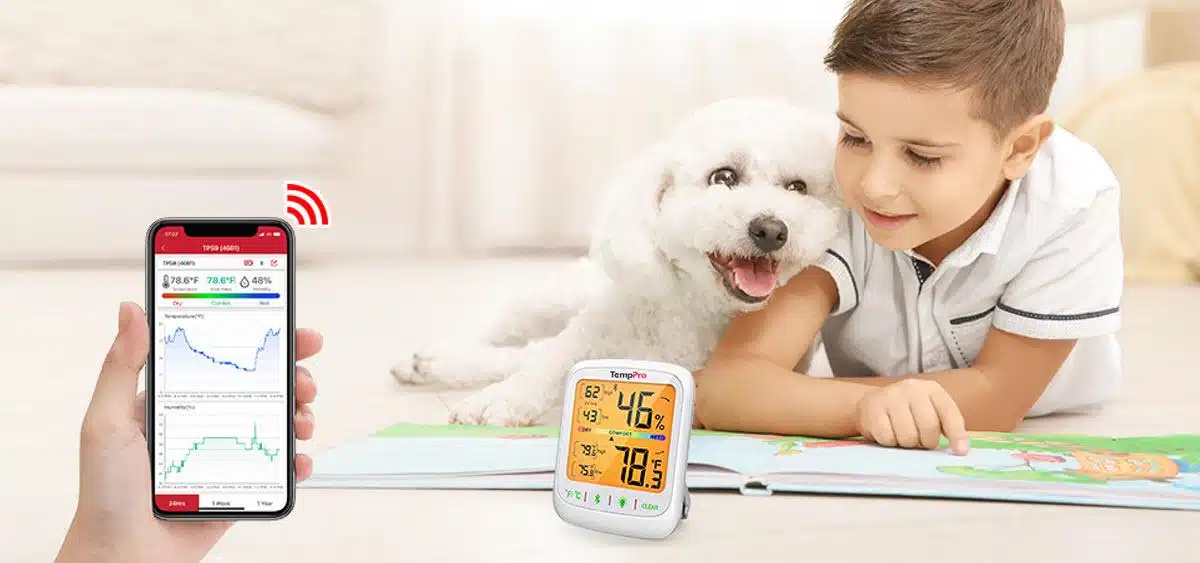
As we head into the summer, many people are cranking up their air conditioners, scheduling backyard BBQs, and trying to stay cool. But while you are adjusting the thermostat for your own comfort, have you stopped to think about your furry, feathered, or scaled family members?
Pets rely entirely on us to manage their living environment. Because they cannot sweat the way humans do, high indoor humidity combined with rising summer temperatures can quickly become uncomfortable and even dangerous for them.
In this guide, we will break down the ideal temperature and humidity levels for different pets, explain why monitoring your indoor climate is essential this summer, and show you how to take control of your home’s air quality to keep your pets safe and thriving.
What’s the Ideal Temperature and Humidity for Pets?
Just like humans, pets feel the combined effects of heat and moisture (often referred to as the heat index). High humidity makes the air feel much hotter than it actually is because it prevents the body from cooling itself through evaporation.
Depending on what kind of pet you have, their environmental needs will vary:
Dogs and Cats
- Ideal Humidity: 30% to 50%
- Ideal Temperature: 68°F to 78°F
Dogs and cats cool themselves primarily through panting and releasing heat through their paw pads. If the humidity inside your home climbs above 60%, their panting becomes inefficient. This puts them at a much higher risk for heat exhaustion and heatstroke. Brachycephalic breeds (short-nosed dogs like Pugs, Bulldogs, and Frenchies) are especially vulnerable and need strictly monitored, cooler environments.
2. Birds (Parrots, Budgies, Cockatiels)
- Ideal Humidity: 40% to 60%
- Ideal Temperature: 70°F to 80°F
Many companion birds natively come from tropical climates and actually prefer slightly higher humidity than dogs or cats. However, typical summer AC usage can strip moisture from the air, dropping indoor humidity below 30%. This dry air can lead to dry skin, respiratory issues, and behavioral problems like feather plucking.
3. Reptiles and Amphibians (Bearded Dragons, Geckos, Frogs)
- Ideal Humidity: Highly species-dependent, e.g., 30-40% for desert species like Bearded Dragons; 60-80% for tropical species like Crested Geckos.
- Ideal Temperature: Requires a thermal gradient (a hot basking side and a cooler side).
Reptiles are ectothermic, meaning they rely on their environment to regulate their body temperature. Summer heatwaves can easily overheat a terrarium if the room’s ambient temperature isn’t tracked closely.
Why You Must Monitor Indoor Climate in the Summer
You might think, “I feel fine, so my pet must feel fine too.” Unfortunately, this is a dangerous assumption. Here is why active monitoring with a smart hygrometer thermometer is a must-have for pet parents:
Microclimates in the House:
Temperature and humidity are not uniform throughout a home. Your living room might feel perfectly cool, but a pet’s crate in the hallway, a reptile tank near a sunny window, or a cat’s favorite sleeping spot upstairs could be drastically hotter and more humid.
The Silent Threat of Mold and Allergens:
June’s high humidity creates the perfect breeding ground for dust mites and mold spores. If your indoor humidity consistently stays above 60%, it can trigger severe skin allergies, scratching, and respiratory distress in both dogs and cats.
AC Dehydration:
While air conditioning lowers the temperature, it also acts as a dehumidifier. Running your AC non-stop can cause indoor humidity to crash below 30%, leading to dry, itchy skin for dogs and respiratory irritation for tropical birds.
Without an accurate digital reading, you are simply guessing at your pet’s comfort level.
How to Measure Indoor Humidity and Temperature
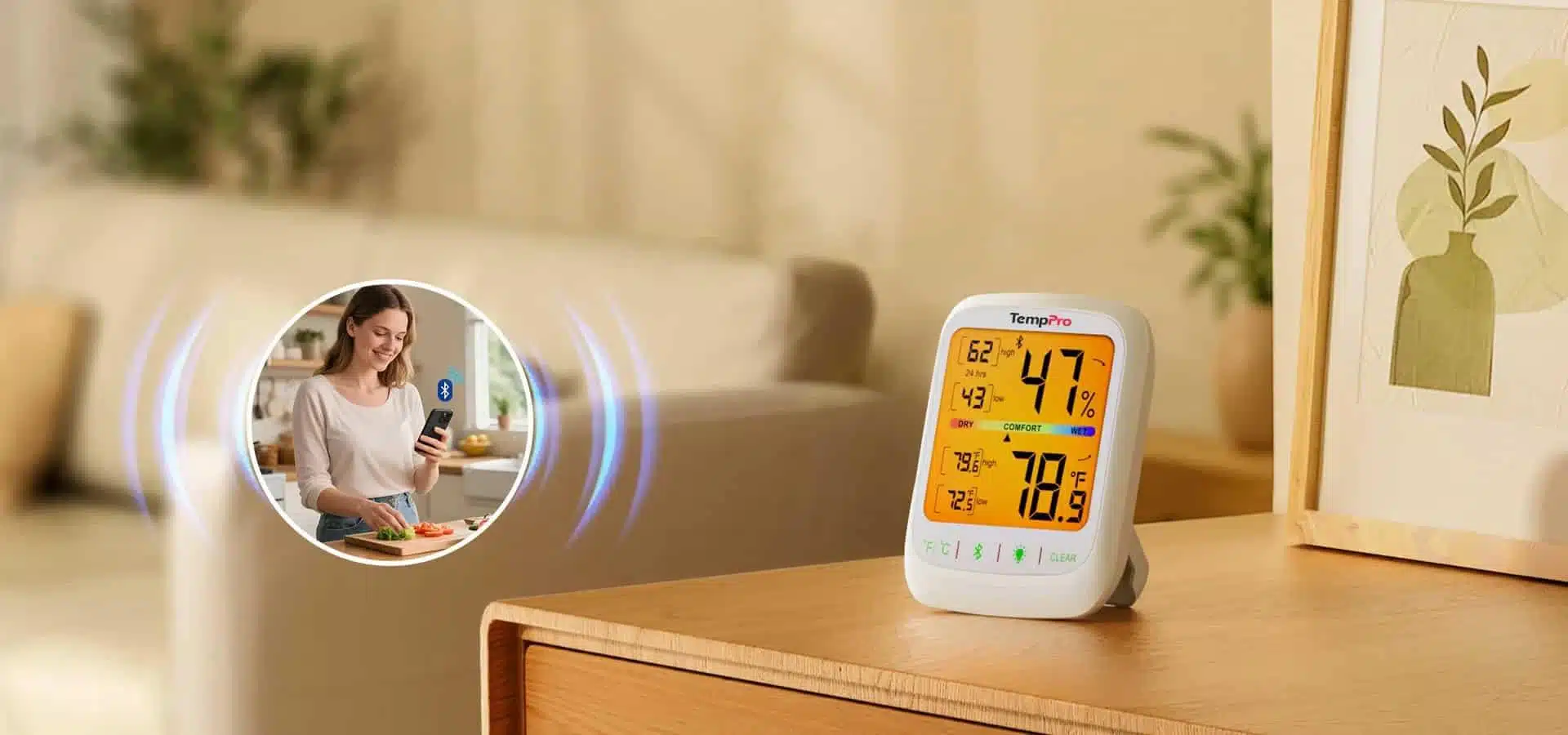
To eliminate the guesswork and keep your pets perfectly safe, you need a reliable, real-time monitoring system. The TempPro TP359 Bluetooth Indoor Thermometer Hygrometer is designed to give pet parents ultimate peace of mind. Whether you are in the next room or working in the yard, this smart device ensures you always know exactly what kind of environment your pet is experiencing.
Key Features of the TempPro TP359:
High-Accuracy Swiss Sensors: Equipped with advanced Swiss-made Sensirion sensor, the TempPro TP359 provides incredibly precise readings, accurate to ±0.9℉ for temperature and ±2% for humidity. It refreshes every 10 seconds, giving you the most up-to-date data.
Smart Bluetooth Connectivity: No need to constantly walk up to the device. The TempPro TP359 connects seamlessly to your smartphone via a user-friendly app, allowing you to check your home’s climate from up to 260 feet away.
Instant Smart Alerts: This is a lifesaver for pet owners. You can preset your pet’s ideal temperature and humidity ranges in the app. If the summer heat causes the temperature to spike or the AC causes the humidity to drop outside of those safe zones, your phone will receive an instant push notification.
Clear LCD Display with Comfort Indicators: If you are glancing at the device across the room, the large, easy-to-read screen displays bold numbers alongside a 3-level comfort indicator (Dry, Comfort, Wet) so you can evaluate the room’s status at a glance.
Data Logging and Trends: The app stores historical data, allowing you to review daily, weekly, or monthly trends. This helps you identify if a specific room gets dangerously hot during peak afternoon sun hours.
How to Check and Adjust Your Pet’s Environment
Using the TempPro TP359 to protect your pets is incredibly straightforward. Follow these steps to set up a foolproof summer climate plan:
Step 1: Strategic Placement
Place your TempPro TP359 at “pet level.” Do not hang it high on a wall if your dog spends all day on the floor, as heat rises. Position it near your pet’s bed, crate, or terrarium, ensuring it is out of direct sunlight and away from direct AC vents, which can skew the readings.
Step 2: Set Your App Alerts
Open the app and configure your safety thresholds based on your specific pet. For a standard household with a dog or cat, set the high-temperature alert to 78°F and the high-humidity alert to 55%.
Step 3: Take Action Based on the Data
Once your TempPro gauge gives you a reading, use these simple household adjustments to regulate the air:
If the TempPro reads “Too Wet” (Humidity > 60%): Turn on a dehumidifier in the room where your pet spends the most time. Ensure your AC unit is set to “Cool” rather than just “Fan” mode, as the cooling cycle naturally extracts moisture from the air.
If the TempPro reads “Too Dry” (Humidity < 30%): This is common in heavily air-conditioned spaces. Set up a small ultrasonic humidifier near your bird’s cage or your dog’s favorite resting area. Alternatively, adding pet-safe water fountains around the house can subtly boost local humidity while keeping your pets hydrated.
If the TempPro reads “Too Hot” (Temperature > 80°F): Draw the curtains or blinds to block out solar heat. Turn on ceiling or floor fans to create a cooling breeze (remember, fans cool pets via convective heat loss, but only if the ambient temperature is lower than their body temperature). Always ensure they have access to fresh, ice-cold water.
Final Thoughts
Our pets give us unconditional love, and the least we can do is provide them with a safe, comfortable place to live. This year, don’t let summer’s invisible dangers, extreme heat and hidden humidity, put your furry family members at risk.
By investing in a precise tool like the TempPro TP359 Bluetooth Indoor Hygrometer Thermometer, you take the guesswork out of pet care. You will gain the power to track, adjust, and optimize your home’s climate, ensuring your pets stay cool, happy, and healthy all summer long.