Recessed and flush-mount fixtures and ceiling fan light kitsThere’s a moment most of us know too well. You finish rearranging a small room, step back, switch on the light… and the space still feels tight. Heavy. Almost annoyed with you.
That feeling isn’t imaginary. Homes really are shrinking. The U.S. Census Bureau shows the median size of newly built single-family homes dropped to about 2,286 square feet in 2023, down from its mid-2010s peak. Less room to work with. Same expectations of comfort.
Lighting ends up carrying more responsibility than we admit. It shapes mood, movement, and even how big a room feels. This article breaks down why lighting matters so much in small homes and then walks through nine space-saving lighting ideas that genuinely help rooms relax instead of closing in. Keep reading. It gets practical fast.
Why Lighting Matters More When Space Is Tight
In a big house, bad lighting is annoying.
In a small one, it’s suffocating. Light affects how we perceive volume. Brighter, evenly distributed light makes rooms feel larger, a phenomenon supported by environmental psychology studies published in journals like Lighting Research & Technology.
Dark pockets shrink space mentally, even when square footage stays the same.
And here’s another number that matters: lighting accounts for about 15% of the average household’s electricity use, according to the U.S. Department of Energy. In small homes, every watt and fixture choice carries more weight.
So yes, lighting isn’t decoration. It’s architecture.
8 Space Saving Lighting Ideas for Small Homes
There’s no single magic fixture. It’s about choosing light that disappears when it needs to and shows up when it counts. Here are nine approaches that consistently work in small homes.
1. Recessed Ceiling Lighting & Flush Fixtures
Hanging pendants look great on Instagram. In real life? They eat headroom.
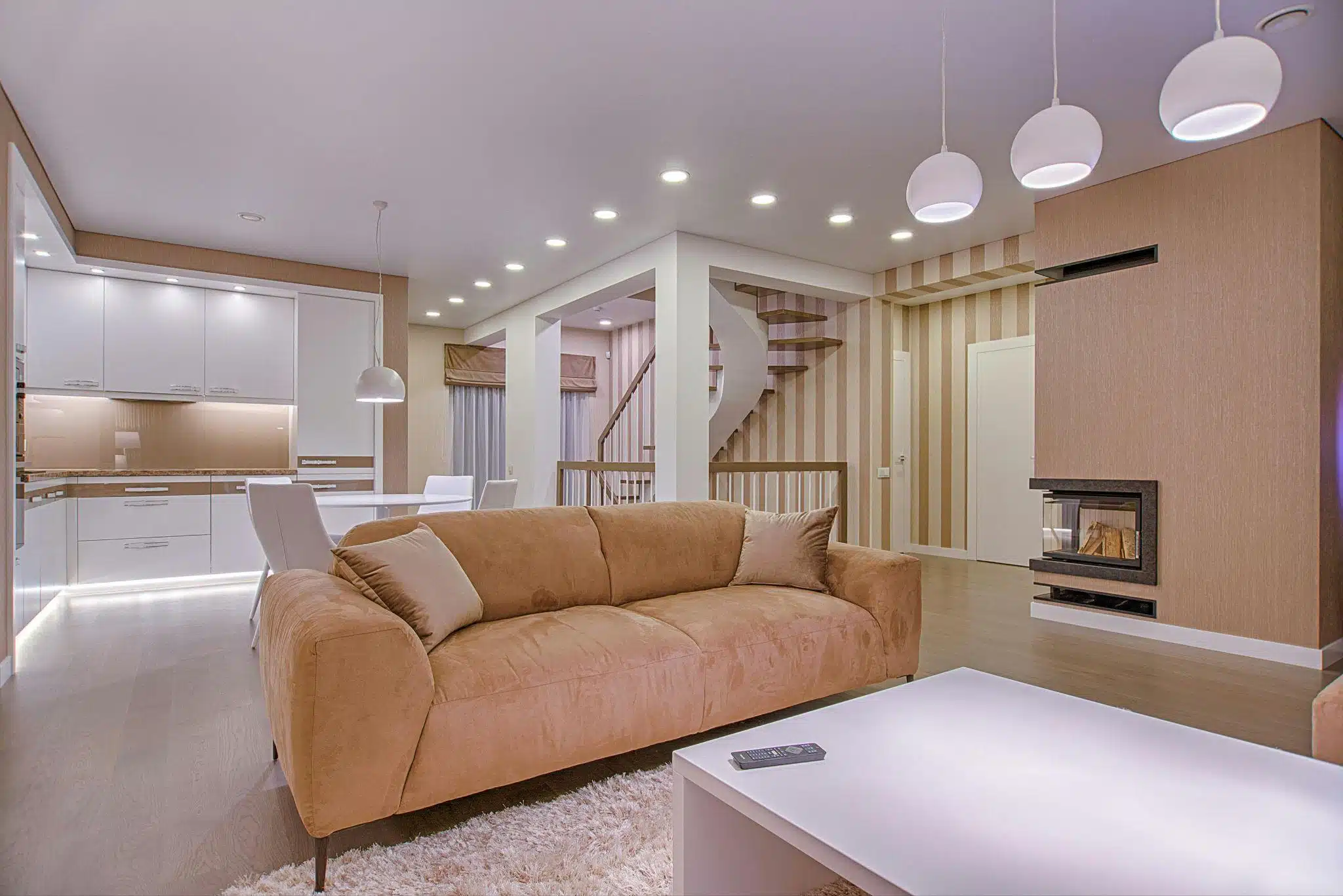
Recessed and flush-mount fixtures and ceiling fan light kits sit close to the ceiling, sometimes inside it. No dangling cords. No visual clutter. Just light where you need it.
Recessed LEDs are especially efficient. The DOE reports that LEDs use at least 75% less energy and last up to 25 times longer than incandescent bulbs. That longevity matters when your ceiling is already low, and ladder gymnastics aren’t fun.
Still, spacing matters. Too many recessed lights, and the ceiling turns into Swiss cheese. Balance is the trick.
2. Low-Profile Flush Mounts
Sometimes recessed lighting isn’t possible. Old wiring. Concrete ceilings. You know the drill.
Slim flush-mount fixtures are the fallback that doesn’t feel like a compromise. Modern versions are thinner and spread light more evenly than older dome styles. Even illumination reduces harsh shadows, which studies link to cramped visual perception.
Quiet ceiling. Calmer room.
3. Linear LED Lighting
There’s a kind of lighting that doesn’t scream for attention. It just… works.
Linear LED systems fall into that category. They’re slim, modular, and designed to tuck into places traditional fixtures can’t, under cabinets, along ceilings, inside shelving.
You can see this philosophy reflected in home lighting from Inline Lighting, where low-profile linear systems are designed to integrate into architecture rather than hang off it. The emphasis on diffused light and slim profiles makes sense in small spaces.
Nothing bulky. Nothing shouting for attention.
4. Wall Sconces Instead of Floor Lamps
Floor lamps take up more space than we like to admit.
Wall sconces free that space instantly. Mounted higher on the wall, they pull the eye upward, making rooms feel taller. The American Lighting Association points out that layered lighting improves visual comfort, and in small homes, it also improves flexibility.
No cords. No tripping hazards. No regrets.
5. Under-Cabinet Lighting
Kitchens and workspaces get weirdly overlooked.
Under-cabinet lighting clears shadows from counters, keeping prep areas safer and more usable. The National Kitchen & Bath Association notes that task lighting improves kitchen usability, especially in small layouts where daylight rarely reaches inside.
Built-in LEDs tucked into shelves or closets work similarly. They turn ignored pockets into working spaces. You stop squinting. You stop guessing. It feels… lighter.
And since modern LED strips stay slim, often under half an inch, they don’t eat space. They simply bring focus.
6. Integrated Shelf and Closet Lighting
Dark storage spaces make homes feel cluttered.
Adding integrated lighting inside shelves or closets changes that instantly. You see everything. You move faster. You stop pulling everything out just to find one thing. LED strips used here are usually under half an inch thick, so they don’t eat into storage depth.
It’s a small detail. Still, it changes daily life.
7. Adjustable Track Lighting
Track lighting used to feel industrial and clunky.
Newer systems are slimmer and more adaptable. One track can replace several fixtures, reducing ceiling clutter. Adjustable heads let you redirect light as layouts shift, which they always do in small homes.
The International Energy Agency (IEA) reports that efficient lighting combined with controls can reduce lighting energy use by 16–22%. Flexibility helps make that happen.
8. Dimmable and Smart Lighting
One fixture, multiple moods.
Dimmable and smart lights allow a single source to handle work lighting during the day and softer ambient light at night. Fewer fixtures mean fewer visual interruptions and fewer switches breaking up the walls. It’s not about gadgets. It’s about restraint.
The Takeaway
Small homes don’t need louder lighting. They need kinder lighting.
When fixtures step back, and illumination spreads evenly, rooms soften. Corners loosen. You stop noticing the limits of the space and start noticing how well it supports you. Maybe that’s the real win, not making a small home feel bigger, but making it feel settled.
And once a room finally feels settled… you don’t rush to change it. You just live there.