
Moving across the country feels expensive before you even start. You’ll see people say “just rent a truck” or “sell everything and start over,” while others insist movers are a scam.
The truth is, the cheapest way to move cross-country depends less on the company you choose and more on your situation.
Cost shifts based on distance, how much you own, whether you have a car, and how flexible you are with time. Once you understand those mechanics, the decision usually gets a lot clearer.
Let’s break it down properly.
What Actually Determines the Cheapest Way to Move Cross Country?
Before comparing trucks, containers, or shipping boxes, you need to understand what drives cost in the first place. It comes down to six core factors:
- Distance: The farther you move, the more fuel you burn and the more mileage fees stack up. Rental trucks often charge per mile, freight services use distance bands, and shipping rates increase by zone.
- Load size: This is the biggest cost driver. Some services charge by weight, others by cubic feet, and your total volume determines which options are even practical.
- Vehicle ownership: Owning a reliable car or SUV eliminates rental base fees. Without one, you’re automatically pushed toward truck rental, containers, or shipping.
- Time flexibility: Moving mid-week or outside peak season can reduce base pricing. High-demand dates raise costs across most services.
- Labor: Doing everything yourself saves labor fees but costs time and effort. Hiring help increases cost while reducing strain.
- Replacement value vs transport cost: Sometimes it’s cheaper to rebuy items than move them. The decision depends on comparing transport fees to the realistic replacement cost.
When you look at these factors together, the “cheapest” option becomes less about the company and more about how your situation fits these variables.
When is Using Your Own Vehicle the Absolute Cheapest Option?
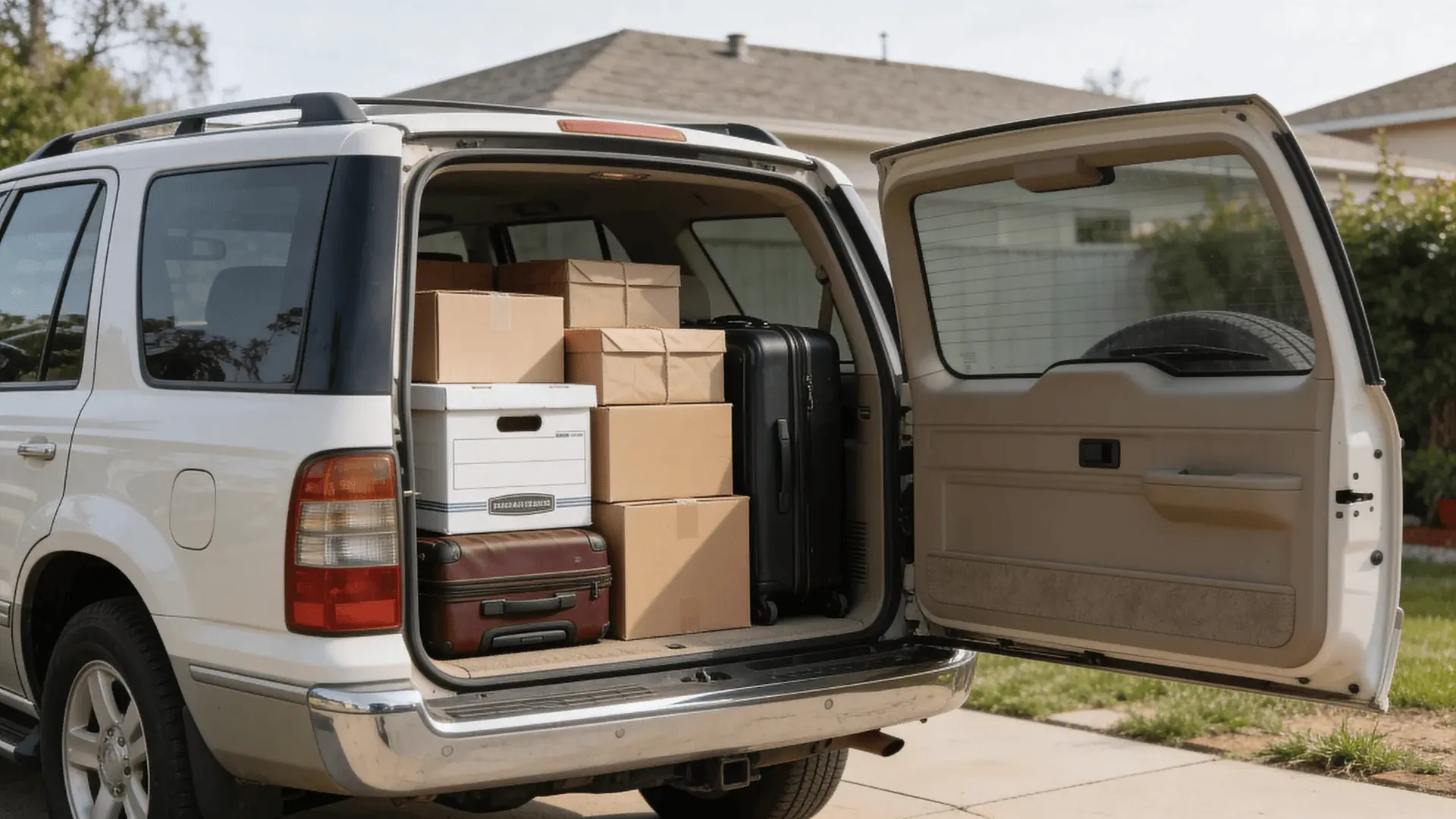
Using your own car or SUV is usually the cheapest method, but only under very specific conditions. It works best when:
- You have minimal furniture
- Everything fits in one trip
- You don’t need multiple hotel stays
Fuel becomes your primary expense. If you drive 2,000 miles and your car averages 30 miles per gallon, you’ll use around 67 gallons. Multiply that by gas prices, and you have your core cost.
Then add food and maybe one night of lodging. That total is often far lower than renting a truck.
But here’s where it flips.
If your belongings don’t fit and you need a second trip, fuel doubles. Lodging doubles. Time off work increases. Suddenly your “cheap” move isn’t cheap anymore.
Wear and tear also matters. Long-distance driving adds mileage to your vehicle. While not an upfront fee, it’s still real cost over time.
The internal contrast looks like this:
- Small load, one trip → extremely cheap
- Slightly too much stuff, multiple trips → no longer cheapest
Driving yourself only wins when your cargo fits cleanly inside your vehicle in one pass. If it doesn’t, this option breaks.
When Does Renting a Moving Truck Cost Less than Every Other Option?

Truck rental becomes dominant when your load is too large for your car but not large enough to justify professional movers. You typically pay:
- Base rental fee
- Per-mile charge
- Fuel
- Optional insurance
For medium-sized moves, this often beats containers and movers. The key mechanism is control. You manage loading and unloading yourself, which means you avoid labor and freight handling fees.
However, trucks burn more fuel than cars. A loaded truck may get 8–12 miles per gallon. On long routes, fuel becomes significant and can narrow the savings gap.
One-way pricing also matters. Companies adjust rates based on truck supply and demand between cities. That’s why the same distance can cost very different amounts depending on direction.
| When Truck Rental Is Strongest | When It Weakens |
|---|---|
| You have a 1–2 bedroom load | Your load is tiny (you’re paying for unused space) |
| You’re comfortable driving a large vehicle | Your move is extremely long and fuel costs balloon |
| Distance is moderate to long | You can’t drive or don’t want to |
| You can complete the move in one trip |
Truck rental isn’t automatically cheapest. It’s cheapest inside a specific load range and distance window.
When are Moving Containers or Freight Services Cheaper than Truck Rental?
Containers and freight services use a different pricing structure. They often charge based on:
- Cubic footage
- Distance bands
- Delivery and pickup fees
You’re paying for space and transport handled by someone else, not miles driven by you. This model becomes cost-efficient when:
- Your load is medium-sized
- You don’t want to drive
- You can load within scheduled time windows
If your move spans a long distance, fuel savings can offset container costs because you’re not paying for gas or truck mileage directly.
Urban access fees can raise prices. Tight city streets sometimes require special handling. Storage add-ons also increase cost if you need temporary holding between homes. The internal contrast:
- Medium load + long distance → containers can rival truck rental
- Small load → container overkill
- Large household → often more expensive than full-service movers
Containers aren’t just convenience upgrades. In certain mid-range scenarios, they compete closely with truck rental pricing.
When is Shipping Boxes or Selling Everything the Cheapest Strategy?

This is where extreme minimalism can win. Shipping boxes works when your total shipment is light. Carriers price by weight and sometimes by dimensional weight, which accounts for box size as well as weight.
If you ship heavy, bulky furniture, dimensional pricing climbs fast. But shipping 8–10 medium boxes of clothes and essentials can be surprisingly affordable.
Airline baggage can also compete if you’re flying. Extra checked bags sometimes cost less than ground shipping for small loads.
Selling everything becomes logical when:
- Your furniture is low value
- Replacement cost is low
- Moving fees exceed replacement price
But here’s the break-even thinking.
If moving your belongings costs $1,500 and replacing everything costs $2,000, transporting wins. If replacement costs $700, selling wins.
Mattresses and appliances often break the rule. Quality mattresses are expensive to replace. Appliances may not be included in rentals anyway. The contrast:
- No furniture, just boxes → shipping cheapest
- Cheap furniture → sell and rebuy
- High-quality items → transport instead
Selling everything is not automatically smart. It depends entirely on replacement math and what you actually own.
How Much Should a Cross-Country Move Realistically Cost?
Costs vary widely because the underlying variables vary.
Here’s a general breakdown:
- Studio or minimal load: $500–$2,000
- 1-bedroom: $1,500–$4,000
- 2–3 bedrooms: $3,000–$8,000+
DIY moves land on the lower end. Containers tend to sit in the middle. Full-service movers usually land at the top.
What pushes the cost above $5,000?
- Large household
- Long distance (2,000+ miles)
- Labor added
- Peak season timing
- Storage needs
There is no universal average that applies to everyone. A $1,000 move and a $9,000 move can both be normal depending on conditions.
Ranges exist because load size and distance multiply everything else.
Which Option is Cheapest for Your Situation?
Instead of asking “What’s cheapest overall?”, narrow it down to your conditions.
- No furniture, mostly clothes → ship boxes or fly with luggage
- Small load + reliable car → drive your own vehicle
- Medium load + comfortable driving → rent a truck
- Medium load + don’t want to drive → container or freight
- Large household → compare truck rental vs. movers carefully
- No car → rental truck or container
There is no universally cheapest method. The cheapest method appears when your load size, distance, and vehicle access line up with the right pricing model. When those pieces fit, the answer tends to feel straightforward rather than confusing.
Wrapping Up
Finding the cheapest way to move cross-country isn’t about chasing a single trick. It’s about understanding what actually drives the price.
Distance multiplies cost, load size shifts pricing models, and vehicle access changes everything. Once you match your situation to the right cost structure, the decision becomes clearer and less emotional.
Start by measuring how much you truly need to move, then compare that against replacement value and distance. When you look at the math calmly and directly, the right choice usually reveals itself.
Frequently Asked Questions
Is $5,000 enough to move cross-country?
Yes, for many studio or one-bedroom moves. Larger households or peak-season moves can exceed $5,000 depending on distance and labor needs.
What is the most affordable way to move across states?
For small loads, using your own vehicle or shipping boxes is often cheapest. For medium loads, truck rental usually wins.
How much should a cross-country move cost?
Anywhere from $500 to $8,000 or more. The final cost depends on distance, load size, labor, and timing.
What is the cheapest way to move without a car?
Renting a moving truck or using a container service is typically cheapest if you have furniture. For very small loads, shipping boxes works.
Is it cheaper to sell furniture or move it?
It depends on replacement cost. If moving fees exceed what it would cost to rebuy similar items, selling makes more sense.