A dining table is the anchor of many U.S. homes, used for meals, homework, laptop time and holiday gatherings. The fixture above it has a huge visual impact, but size, shape and hanging height matter just as much as style. Choose the wrong arrangement and the table can feel cramped, underlit or oddly disconnected from the rest of the room.
This guide walks through simple, shape-based rules for round, oval and rectangular tables, so you can match your dining room lighting to the furniture you already have.
Start With the Table, Then Choose the Fixture
Before you think about chandeliers or pendants, measure the table:
- Length and width (for rectangular and oval tables)
- Diameter (for round tables)
- Ceiling height above the table
In general, most dining tables look balanced when the main light fixture is about 1/2 to 2/3 the width of the table surface. From there, you can adjust up or down a little, depending on how bold you want the fixture to look.
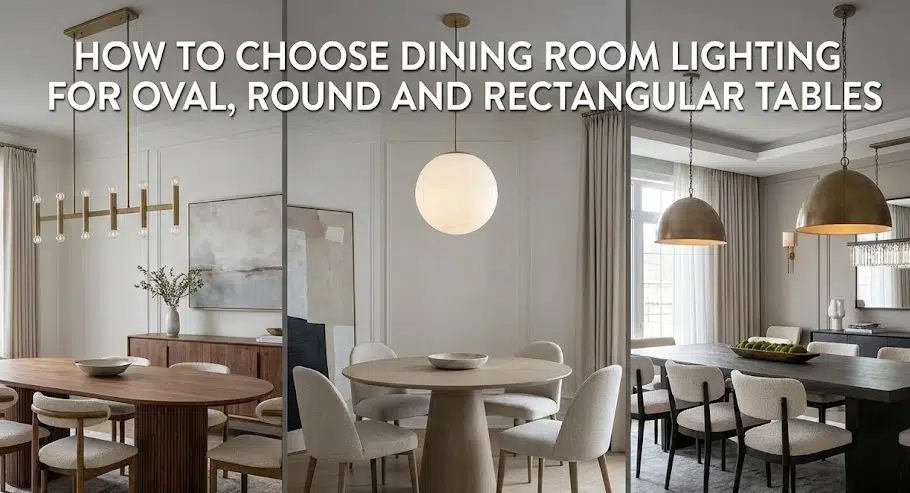
Lighting for Round Dining Tables
Round tables naturally draw people inward. The light above them should echo that shape and center the group.
Fixture shapes that usually work well
- Single round chandelier, either drum-style or with arms that form a circle.
- Cluster of small pendants grouped to form a visual circle.
- Soft, organic shapes that keep roughly equal dimensions in all directions.
Size guidelines for round tables
- Table diameter 36–42 inches: fixture around 18–24 inches wide.
- Table diameter 48–54 inches: fixture around 24–30 inches wide.
- Table diameter 60 inches and above: fixture around 30–36 inches wide works for many rooms.
Hanging height over a round table
For standard 8–9 foot ceilings, a common rule is:
- Bottom of the fixture roughly 30–36 inches above the tabletop.
In rooms with taller ceilings, you can move slightly higher, as long as the light still feels tied to the table rather than floating in the middle of the room.
Lighting for Oval Dining Tables
Oval tables sit between round and rectangular in feel. They often benefit from fixtures that stretch along the long axis but still have some softness.
Good fixture choices for oval tables
- Linear chandeliers with curved elements or rounded shades.
- Two medium-size pendants spaced along the length of the table.
- Elongated oval chandeliers that mimic the table’s outline.
Size guidelines for oval tables
- Take the shorter width of the table as your reference, not the full length.
- Fixture length often works well at about 1/2 to 2/3 of the table length.
- Fixture width should usually stay several inches inside the tabletop edge on all sides.
This keeps the light centered and avoids guests bumping their heads when they stand up or sit down near the ends.
Height and alignment tips
- Keep the center of the fixture lined up with the center of the tabletop, not just the center of the room.
- For open-concept spaces, check views from the living area to make sure the fixture sits straight over the table, even if the walls are not symmetrical.
Lighting for Rectangular Dining Tables
Rectangular tables pair well with fixtures that carry that directionality: long, linear lights or multiple pendants in a row.
Fixture approaches that work for rectangles
- One linear chandelier centered over the table.
- Two or three pendants spaced evenly along the length.
- A broad multi-arm chandelier if the table is not extremely long.
Size guidelines for rectangular tables
- Fixture length between 1/2 and 2/3 of the table length usually feels balanced.
- Width should stay narrower than the table so people can see across without visual clutter.
- If you use multiple pendants, leave equal spacing between them and from each end of the table.
Height for rectangular fixtures
The same 30–36 inch guideline above the tabletop still applies, but check sightlines carefully:
- Make sure people can see each other across the table without looking through tight clusters of bulbs.
- Check how the fixture looks from the side: it should hang low enough to connect with the table, but not so low that tall guests feel crowded.
Brightness and Color: Making Food and Faces Look Good
Once shape and size are set, light quality finishes the look.
Brightness
- Many dining rooms feel comfortable in the range of roughly 20–30 lumens per square foot.
- That total can come from the chandelier plus any nearby wall lights or lamps.
- A dimmer on the main fixture gives you flexibility for meals, homework, and evening gatherings.
Color temperature
- Warm to soft white light, around 2700K–3000K, tends to flatter food and skin tones.
- Too cool a light can make the table look more like an office than a place to relax.
Common Mistakes to Avoid
- Choosing a fixture that is much narrower than the table, which makes the room feel off-balance.
- Centering the light in the room instead of over the table, especially when the table is not in the geometric center of the space.
- Hanging the fixture so high that it feels disconnected from the dining area.
- Using very bright bulbs with no dimmer, which can feel harsh for longer meals.
Planning Your Dining Room Update
The easiest way to choose dining room lighting is to think through three questions in order: What shape is my table? How large is the surface? How high is the ceiling? Once those are clear, fixture type, size and height fall into place much more easily.
If you are considering a new chandelier, linear light or pendant arrangement and want options that suit round, oval or rectangular tables, you can see dining room lights on Seus Lighting. Matching the table’s outline and scale with the right overhead piece gives the room a more intentional and comfortable feel, whatever shape you are working with.