Water bills across Europe have climbed 18–23% on average over the past five years. In Australia, droughts stopped being seasonal events years ago — they’re chronic now, and some households have been living under strict consumption limits for a while. California has repeatedly introduced mandatory irrigation restrictions after stretches of severe water scarcity. The picture is familiar, and it’s not improving.
What’s happening alongside this, though, is something worth paying attention to. The smart home tech market has started moving toward genuine resource conservation — not the kind with green stickers on packaging, but soil moisture sensors, cloud-managed drip irrigation, and smart water meters with real-time consumption analytics. That’s what this piece is about: specific technologies that change how much water a household actually uses, and what the numbers look like.
From Garden Hose to Digital Irrigation
Ten years ago, “smart watering” meant a mechanical timer screwed onto an outdoor tap. Set it, forget it, hope for the best. The lawn got watered whether it needed it or not — including the morning after a thunderstorm.
The gap between that and what’s available now is significant. Rachio, RainBird, Hunter Industries — these aren’t startups pitching concepts at trade shows anymore. They’ve been quietly building platforms where the irrigation system pulls weather forecasts, reads soil moisture sensors in the ground, accounts for plant type and sun exposure, and makes its own call on whether to run a cycle. Rachio 3 will cancel a scheduled watering if rain is in the forecast overnight. No app interaction required, no manual override. It just doesn’t run.
Rachio claims up to 50% annual water savings on irrigation compared to a standard timer setup. That figure is self-reported, so some skepticism is fair — but independent testing from irrigation associations has landed in a similar range.
There’s a commercial side to this worth mentioning. Landscaping and irrigation companies managing dozens of client properties face a different kind of problem: not just whether the sprinklers are working, but keeping track of service schedules, crew assignments, and system status across multiple sites at once. Tools like irrigation business software from MrTask were built for exactly that — consolidating field operations into one place rather than juggling spreadsheets and phone calls. The efficiency gains on the business side tend to translate into faster response times and fewer missed service visits for the end customer.
Smart Meters: Visibility Changes Behavior

One of the most straightforward tools in the category — and one of the more underrated — is a smart water monitor with detailed analytics. Where a traditional mechanical meter shows total cubic meters consumed, devices like Flume Water Monitor or Phyn Plus track usage in real time and can distinguish between individual sources: toilet, dishwasher, shower, outdoor irrigation.
Phyn Plus goes further. It analyzes pipe pressure and can detect leaks before they become visible. The EPA estimates the average U.S. household loses around 10,000 gallons — roughly 38 cubic meters — per year through leaks alone. At $3–5 per cubic meter, that’s $115 to $190 disappearing annually without anyone noticing.
There’s also a behavioral dimension to this that tends to get overlooked. A 2019 Oracle Utilities study found that consumers with access to granular usage analytics reduced water consumption by 8–12% on average — just from seeing the numbers.
Rainwater Harvesting: From the Barrel to a Closed Loop
Collecting rainwater is ancient practice, but modern execution looks nothing like a wooden barrel under a downspout. Integrated systems from manufacturers like WISY and RainHarvesting capture roof runoff, filter it, and route it back into the home’s distribution system for toilets, washing machines, and garden irrigation.
In Berlin, new construction in some districts is required by code to include rainwater harvesting infrastructure. Singapore took it further with the NEWater program — water recycling there operates at a scale where treated water re-enters the drinking supply, accounting for over 40% of the city-state’s total water needs. That’s not a concept paper; it’s been running for years.
For a private home, a basic system with a 2,000–3,000 liter tank runs roughly $1,500–3,000 depending on installation complexity. Payback period lands somewhere between four and seven years — shorter in areas with expensive water rates or frequent dry seasons.
Greywater Recycling Inside a Single Home
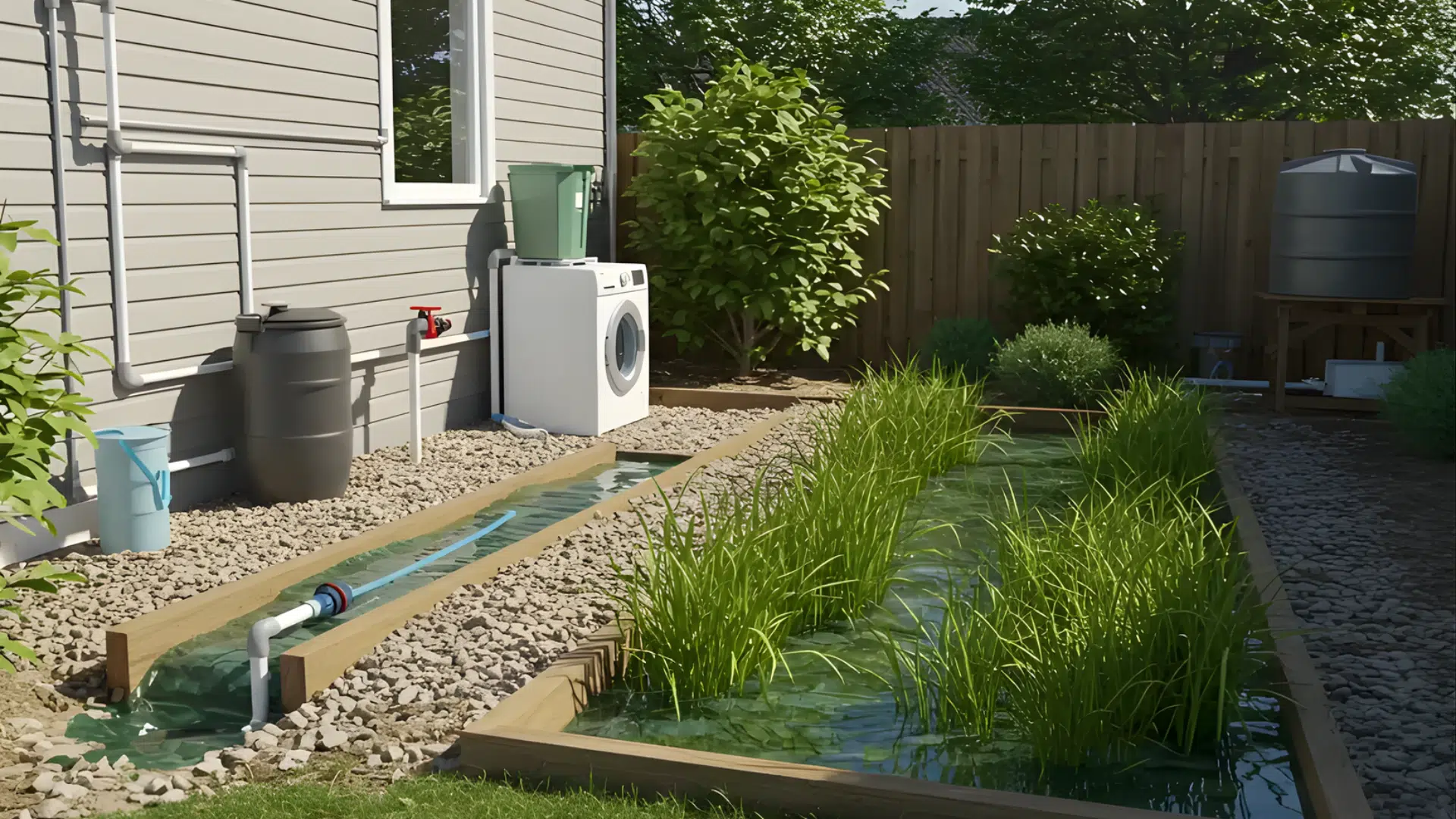
Greywater systems — once firmly in the “niche” category — are increasingly finding their way into mainstream construction. The concept: water from sinks, showers, and baths (not toilets) gets treated at a basic level and reused for flushing or outdoor irrigation.
Hydraloop, a Dutch company, built probably the most recognized residential product in this space. Their system, roughly the size of a refrigerator, handles aeration, flotation, and disinfection, then sends treated water back for toilets and garden use. The company claims a 45% reduction in total household water consumption. Hydraloop won a CES Innovation Award in 2020 — which is an unusual achievement for plumbing equipment.
Three practical advantages of greywater systems worth noting:
- Water bills drop 30–50% depending on household size
- Reduced load on municipal sewage infrastructure — relevant in older cities where pipes are already near capacity
- In areas where sewer charges are tied to water consumption volume, savings compound on both sides of the bill
Efficient Fixtures: Where the Quiet Losses Hide
Not every water-saving technology requires a cloud platform or a smartphone app. Tap aerators from manufacturers like Neoperl or the Hansgrohe Ecostop line cut flow from 12–15 liters per minute down to 5–6, with virtually no difference in perceived pressure. Low-flow showerheads from Niagara Conservation or Bricor work on the same principle.
Dual-flush toilets are now standard in most new fixtures, but the gap between an old 13-liter-per-flush toilet and a modern 4.8/3-liter model adds up to 20–30 cubic meters per year for a family of three.
Technology | Average Annual Water Savings | Estimated Install Cost |
|---|---|---|
Smart irrigation controller (Rachio 3) | 50 m³ | $200–350 |
Smart meter + leak detection | 38+ m³ | $250–500 |
Rainwater harvesting (2,000 L tank) | 30–60 m³ | $1,500–3,000 |
Greywater recycling (Hydraloop) | 80–120 m³ | $3,500–5,000 |
Aerators + efficient fixtures | 15–25 m³ | $50–300 |
Subsidies and Rebate Programs
The upfront cost of water-efficient upgrades puts some people off — understandably. A greywater system or a full rainwater harvesting setup isn’t cheap. But a lot of homeowners run the numbers without factoring in what’s actually available to offset those costs, and that’s a mistake.
Queensland’s “Water Efficient Homes” program in Australia paid out rebates up to $600 on qualifying fixture installations. After drought years hammered Spain and Portugal, local municipalities started subsidizing residential rainwater systems — not as a pilot, but as standard policy in some areas. Germany has building codes in certain districts requiring rainwater infrastructure in new construction, which has pushed both adoption and installer availability, which in turn brought costs down.
The U.S. picture is patchier but still worth investigating. LADWP in Los Angeles and East Bay MUD in the Bay Area run rebate programs on smart irrigation controllers year-round — not during water emergencies, all the time. The reasoning from the utility side is straightforward: subsidizing conservation is cheaper than expanding supply infrastructure. So the incentive exists, it’s just not always well advertised.
Before writing off a system as too expensive, it’s worth spending twenty minutes checking what the local water utility or municipal government actually offers. The answer is sometimes nothing. But often it isn’t.
Why This Goes Beyond Personal Choice
Global freshwater scarcity isn’t a distant scenario. UNESCO projections suggest that by 2025 — which is now — two-thirds of the world’s population may face water stress conditions. That doesn’t put the burden of planetary rescue on individual homeowners, but it explains why this market is growing at the pace it is. MarketsandMarkets puts the water efficiency technology sector at $1.4 trillion by 2027.
The combination of real financial incentives, more accessible hardware, and maturing digital infrastructure makes the shift to water-efficient technology considerably less disruptive than it was even five years ago. A soil sensor that cancels irrigation before a rainstorm, or a monitor that flags a hidden leak within seconds — these aren’t luxury additions. They’re what a reasonably well-organized modern home looks like.