Most people want a quick number, but solar sizing isn’t a guess-and-check thing.
The tricky part is that two homes can look identical and still need totally different setups, because the drivers sit under the surface: how much electricity you actually use, how much sun your roof can turn into power, and how real-world losses quietly trim production.
In this blog, I’ll show you how to think about those drivers, how to run the math without getting lost, and how to sanity-check the result with simple reference points so it feels grounded.
I’ve seen two similar houses on the same street need very different systems. The difference wasn’t size. It came down to usage and sunlight.
So instead of guessing, let’s walk through the real math step by step. No shortcuts.
Quick Answer: How Many Solar Panels Do I Need?
Most average U.S. homes need 15 to 25 solar panels to offset 100% of their electricity use.
That estimate usually assumes:
- Around 10,000 to 12,000 kWh per year
- Panels rated at about 400 watts each
- A moderate sun region with decent exposure
If your home uses more power, you’ll need more panels. Live in a cloudier region, and you’ll likely need more as well. Use higher-watt panels, and you may need fewer.
The key point is simple: panel count is driven by energy use and sunlight, not by how big your house looks from the street.
Now let’s calculate yours properly.
Step 1: Find Your Annual Electricity Usage (kWh)
Start with your electric bills.
Look at the total kilowatt-hours (kWh) used over the last 12 months. Many utilities provide an annual summary; if yours doesn’t, you can add the monthly totals.
Annual kWh matters more than square footage.
Two 2,000-square-foot homes can use very different amounts of power. One might have electric heat, an EV charger, and a hot tub. The other may rely on gas heating and use little cooling. Same size, very different loads.
Energy use also shifts throughout the year. Summer air conditioning pushes usage up. Winter heating can do the same in colder climates. That’s why a full 12-month total gives you a clearer picture. It smooths out the spikes.
Once you know your annual kWh, you have a solid starting point.
Step 2: Convert Your kWh Usage Into Required System Size (kW)
Now we translate yearly usage into the solar system size you’ll need.
Solar systems are rated in kilowatts (kW) , while your home uses kilowatt-hours (kWh). So the goal here is to connect energy use to expected solar production.
What Production Ratio Really Means
Solar panels don’t produce full power all day. Instead, they rely on peak sun hours, which represent the average number of hours per day your panels receive strong, usable sunlight.
For example:
- Arizona might average around 6 peak sun hours per day.
- Parts of the Northeast might average closer to 4.
Over a year, that difference becomes significant. The production ratio reflects how much energy a 1 kW system produces annually in your location.
A practical way to estimate system size is:
Formula: Required system size (kW) = Annual kWh ÷ Annual production per kW
- In many moderate sun areas, 1 kW of solar produces around 1,300 to 1,600 kWh per year.
- In sunnier regions, it can exceed 1,700 kWh per kW.
- In cloudier regions, it may fall closer to 1,200.
That’s why two identical homes in different states need different system sizes.
Example Calculation with Real Numbers
Let’s say your home uses 12,000 kWh per year.
If your area produces about 1,500 kWh per kW annually:
12,000 ÷ 1,500 = 8 kW system
That means you’d need roughly an 8 kW solar system to offset 100% of your usage under average conditions.
If you lived in a less sunny region producing 1,250 kWh per kW:
12,000 ÷ 1,250 = 9.6 kW system
Same house and usage, but a larger system is required.
Sunlight works like a multiplier. It quietly reshapes the final number.
Step 3: Adjust for Real-World System Losses
The math so far assumes ideal conditions. Real systems don’t operate in a lab.
Several factors reduce output:
- Inverter losses: Some energy is lost converting DC to AC.
- Temperature: Panels lose efficiency as they heat up.
- Shading: Even minor shade can reduce output.
- Wiring losses: Small but measurable.
- Degradation: Panels slowly lose capacity over time.
Together, these losses often total 10% to 20% .
So if your earlier calculation suggested an 8 kW system, you might size closer to 8.8 to 9 kW to account for those realities.
This is where many online calculators stop. They provide a clean number without accounting for margin, but real systems require one.
Without that buffer, your annual production may fall slightly short of your annual usage, and that gap shows up on your bill.
Step 4: Convert System Size Into Number of Panels
Now we translate system size into panel count.
Let’s say you need a 9 kW system.
With 400-watt panels:
9,000 watts ÷ 400 watts per panel = 22.5 panels
You can’t install half a panel, so you round up.
That means 23 panels .
If you use 450-watt panels instead:
9,000 ÷ 450 = 20 panels
Higher wattage reduces panel count, but it doesn’t increase your sunlight. It simply concentrates more output into each panel.
Rated wattage is measured under ideal lab conditions. In everyday operation, panels rarely hold that maximum continuously. That’s normal and already factored into system sizing.
Panel wattage affects panel count, not your home’s total energy consumption.
How Location Changes Your Final Panel Count
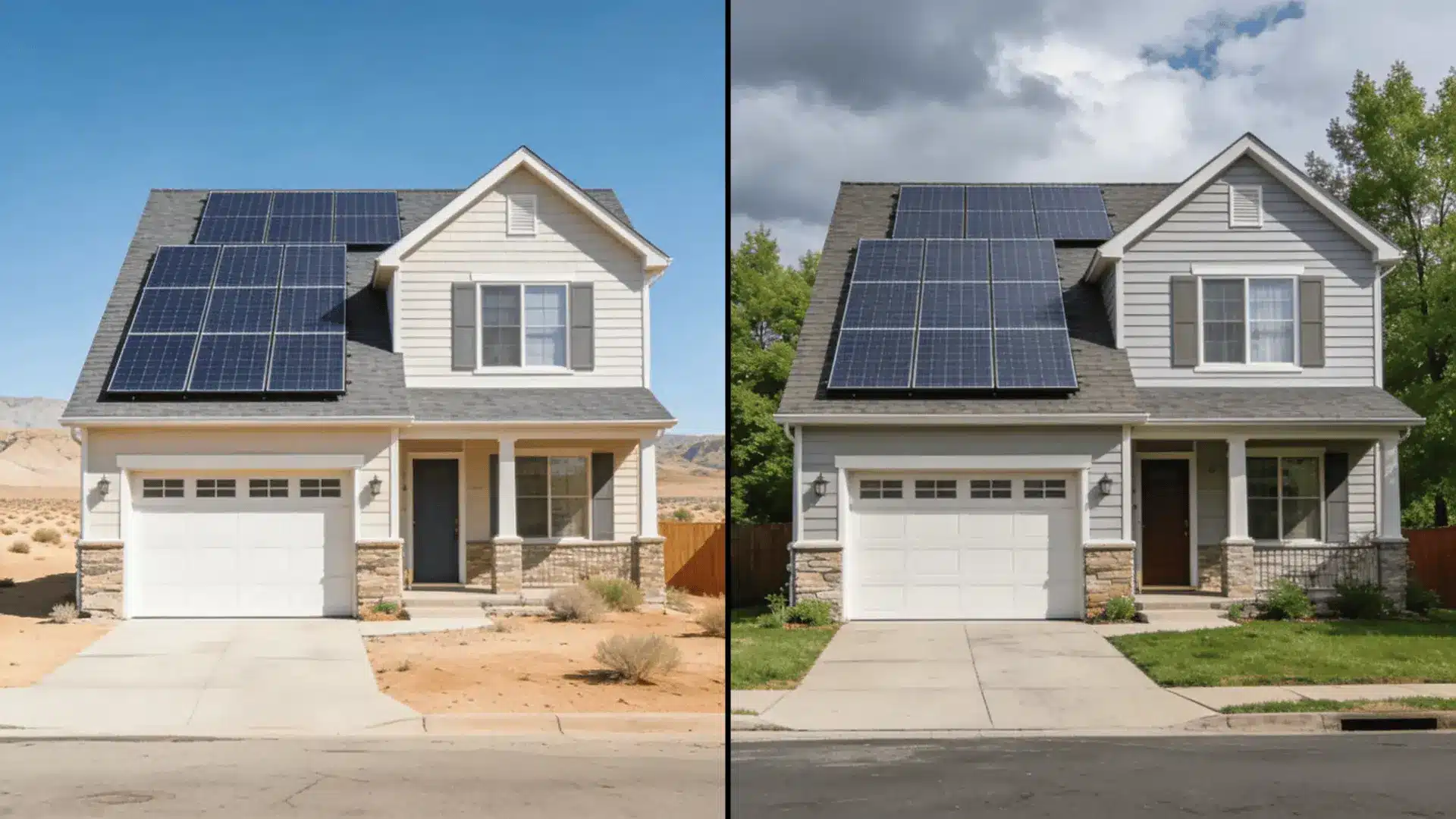
Let’s compare two homes using 12,000 kWh per year: home A in Arizona and home B in the Northeast.
| Location | Annual Production per kW | Annual Usage (kWh) | Calculation (kWh ÷ Production per kW) | Required System Size (kW) | Panel Calculation (kW ÷ 0.4 kW) | Approx. Panels (400W) |
|---|---|---|---|---|---|---|
| Arizona | 1,750 kWh | 12,000 | 12,000 ÷ 1,750 | 6.9 kW | 6.9 ÷ 0.4 | ~18 panels |
| Northeast U.S. | 1,250 kWh | 12,000 | 12,000 ÷ 1,250 | 9.6 kW | 9.6 ÷ 0.4 | ~24 panels |
Both homes use the same 12,000 kWh per year. The only thing that changes is sunlight. That difference in annual production per kW is what drives the larger system size and higher panel count in the Northeast.
Season also matters. In winter, shorter days reduce output, so monthly production drops. In summer, longer and stronger sun often creates surplus energy.
Whether that extra energy offsets winter shortages depends on your local net metering rules. That’s why sunlight, shown in the production numbers above has such a strong impact on the final panel count.
Why Online Estimates (15–25 Panels) May Be Wrong for You
You’ll likely need more panels if your electricity use is higher than typical, such as when:
- You charge an electric vehicle at home
- You use electric heating instead of gas
- You run a pool, hot tub, or other large equipment
- You plan to switch more appliances from gas to electric
On the other hand, you may need fewer panels if :
- Your heating and cooking are gas-powered
- Your overall energy use is modest
- You only want to offset part of your electric bill, not all of it
Panel count follows usage. The more power you rely on, the larger the system needs to be.
Utility rules also shape your final system size. In many areas, you’re only allowed to install a system that produces about 100% to 120% of your past annual usage. That means you can’t always oversize freely, even if you expect higher usage later.
So when someone says, “just install 20 panels,” it sounds straightforward, but it skips over those limits.
Your past energy use, your local sunlight levels, and your utility’s sizing rules all work together to determine what’s actually possible.
Quick Reference Panel Estimates by Annual Energy Usage
The estimates below assume:
- 400-watt panels
- Moderate sun region (~1,500 kWh per kW annually)
- Standard system loss buffer included
| Annual Usage (kWh) | Approx. System Size | Estimated Panels |
|---|---|---|
| 6,000 | ~4.5 kW | 11–12 panels |
| 10,000 | ~7.5 kW | 18–19 panels |
| 15,000 | ~11 kW | 27–28 panels |
Note: These figures are reference points, not guarantees. In very sunny areas, your panel count may come in lower. In cloudier regions, it may rise. Always anchor your estimate to your own annual kWh and local sunlight conditions.
Wrapping Up
If you’ve been wondering how many solar panels you need, the answer isn’t a fixed number. It’s a calculation built on your usage, your sunlight, and realistic system losses.
Once you understand that chain, the result stops feeling random and starts to feel predictable.
Pull your last 12 months of bills. Run the math carefully. Adjust for sun and losses, then translate that system size into panels.
When you follow that process, you’re not guessing anymore. You’re sizing your system based on reality.
Frequently Asked Questions
How do I calculate how many solar panels I need?
Start with your annual kWh usage. Divide by your area’s yearly production per kW to find system size, then divide by panel wattage to estimate panel count.
How many solar panels are needed for a 2,000 sq ft house?
Square footage by itself isn’t reliable. A 2,000 sq ft home could need 12 panels or 28 panels depending on energy use, heating type, and location.
What is the solar 120% rule?
Many utilities allow systems sized up to about 120% of your past yearly usage. This prevents major oversizing beyond historical consumption.
Why is my electric bill still high after installing solar?
Bills can remain due to seasonal production gaps, fixed utility charges, or using more electricity than your system was designed to offset.