A damaged underground sewer line can turn an ordinary home improvement project into a much bigger undertaking. What begins as a recurring drain blockage may eventually require work beneath a driveway or a carefully landscaped yard. For homeowners preparing to move, renovate, or sell, the timing can make the situation even more complicated.
Fortunately, repairing a sewer line does not always mean digging a long trench across the property. Modern methods can restore certain underground pipes through smaller access openings, although traditional excavation remains necessary for some types of damage.
Before choosing a repair method, homeowners should understand what each approach can realistically accomplish. Researching trenchless plumbing is a useful starting point when comparing alternatives to conventional excavation, particularly if preserving existing outdoor surfaces is a priority.
Trenchless sewer repair generally causes less surface disruption, but traditional excavation is often more suitable when the pipe needs structural repositioning. The best choice depends on the actual condition of the sewer line rather than the repair method’s advertised advantages.
How Do Trenchless Repair and Traditional Excavation Differ?
The main difference is how contractors access the damaged underground pipe.
Trenchless technology allows certain repairs or replacements to be completed without exposing the entire sewer line from above. Contractors generally work through existing access points or smaller excavated openings.
Traditional excavation involves opening the ground to reach the pipe directly. This allows damaged sections to be removed and the surrounding conditions to be assessed.
Both methods can provide effective repairs when used in appropriate circumstances.
Trenchless Sewer Repair: Working Through the Existing Pipe Route
Trenchless sewer repair is an umbrella term for several techniques that reduce the amount of digging required.
Two common methods are cured-in-place pipe lining and pipe bursting.
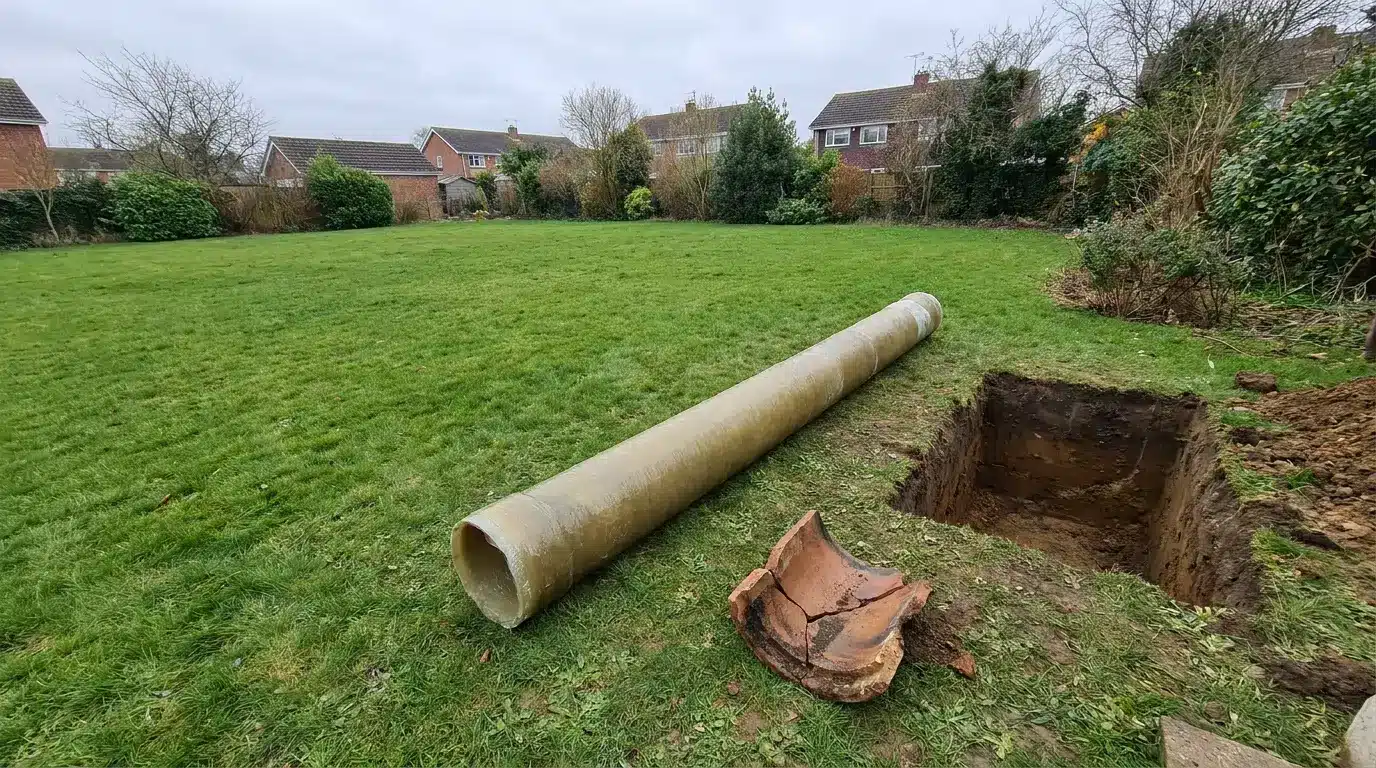
Cured-in-place pipe lining (CIPP) creates a new internal pipe surface within the existing sewer. A flexible liner containing resin is inserted into the line, expanded against the pipe walls, and cured until it hardens.
This technique can rehabilitate certain cracked or deteriorated pipes, provided the existing line remains suitable for lining.
Pipe bursting, by contrast, replaces the existing pipe. A bursting head travels through the original sewer route, breaking the old pipe outward while pulling a new replacement pipe behind it.
Pipe bursting can be useful when the existing material is too deteriorated for lining, although feasibility depends on access and underground conditions.
Despite the common description “no-dig repair,” these methods may still require excavation for access or connections.
Traditional Excavation: Direct Access to the Damaged Line
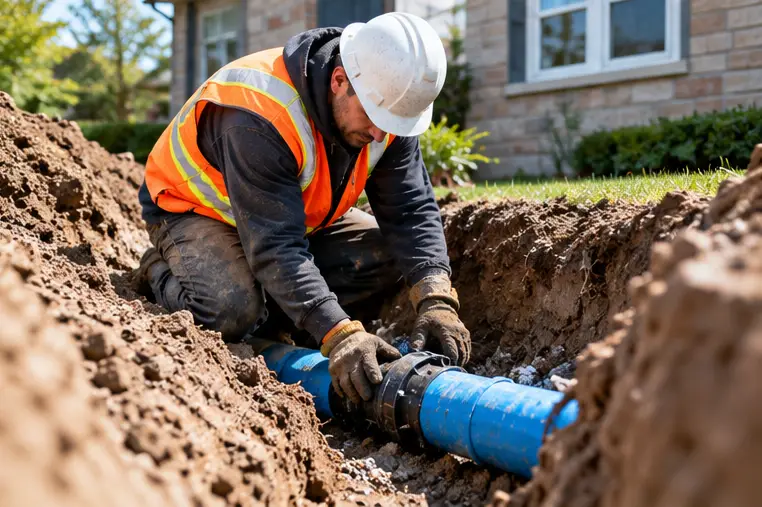
Traditional sewer excavation involves removing the material above the damaged pipe.
Once the pipe is exposed, the contractor can examine its condition and assess the surrounding support.
This approach is particularly useful when a line has shifted or needs to be repositioned.
For example, a sewer section that has developed an incorrect slope may need to be excavated and installed on a properly prepared base.
Although excavation creates greater disturbance, it provides access that trenchless methods cannot always achieve.
Which Method Causes Less Damage to Your Property?
For many homeowners, the condition of the surrounding property is a major consideration.
A sewer line may run beneath a finished driveway or an established garden. Opening the entire route could affect improvements that are expensive or inconvenient to restore.
Preserving Driveways and Landscaping
Trenchless methods can reduce disturbance to outdoor surfaces because the entire pipe route does not normally need to be exposed.
This can be particularly valuable where access is limited or the sewer runs beneath mature landscaping.
However, smaller access excavations may still be required.
The amount of disturbance depends on the selected technique and the location of the damaged pipe.
When Excavation May Be More Practical
Not every property benefits equally from trenchless installation.
If a short section of pipe is shallow and located beneath an open lawn, direct excavation may be straightforward.
In this situation, using specialized trenchless equipment could offer little practical advantage.
The appropriate choice depends on both the pipe defect and the work required to restore the surrounding area.
When Is Trenchless Sewer Repair the Better Option?
Trenchless repair is often appropriate when the existing sewer route remains usable and the damaged pipe can support the selected technique.
The method may also be attractive when homeowners want to avoid extensive disturbance during other property improvements.
Repairing Cracked or Deteriorated Pipes
CIPP lining may be suitable for a pipe with cracks or leaking joints if its existing shape allows proper liner installation.
It may also be used for certain corrosion-related defects.
Before lining, the pipe typically requires appropriate cleaning and preparation.
The liner must be installed and cured according to the selected system’s requirements.
A successful installation depends on accurate assessment and preparation, not simply on placing a new material inside the old pipe.
Reducing Disruption During a Renovation
Imagine a homeowner who has recently completed an outdoor renovation.
The sewer line runs beneath a new patio, and an inspection identifies defects that may be suitable for lining.
If the existing pipe remains structurally appropriate, trenchless rehabilitation could help avoid opening a large section of the finished surface.
This is where reduced excavation can provide meaningful value beyond the pipe repair itself.
For homeowners preparing to relocate, less surface work may also simplify the schedule when other moving arrangements are already underway.
When Is Traditional Sewer Excavation Necessary?
Some underground sewer problems cannot be adequately corrected through the existing pipe.
In these situations, direct access may be required to restore proper drainage.
Completely Collapsed Sewer Sections
A fully collapsed pipe may prevent inspection or repair equipment from passing through the damaged area.
If the original route cannot be used, excavation may be necessary to remove the failed section.
Depending on the surrounding line’s condition, the remainder may still be suitable for another repair method.
Incorrect Pipe Slope or Sewer Bellies
Residential sewer lines generally rely on gravity to carry wastewater away from the building.
When part of a pipe settles, it can create a low section commonly called a sewer belly.
Water and waste may collect in this area, contributing to recurring blockages.
Pipe lining follows the existing pipe shape. It cannot correct a substantial sag or rebuild the supporting ground beneath the line.
Excavation may therefore be required to restore the proper grade.
Severe Pipe Misalignment
Ground movement can cause connected pipe sections to shift.
Minor joint defects may sometimes be suitable for rehabilitation, but severe displacement can prevent trenchless equipment from passing through safely.
Where the pipe needs physical repositioning, excavation may be the appropriate approach.
Can Trenchless Repair and Excavation Be Combined?
Yes. A combined repair strategy can be effective when different sections of the same sewer have different problems.
For example, a contractor may excavate a short collapsed section to restore access, then rehabilitate an adjacent section using pipe lining.
This approach can preserve suitable portions of the existing route while addressing defects that cannot be repaired internally.
It also illustrates why homeowners should avoid assuming that the project must involve either complete trenchless repair or full-length excavation.
The most practical solution may fall somewhere between those options.
Is Trenchless Sewer Repair Cheaper Than Traditional Excavation?
Trenchless repair is not automatically less expensive.
Specialized equipment and installation materials can make the initial repair cost comparable to or higher than conventional excavation.
However, the pipe installation price does not necessarily represent the total project cost.
Look Beyond the Initial Repair Quote
Traditional excavation may require additional work after the pipe has been replaced.
A driveway could need resurfacing, while disturbed landscaping may require reconstruction.
These costs can influence the overall project budget.
Trenchless installation may reduce restoration expenses when large sections of finished surfaces remain undisturbed.
On the other hand, excavation may cost less when the damaged pipe is shallow and easily accessible.
Compare the Complete Project Scope
Before choosing between estimates, make sure each contractor is describing comparable work.
The quote should explain the proposed repair method and the work required to access the pipe.
It should also clarify whether surface restoration is included.
Homeowners should pay particular attention to:
- Inspection and preparation: Camera assessment, cleaning, and pipe locating
- Installation work: Materials, equipment, and required excavation
- Property restoration: Backfilling and reinstatement of affected surfaces
- Completion checks: Appropriate testing and post-repair inspection
- Potential additional costs: Conditions that could change the original scope
A higher initial price may be reasonable if it reduces substantial restoration work, but the figures should be evaluated for the specific property.
Why a Sewer Camera Inspection Should Come First
The symptoms of a sewer problem rarely establish the exact cause.
Recurring blockages may result from accumulated debris, root intrusion, or structural defects deeper in the line.
A sewer camera inspection helps identify visible internal conditions before a repair method is selected.
What Can a Camera Inspection Reveal?
A professional inspection may show cracks or displaced joints.
It can also help identify the location of visible obstructions and sections containing standing water.
However, camera footage has limitations. It does not necessarily reveal the condition of the surrounding soil or prove the precise pipe grade without additional assessment.
Pipe locating and other diagnostic work may be required.
Why the Diagnosis Changes the Repair Recommendation
Consider two homes experiencing repeated sewer backups.
In the first property, a camera identifies a cracked pipe that remains reasonably aligned. Pipe lining may be a suitable option.
In the second property, the camera reveals a sagging section where wastewater collects.
Installing a liner would not correct the underlying slope problem.
Although both homes experience similar symptoms, they may require different repairs.
This is why the recommendation should be based on evidence rather than the symptoms alone.
How Long Does Sewer Repair Take?
Project duration depends on the condition of the existing pipe and the amount of preparation required.
Trenchless repairs can sometimes be completed more quickly because less excavation and restoration are necessary.
However, additional cleaning or access work may extend the schedule.
Traditional excavation may involve more extensive site preparation, particularly when the damaged line runs beneath paved surfaces.
Weather conditions and the depth of the pipe can also influence progress.
Planning Repairs Before Moving Into a Home
For buyers preparing to move into an older property, an unexpected sewer repair can affect the relocation schedule.
If an inspection identifies a significant defect, ask how long the sewer will be unavailable and whether exterior access will be restricted.
Heavy equipment or temporary excavation may interfere with moving trucks.
Where practical, major underground work can be scheduled before furniture and belongings arrive.
The objective is to coordinate the repair with the moving process rather than allow the two activities to create unnecessary complications.
What Happens After Installation?
A completed sewer repair should undergo appropriate verification before normal use resumes.
For trenchless projects, post-installation camera footage can help document the finished internal condition.
Traditional replacement also requires suitable installation checks, which may include inspections or testing under applicable requirements.
The contractor should explain when fixtures can return to normal use.
What Determines the Long-Term Performance of a Sewer Repair?
Neither trenchless technology nor traditional excavation guarantees that a sewer will remain trouble-free indefinitely.
Durability depends on the selected materials and whether they were installed correctly.
Pipe lining requires appropriate preparation of the host pipe. A replacement sewer also needs a suitable installation base and correct alignment.
Ground movement and conditions affecting nearby connections can influence future performance.
Homeowners should ask what warranty applies and understand its coverage.
Dr. Pipe Drain and Plumbing, which provides trenchless sewer and drain services in Ottawa, is one example of a contractor homeowners can consult when comparing repair methods and seeking an explanation of the recommended work.
An experienced contractor should be able to describe why the chosen method suits the pipe’s condition, rather than recommending a technique solely because it involves less digging.
How to Choose the Right Sewer Repair Method for Your Property
Choosing between trenchless sewer repair and excavation becomes easier once the diagnosis is clear.
The most useful decision is the one that addresses the actual defect while accounting for the property’s condition and the work required.
A Practical Checklist Before Approving the Repair
Use these questions when reviewing a contractor’s recommendation:
- What is wrong with the sewer line? Ask to see the relevant inspection findings and understand the identified defect.
- Can the existing pipe route be reused? Confirm whether lining or pipe bursting is technically feasible.
- Does the pipe need repositioning? Problems involving slope or severe displacement may require excavation.
- How much of the property will be disturbed? Clarify access requirements and restoration responsibilities.
- What is the complete project cost? Compare installation work and associated restoration rather than the pipe repair price alone.
A second opinion may be worthwhile when the proposed work is extensive or different contractors recommend substantially different solutions.
The best sewer repair method is not necessarily the one involving the least digging. It is the one that corrects the identified problem while keeping the overall project practical for the property and its occupants.