Spend an afternoon browsing Maryland move-in ready homes, and the appeal becomes obvious fast. A finished house, an actual address, and a closing date that exists in the real world rather than on an architect’s estimate.
But most serious buyers carry a quieter question alongside that appeal: what if the home were actually built around how I live, not around a builder’s assumption of what most people want?
That tension sits at the center of one of the most consequential decisions in homeownership, and the right answer is less universal than most articles admit.
What Quick Move-In Actually Delivers
A quick move-in home is a property that a builder finished before you arrived. The floor plan was chosen, the finishes were selected, and the lot was picked without your input. What you receive in return is certainty.
You can close in 30 to 45 days once preapproved, walk into a brand-new house with modern systems, and carry builder warranties that cover structural defects for up to ten years in most markets.
I talked to a woman who closed on an inventory home outside Bethesda last spring. She had rented for four years, lost three offers on resale properties to all-cash buyers, and was finished waiting.
“I walked in on a Tuesday and had a contract by Friday,” she told me. The primary bathroom was smaller than she would have chosen, and she had no say in the kitchen tile, but her builder resolved a heating issue in the first winter at zero cost, and she moved in before her lease expired. That tradeoff worked for exactly where she was in life.
The financial picture also favors buyers in ways that resale properties cannot match. 67% of builders currently offer some form of sales incentive, with mortgage rate buydowns among the most common, and those buydowns can reduce your effective rate by one to two percentage points. On a $600,000 home, that difference runs several hundred dollars per month, and no seller of an existing property can replicate it.
The honest limitation is location, as most inventory communities sit farther from urban cores because that is where buildable land still exists at a workable price. You may genuinely love the house and feel neutral about the surroundings, which is worth naming before you sign rather than after.
What a Custom Build Actually Costs You
The word “custom” carries a certain romance. You select the lot, the floor plan, the ceiling height, and the finish on every fixture.
For buyers with specific needs, that control is genuinely valuable rather than merely aesthetic. A home office that flows properly from a dedicated entry, an accessible first-floor suite, and a garage orientation that fits your actual property.
These are real functional differences, not personal preferences dressed up as necessity.
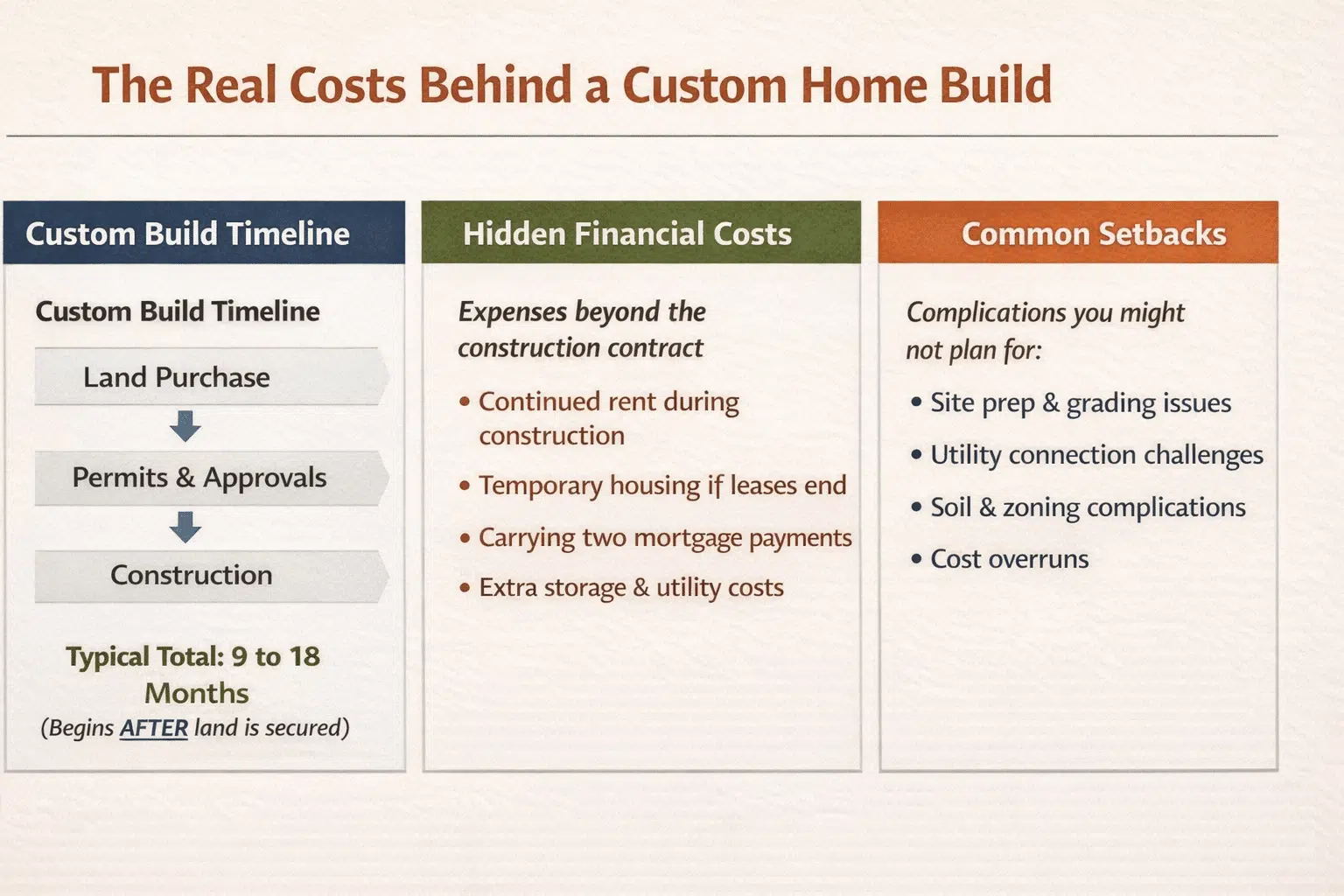
But a custom build extracts a price beyond the construction contract. The full timeline from land purchase through permits, construction, and final walkthrough runs between nine and eighteen months in most markets, and that estimate starts after you have already secured land.
Those months carry real costs: continued rent, temporary housing, or two mortgage payments running at once. None of those expenses appear in a builder’s proposal, but all of them are real.
The path from an empty lot to a finished home is also more complicated than most buyers expect. Site preparation, utility connections, soil conditions, and local zoning requirements can add tens of thousands of dollars to a project that read as straightforward on paper.
A firsthand account of what that process demands in practice is worth reading before committing to that route. Cost overruns are persistent rather than exceptional, and buyers who budget to their maximum frequently find themselves cutting features or stretching finances that were planned to stay comfortable.
The Middle Option Most Buyers Overlook
The framing of quick move-in versus full custom misses what many buyers actually want, which is a new home built to their specifications without the full weight of ground-up construction.
Semi-custom builders occupy that space. They start from proven floor plans that buyers then adjust, working with an in-house design team to shift layouts, select finishes, and personalize the home without managing architects, subcontractors, or permitting independently.
The timeline is shorter than a full custom build, the process is guided rather than open-ended, and the result reflects the buyer’s actual priorities rather than a builder’s market research.
How to Actually Decide
The choice comes down to where you are right now.
Quick move-in fits buyers whose timeline is non-negotiable, whose finances need the predictability of fixed pricing and builder incentives, and who accept that some design decisions were made for them.
Custom builds fit buyers with genuine schedule flexibility, prior homeownership experience, and needs specific enough that no inventory product satisfies them.
Semi-custom fits the wide middle: buyers who want personalization without the full exposure of building from scratch.
A few things worth doing before committing to any path: get preapproved first, because your financing ceiling shapes each option differently. Tour inventory communities on a weekday rather than during a scheduled showing to get an honest read on the neighborhood.
If you pursue a custom or semi-custom route, talk to buyers who completed a similar project in your target market within the past twelve months, not five years ago, because costs and timelines have shifted considerably since then.
The home that fits your life right now is worth more than the home that would have been perfect under different circumstances.